
Most golfers try to control their short game through mechanics.
They think about:
- Swing length
- Tempo
- Acceleration
- Stroke path
It feels like control.
But when pressure increases, those mechanical thoughts often disappear — or worse, interfere.
Learning how to train feel in golf changes that.
Feel is what allows distance control to hold up when it matters.
Why Mechanics Don’t Hold Up Under Pressure
Mechanics are important.
They build the foundation of your swing and stroke.
But mechanics require conscious control.
And under pressure, conscious control becomes unreliable.
That’s why:
- Wedge shots fly inconsistent distances
- Lag putts run too far or come up dreadfully short
- Tempo changes unexpectedly
The golfer isn’t lacking knowledge.
They’re relying on the wrong system during execution.
What “Feel” Actually Means
Feel is often misunderstood.
It’s not guesswork.
It’s not intuition.
Feel is trained.
It’s the brain’s ability to match movement to a target without conscious calculation.
When you train feel in golf:
- The brain recognizes distances
- The body reproduces motion automatically
- Tempo becomes consistent
- Distance control improves
Feel is simply implicit memory applied to movement.
Why Feel Improves Distance Control
Distance control depends on matching motion to distance.
That process happens too quickly for conscious thought.
You don’t calculate:
- Exact swing length
- Exact stroke speed
Instead, your brain recalls a learned pattern.
That pattern comes from structured repetition.
When golfers train feel properly:
- Wedge distances become predictable
- Putting speed stabilizes
- Pressure has less impact
Distance control becomes reliable.
How to Train Feel Instead of Mechanics
Training feel requires a shift in how you practice.
Instead of focusing on positions, focus on outcomes.
Effective feel training includes:
- Hitting to specific yardages without changing mechanics
- Using consistent pre-shot routines
- Training multiple distances in the same session
- Repeating movements with small variations in feel
- Not hitting the same shot twice, no mulligans in practice either.
This type of training builds recognition.
The brain begins to understand what different distances feel like.
Over time, those patterns become automatic.
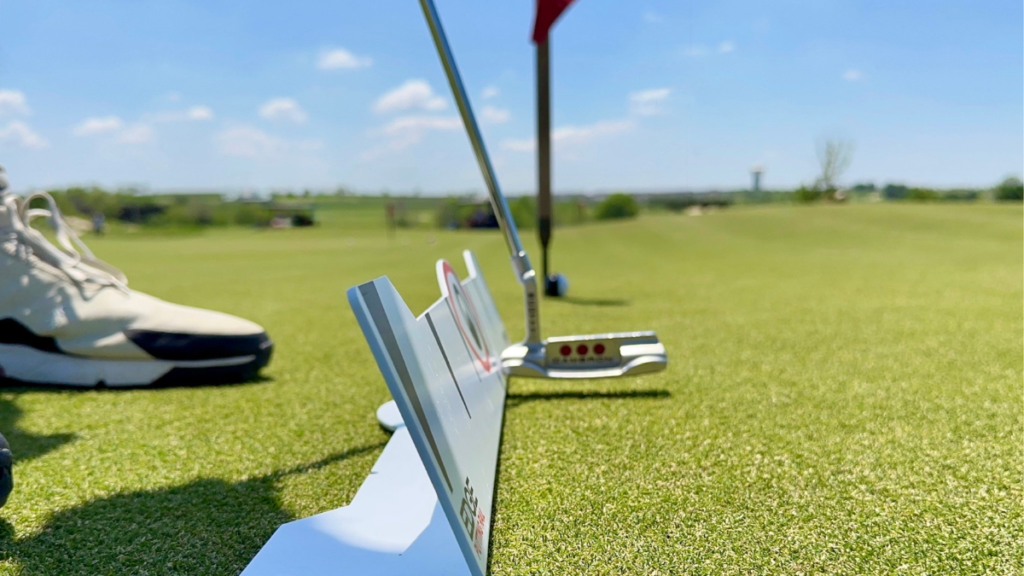
Why Short Game Is the Best Place to Train Feel
The short game exposes distance control immediately.
There’s less margin for error.
And feedback is instant.
That makes it the ideal place to train feel.
Wedges and putting both rely heavily on:
- Distance calibration
- Tempo consistency
- Repetition with variation
When feel improves in the short game, it often carries into the full swing.
Because the same principles apply.
From Mechanical Practice to Automatic Performance
Most golfers stay stuck in mechanical practice.
They adjust, fix, and analyze.
But performance requires something different.
It requires trust.
That trust comes from training.
A structured approach to distance control helps convert repetition into automatic execution.
That’s the foundation of a
golf distance control practice system.
It organizes practice so the brain can learn and store movement patterns effectively.
Why Feel Holds Up Under Pressure
When a skill is trained through feel, it doesn’t rely on conscious thought.
That’s why it holds up under pressure.
Instead of thinking about mechanics, the golfer focuses on:
- The target
- The distance
- The intention
The movement happens automatically.
If you haven’t read Why Swing Thoughts Destroy Distance Control, it explains how mechanical thinking interferes with performance.
Frequently Asked Questions About Training Feel in Golf
What does it mean to train feel in golf?
Training feel means developing the ability to match movement to distance without conscious calculation. It relies on repetition that builds implicit memory.
Is feel more important than mechanics?
Both matter. Mechanics build the foundation, but feel allows golfers to perform without thinking during play.
How do you improve feel in your short game?
Improve feel by practicing multiple distances, using structured drills, and focusing on outcomes rather than swing positions.
Why does feel disappear under pressure?
Feel disappears when golfers rely on conscious swing thoughts instead of trained patterns. Proper training helps feel remain stable during competition.
Can beginners train feel effectively?
Yes. In fact, beginners often improve faster when they focus on distance control and feel rather than overloading on mechanics.
1 thought on “How to Train Feel Instead of Mechanics in Your Short Game”
Comments are closed.