
If you’ve spent years grinding at the range—bucket after bucket, swing thought after swing thought—and your scores haven’t changed… you’re not alone.
Most golfers don’t have a work ethic problem.
They have a training problem.
Why Practicing More Isn’t Fixing Your Game
There’s a belief in golf that more practice leads to better results.
Hit more balls.
Fix more things.
Put in more time.
But if that were true, every golfer who spends hours on the range would be improving.
They’re not.
In fact, many golfers feel like they’re getting worse the more they try.
That’s because most of what we call “practice” isn’t actually helping us perform.
It’s just keeping us busy.
What Most Golfers Do at the Range
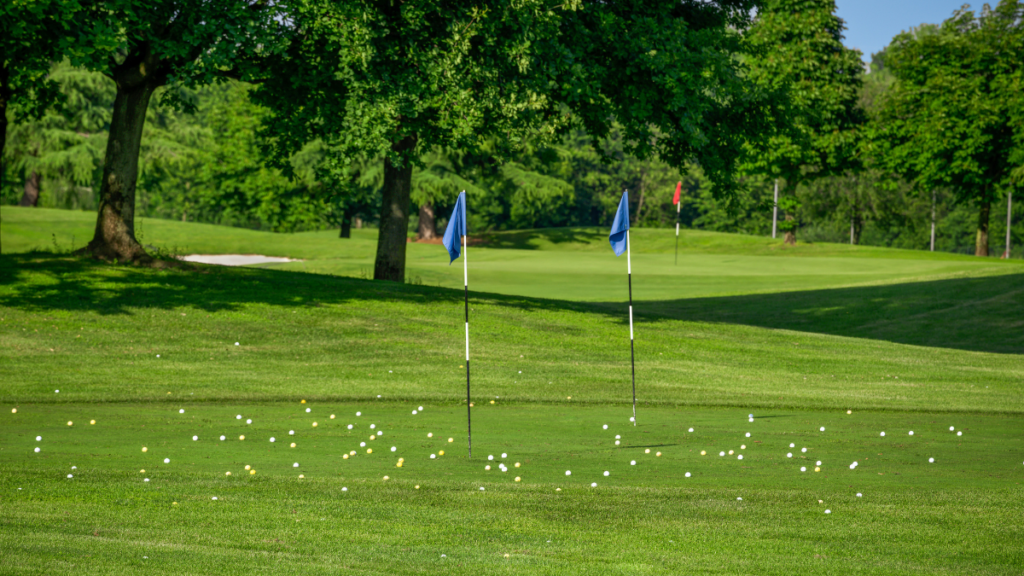
Think about a typical range session.
You hit the same club…
To the same target…
Trying to fix the same swing issue…
Over and over again.
You might even hit some great shots.
But here’s the problem:
You’re training your swing in a controlled environment that doesn’t exist on the course.
There’s no pressure.
No consequence.
No variability.
Just repetition.
Why That Approach Breaks Down on the Course
The course doesn’t give you the same shot twice.
Different distances.
Different lies.
Different conditions.
And most importantly…
Different pressure.
That’s where everything changes.
The swing you trusted on the range suddenly feels uncertain.
The distance you “had” disappears.
And the thoughts start creeping in.
It’s not because your swing broke.
It’s because your training didn’t transfer.
As described in Breaking the Cycle, the harder you try to control your swing, the more you get in your own way.
The Difference Between Practice and Training
This is where things start to shift.
Practice is:
- Repetition
- Mechanical focus
- Trying to “fix” your swing
Training is different.
Training is:
- Building a system
- Developing feel
- Preparing for real conditions
The goal isn’t to hit perfect shots on the range.
The goal is to step onto the course and trust what you’ve built.
That requires a completely different approach.
What Needs to Change
If your current practice isn’t working, the answer isn’t to try harder.
It’s to train differently.
Instead of asking:
“How do I fix my swing?”
You start asking:
“How do I build something I can trust?”
That shift changes everything.
Because when you stop chasing perfection…
And start building a system…
You give yourself a chance to actually improve.
If you want to understand why your distance control feels inconsistent—especially when it matters most—this is the next step:
👉 why your distance control doesn’t transfer to the course
And when you’re ready to move beyond range practice and into a structured approach, this is where it starts:
👉 distance control training system
FAQ
Why doesn’t range practice improve scores?
Because most range practice is based on repetition in a controlled environment. The golf course requires adaptability, decision-making, and trust—none of which are trained through repetitive ball striking alone.
What is the difference between practice and training in golf?
Practice focuses on mechanics and repetition. Training focuses on building a system that prepares you to perform under real conditions without overthinking.
How do you practice golf more effectively?
By shifting from repetition to structured training—developing feel, building routines, and preparing for the variability of the golf course rather than trying to perfect your swing on the range.
1 thought on “Why Range Practice Isn’t Lowering Your Scores”
Comments are closed.