
Most missed putts don’t happen because your stroke suddenly disappeared.
They happen in the few seconds before you hit it.
That little moment where you stand over the ball too long. You see the line, then question it. You feel the speed, then try to control it. You’re ready to putt, but instead of pulling the trigger, you sneak in one more thought.
That is where a good pre-putt routine matters.
Not because it makes you look organized.
Because it gives you a way to stop thinking and actually hit the putt.
The Moment Before the Stroke Matters
Every golfer knows this moment.
You read the putt.
You pick your line.
You get your feet set.
Then something happens.
You start wondering if you aimed right. You wonder if it breaks more than you thought. You think about taking it back straighter. You tell yourself not to leave it short.
Now you are no longer putting.
You are managing fear.
That is no way to roll the ball.
A pre-putt routine gives you a job. A simple one. It helps you make the decision, step in, see the putt, and go.
That is the whole point.
Not perfect mechanics.
Not a pretty routine.
Just a repeatable way to get out of your own way.
Why Start This at Home?
Because the practice green can turn into a grind fast.
You drop three balls.
Miss the first one.
Adjust your stroke.
Miss the second one.
Try a different grip pressure.
Miss the third one.
Now you are chasing.
That is how a lot of seasoned players practice putting. They don’t mean to, but they end up reacting to every result. Every missed putt becomes another reason to change something.
At home, you can slow that down.
There is no score.
No hole that matters.
No one watching.
No need to fix your stroke after every roll.
You can build the habit first.
That matters because the routine should feel normal before you need it on the course.
You do not want to be standing over a four-footer on the 18th green trying to remember how your routine works.
Build it where it is quiet.
Then take it outside.
A Pre-Putt Routine Is Not a Checklist
This is where golfers get it wrong.
They hear “routine” and think it means a bunch of steps.
Stand here.
Look twice.
Waggle once.
Breathe.
Tap the putter.
Look again.
That might work for some players, but the steps are not the point.
The point is the shift.
You are shifting from thinking to putting.
That is it.
A good routine helps you make the decision and then trust the decision long enough to make the stroke.
That is the bridge.
Before the routine, you are reading and choosing.
After the routine, you are reacting and rolling the ball.
If you stay stuck in the middle, the putt gets hard.
What You Are Really Training
You are not just training setup.
You are not just training aim.
You are not just training a stroke.
You are training the moment before the stroke.
That little gap between being ready and actually moving the putter.
For a lot of golfers, that gap is where doubt gets in.
The longer you stand there, the more room doubt has.
That is why I like a simple routine.
Make the decision.
Step in.
Set the face.
See the putt.
Return your eyes.
Pull the trigger.
Nothing fancy.
But if you do it enough, it starts to become the way you putt.
And that is when it helps.
The Simple Pre-Putt Routine
This is a basic routine you can start with.
You can adjust it over time. Every seasoned player should make it their own.
But do not overbuild it.
You want something you can actually use when the putt matters.
Step 1: Decide and Commit
Before you step in, decide what you are doing.
Pick the line.
See the slope. Pick the speed.
Pick the target.
Sometimes that target is a spot on the green.
Sometimes it is the edge of the cup.
Sometimes it is a picture of the ball dying into the hole.
Whatever it is, choose it. Make the picture yours.
Then stop negotiating.
This is where many golfers lose the putt. They make a decision, then keep looking for a better one while standing over the ball.
You cannot putt well that way.
Once the decision is made, live with it.
Step 2: Step In With the Putter Face First
When you move into the ball, set the putter face first.
Not your feet.
Not your shoulders.
The face.
Aim the putter where you want the ball to start. Then let your feet and body settle in around it.
This is simple, but it matters.
A lot of golfers build their stance first, then try to aim the putter from there. That can get sloppy. Let the aim drive the setup.
Set the face.
Set the feet.
Get comfortable.
Then move on.
Do not stay there and tinker.
Step 3: Build the Picture
“Remember; you already aligned your setup to your chosen line. So, you’re done with the line.”
Once you are set, look at your target.
Really see it.
This does not have to be dramatic. You are not trying to create some perfect movie in your head.
Just get a clear picture of what you want the ball to do.
Where does it start?
How fast is it rolling?
Is it firm?
Is it dying in?
Is it breaking from right to left?
Give your body something to respond to.
That is a big part of feel.
Feel does not come from standing over the ball thinking about stroke mechanics. Feel comes when your body has a clear target and enough freedom to react.
Step 4: Return Your Eyes to the Ball
After you see the putt, bring your eyes back to the ball.
This is where you have to be careful.
Do not use this moment to add one more thought.
Do not tell yourself to keep your head still.
Do not remind yourself to accelerate.
Do not start wondering if the putter face is open.
You already did the work.
You picked the line.
You set the face.
You saw the putt.
Now your job is to stay with it.
Return your eyes to the ball and feel ready.
Grounded.
Quiet.
Committed.
Step 5: Pull the Trigger
Now hit it.
Do not wait.
Do not freeze.
Do not give your mind another three seconds to interfere.
Pull the trigger while the picture is still fresh.
That is where trust starts.
Not because you know the putt will go in.
You don’t.
Nobody does.
But you are giving yourself the best chance to roll the ball without steering it, saving it, or guiding it.
That is a better way to putt.
How to Practice This at Home
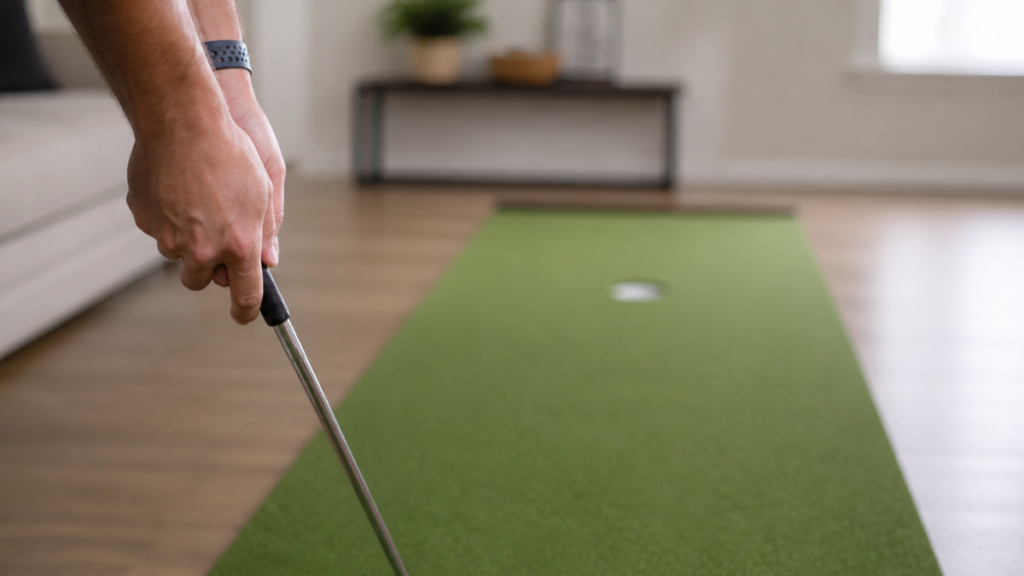
You can start this on carpet.
You can use a putting mat.
You can putt to a cup, a coin, a mark on the floor, or nothing at all.
The target is not the main thing yet.
The habit is.
Here is the simple at-home drill:
- Pick a target.
- Stand behind the ball.
- Decide on the line and speed.
- Step in with the putter face first.
- Set your feet.
- Look at the target and build the picture.
- Bring your eyes back to the ball.
- Pull the trigger.
Then do it again.
Not fast.
Not careless.
But also not stiff.
You are not trying to perform a ceremony.
You are trying to make this feel normal.
That is the goal.
Do Not Judge Every Putt
This is important.
When you practice this at home, do not turn every putt into a pass-or-fail test.
That defeats the purpose.
Yes, you want to roll the ball well.
Yes, you want to start it on line.
But early on, the real question is:
Did you follow the routine?
Did you commit?
Did you pull the trigger without adding another thought?
That is the win.
Because later, when you move to the practice green, the same routine will give structure to your distance control work.
And eventually, when you are on the course, it gives you something familiar to lean on.
That is how at-home training carries over.
Why This Helps Putting Distance Control
Distance control in putting is not just about stroke length.
It is about how clearly you feel the roll before you hit it.
You can have a decent stroke and still struggle with speed if your mind is cluttered.
One putt you guide.
The next one you jab.
The next one you leave short because you got careful.
That is not a stroke problem every time.
Sometimes it is a commitment problem.
A good putting routine helps you step into each putt with the same process. That gives feel a better chance to show up.
You see the roll.
You commit to the speed.
You let the stroke happen.
That is the foundation.
If you want a complete structure for building feel and distance control across both putting and wedge play, this is where a full golf distance control practice system can help connect the pieces.
Take This to the Practice Green
Once the routine starts to feel normal at home, take it to the practice green.
But do not abandon it once you get there.
That is the mistake.
Golfers rehearse something at home, then get to the green and go right back to raking balls and reacting to misses.
Do not do that.
Use the same routine.
Even on short putts.
Even during drills.
Especially during drills.
Because the routine is what connects practice to play.
You are not just rolling putts.
You are training the way you prepare, commit, and let the stroke go.
If you want to connect this idea back to your scoring-shot routine, read this related article on the wedge pre-shot routine. The same basic idea applies: decide, picture the shot, and pull the trigger before doubt gets involved.
You Will Adjust It Over Time
Your routine does not have to be locked in forever.
You may change where you look.
You may change how long you stand behind the ball.
You may change the exact way you settle in.
That is fine.
But do not change the purpose.
The purpose is always the same:
Decide.
Commit.
See it.
Stroke it.
That is the part you keep.
Everything else can be personal.
Final Thought: Stop Practicing Like the Putt Starts at the Ball
The putt does not start when the putter moves.
It starts before that.
It starts when you choose the line.
It starts when you see the speed.
It starts when you step in and decide you are done thinking.
That is why the pre-putt routine matters.
It trains the part of putting most seasoned players skip.
The moment before the stroke.
And if you can learn to handle that moment better, you give yourself a much better chance to roll the ball freely.
Not perfectly.
Freely.
That is where better putting starts.
FAQ
What is a pre-putt routine?
A pre-putt routine is the simple process you use before hitting a putt. It helps you choose the line, commit to the speed, set the putter face, picture the roll, and stroke the putt without extra thoughts.
Should I practice my putting routine at home?
Yes. Home is one of the best places to build your putting routine because there is less pressure. You can train the habit before taking it to the practice green or course.
How does a pre-putt routine help with distance control?
A routine helps you commit to the speed before you hit the putt. When your mind is quieter and your target picture is clearer, your stroke has a better chance to respond naturally.
Should I use the same putting routine on short and long putts?
Yes, but it does not need to take the same amount of time. The basic process should stay the same: decide, aim, picture the roll, return your eyes, and stroke it.
What should I focus on right before hitting a putt?
Focus on the picture of the putt you already chose. Once your eyes return to the ball, avoid adding mechanical thoughts. Pull the trigger while the image is still fresh.
Want to Keep Training This?
This article is a starting point. The real progress comes from training it consistently.
Join The Blackout Journal Training Notes for free weekly guidance on wedge distance control, putting feel, practice plans, and building trust without overthinking every scoring shot.
3 thoughts on “Pre-Putt Routine: How to Trust the Stroke Before You Hit It”
Comments are closed.