
Most seasoned players want a better putting stroke.
But a lot of them never look at the one place the stroke actually starts.
The hands.
Before you worry about your path, your tempo, your setup, or whether you pulled another five-footer, you need to know how your hands are sitting on the putter. Because if the grip is fighting you, the stroke is going to fight you too.
That is why the reverse overlap putting grip matters.
Not because it is fancy.
Because it helps both hands work together, keeps the putter face steadier, and gives you a better chance to roll the ball without flipping, steering, or saving the stroke at the last second.
The Grip Is Not a Small Detail
A lot of golfers treat the putting grip like an afterthought.
They grab the putter.
Set their feet.
Look at the hole.
And hope the stroke behaves.
That is a hard way to putt.
The grip is your connection to the putter face. If your hands are fighting each other, the face usually knows it before you do. It twists a little. It opens a little. It shuts a little.
And with putting, a little is enough.
You do not need to be off by much to miss a straight putt.
That is why we start here.
Before the bigger drills.
Before the longer distance-control work.
Before we start talking about feel on the practice green.
Get your hands working together first.
Why the Reverse Overlap Grip Works
The reverse overlap is one of the simplest putting grips in golf.
It has been used by great putters for a long time because it does one important thing well:
It connects the hands.
That is the whole point.
Your hands, arms, and shoulders need to feel like they are working as one piece. Not stiff. Not locked up. But connected.
When the hands are connected, the stroke gets quieter.
The wrists do not want to take over as much.
The putter face has a better chance to return square.
And your distance control has a better chance to come from feel instead of a last-second hit.
That is what we want.
A putting stroke that is simple enough to trust.
This Is About Connection, Not Control
There is a difference between control and connection.
Control is when you try to manage the putter face with your hands.
Connection is when your hands are placed on the grip in a way that lets the whole stroke work together.
That is a big difference.
A golfer who is trying to control the putter usually gets tight.
The fingers squeeze.
The wrists get stiff.
The shoulders stop moving.
Then the stroke becomes a little jabby.
Or worse, the player starts guiding the ball toward the hole.
That does not hold up under pressure.
The reverse overlap putting grip gives your hands a job, but it does not ask them to overwork. It lets the lead hand guide the face and lets the trail hand provide feel.
That is a good combination.
The Lead Hand Controls the Face
For a right-handed golfer, the left hand is the lead hand.
For a left-handed golfer, it is the right hand.
I like to think of the lead hand as the direction hand.
The back of that hand has a strong relationship to the putter face. When the lead hand is placed well, it gives you a better sense of where the face is aimed.
That matters.
You do not want the feeling that the face can twist through impact.
You want the face to feel stable.
Not forced.
Stable.
The lead hand helps with that.
In the reverse overlap grip, the putter sits more in the palm of the lead hand than in the fingers. The grip should run up through the lifeline, so the putter shaft and lead forearm feel connected.
That connection helps quiet the face.
And in putting, quiet is good.
Do Not Choke the Putter With the Lead Hand
Now, stable does not mean strangled.
You do not want to squeeze the putter like you are trying to keep it from escaping.
Grip pressure is a feel thing. Every seasoned player is a little different.
But here is a simple way to think about it:
The lead hand should feel firm enough to keep the face stable, but not so tight that the whole stroke gets tense.
Some players may feel that as a 4 out of 10.
Some may feel it closer to a 5.
The exact number is not the point.
The point is that the lead hand gives the stroke structure without killing the feel.
Most of that pressure should come from the middle, ring, and pinky fingers. Be careful about squeezing too much with the thumb and index finger. That can put tension in the stroke fast.
And tension is not your friend on the greens.
The Trail Hand Is the Feel Hand
The trail hand has a different job.
It is not there to take over.
It is not there to hit the ball.
It is not there to flip the face shut.
The trail hand is where a lot of feel lives.
That is why it needs to stay lighter.
For a right-handed golfer, this is the right hand.
For a left-handed golfer, it is the left hand.
I like the trail hand to feel light enough that it can sense the stroke, but not so loose that it feels disconnected.
A good starting point is around a 2 out of 10.
Again, do not get obsessed with the number.
Just understand the relationship.
Lead hand: more stable.
Trail hand: more sensitive.
That balance helps the stroke stay connected while still letting you feel speed.
And speed is the heart of putting distance control.
Why Grip Pressure Affects Distance Control
Distance control on the greens is not only about how far you take the putter back.
It is also about how clearly you can feel the weight of the stroke.
If both hands are tight, feel gets dull.
The stroke becomes more hit than roll.
You may still make some putts that way, especially short ones. But longer putts get hard because the hands cannot sense much.
On the other hand, if the trail hand stays soft and the lead hand keeps the face steady, the stroke has a better chance to flow.
You can feel the putter head.
You can feel the pace.
You can roll the ball instead of forcing it.
That is what we are after.
A grip that gives you structure without taking away touch.
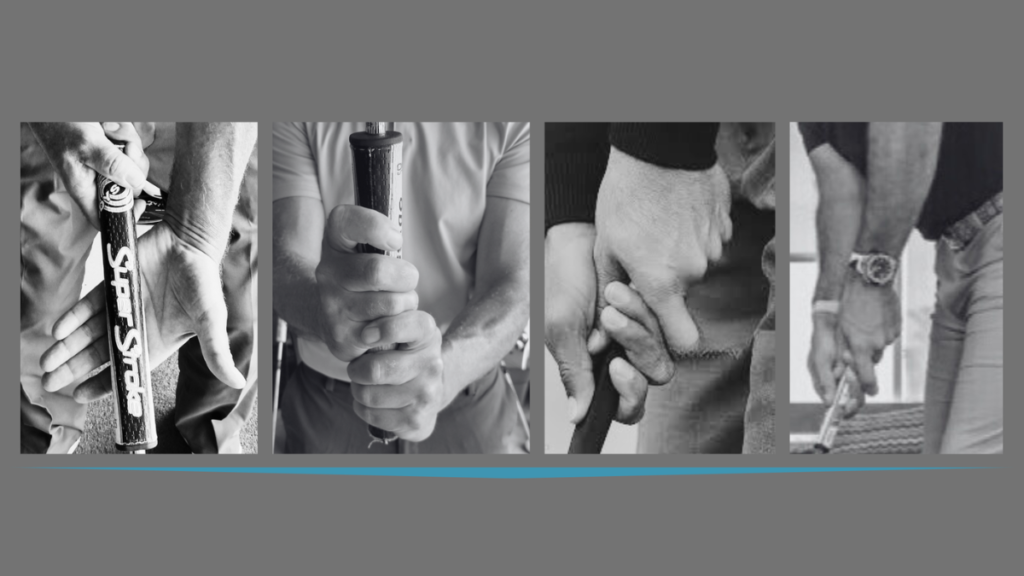
How to Build the Reverse Overlap Putting Grip
Here is the basic setup.
Do this slowly at first.
Not because it is complicated.
Because you want it to feel natural.
Step 1: Set the Putter in the Lead Hand
Start with your lead hand.
Place the putter grip more in the palm than in the fingers.
Let the grip sit along the lifeline of the hand. This helps connect the shaft with the lead forearm.
When this is done right, the back of the lead hand should feel like it has some relationship to the putter face.
That gives you awareness.
And awareness is better than guessing.
Step 2: Let the Lead Thumb Rest Down the Grip
Once the putter is seated in the lead hand, let the thumb rest down the top of the grip.
Do not press it hard.
Just let it sit there.
The thumb is not supposed to dominate the stroke. It is part of the connection.
The pressure should still feel like it lives more in the last three fingers of the lead hand.
That keeps the hand secure without making the wrist and forearm tight.
Step 3: Bring the Trail Hand In Lightly
Now bring the trail hand onto the grip.
Let it sit comfortably against the lead hand.
The trail hand should feel supportive, not dominant.
This is where a lot of golfers go wrong.
They bring the trail hand in and immediately want to control the putter with it.
Do not let that happen.
Keep it light.
Let it feel the stroke.
Step 4: Overlap the Lead Index Finger
This is the part that makes it the reverse overlap.
Take the index finger of the lead hand and let it overlap onto the trail hand.
For many golfers, that lead index finger will rest between the ring finger and pinky of the trail hand.
Some golfers like it more between the middle and ring finger.
Some extend it farther down.
There is some room for comfort here.
The key is that the hands feel tied together.
Not jammed together.
Not twisted.
Connected.
That is the feel you are looking for.
Step 5: Check the Pressure Balance
Once both hands are on the putter, check the pressure.
Lead hand firm enough to stabilize the face.
Trail hand light enough to feel speed.
That is your starting point.
If the putter feels trapped, you are probably squeezing too hard.
If the putter feels loose and sloppy, you may need a little more lead-hand structure.
Find the middle.
Putting is a feel game. You have to let your own hands tell you when it feels right.
Do Not Make This Too Perfect
Here is where I want to be careful.
You can overwork the grip.
Golfers do it all the time.
They keep adjusting.
They keep checking.
They keep trying to make the hands look exactly like a picture.
That is not the goal.
The grip needs to work.
It needs to feel repeatable.
It needs to help the putter face stay quiet.
And it needs to give you enough feel to control speed.
If it does those things, you are in good shape.
Do not turn this into another mechanical project.
The whole purpose of the grip is to make putting simpler.
How This Connects to the Pre-Putt Routine
Your grip and your routine work together.
The grip gives you connection.
The routine gives you commitment.
In the previous article on the pre-putt routine, we talked about the moment before the stroke. You make the decision, set the face, build the picture, return your eyes, and pull the trigger.
That routine gets weaker if your hands do not feel settled on the putter.
Because doubt creeps in fast.
You stand over the ball and start wondering if the face is square.
You start feeling the right hand get too active.
You start steering.
A better grip helps take some of that noise away.
It gives the routine something solid to stand on.
Where This Fits in Blackout Putting Training
This is still foundation work.
It may not feel exciting.
But it matters.
Before you can build real feel on the practice green, you need a grip that lets feel come through.
Before you can train distance control, you need a stroke that is not being hijacked by overactive hands.
Before you can trust the putt under pressure, you need the setup to feel familiar before the putter moves.
That is why this work belongs early.
The goal is not to become obsessed with grip positions.
The goal is to remove one more source of doubt.
And if you want the full structure for training feel, speed, and trust on the greens, the complete putting distance control training system walks through that progression step by step.
How the Grip Supports the Whole Scoring Game
Putting and wedge play are different, but they share one big lesson.
You cannot play good scoring shots while your mind is full of instructions.
At some point, you have to trust what you trained.
That is why the grip matters in putting.
That is why the routine matters before a wedge shot.
That is why stock wedge swings matter inside scoring distance.
All of it points to the same thing:
Build the habit before pressure shows up.
Then let the trained motion come out.
That is the idea behind a complete golf distance control practice system for scoring shots.
Not more swing thoughts.
Better training.
A Simple At-Home Grip Check Drill
You can start this at home in a few minutes.
You do not need a hole.
You do not need a perfect mat.
You just need your putter and a little space.
Try this:
- Place the putter in the lead hand.
- Set it through the lifeline.
- Let the lead thumb rest down the grip.
- Bring the trail hand in lightly.
- Overlap the lead index finger.
- Make a few slow strokes.
- Notice whether the face feels stable.
- Notice whether the trail hand can still feel the stroke.
That is enough to start.
Do not hit 100 putts trying to force it.
Get the hands settled.
Make a few strokes.
Let it become familiar.
Then, when you practice your routine, use the same grip every time.
That is how the habit starts to stick.
Final Thought: The Stroke Starts in Your Hands
Putting does not begin when the putter moves.
It starts when your hands meet the grip.
If the hands are tense, disconnected, or fighting each other, the stroke has to overcome that.
Sometimes it will.
Often it will not.
The reverse overlap putting grip gives you a simple way to connect the hands, steady the face, and keep enough feel in the stroke to control distance.
That is all we are trying to do here.
Keep the face quiet.
Let the hands work together.
Feel the roll.
Then step in, see the putt, and pull the trigger.
That is a better way to putt.
FAQ
What is the reverse overlap putting grip?
The reverse overlap putting grip is a traditional putting grip where the lead index finger overlaps onto the trail hand. It helps connect the hands so the putter can move more as one unit.
Why do golfers use the reverse overlap grip?
Golfers use the reverse overlap grip because it helps quiet the wrists, stabilize the putter face, and keep both hands working together during the stroke.
Is the reverse overlap putting grip good for distance control?
Yes. By keeping the lead hand stable and the trail hand lighter, the grip can help you feel speed better while keeping the putter face more controlled.
How tight should I hold the putter?
The lead hand should feel firm enough to stabilize the face, while the trail hand should stay lighter for feel. A good starting point is medium pressure in the lead hand and light pressure in the trail hand.
Should every golfer use the reverse overlap putting grip?
Not every golfer has to use it, but it is a strong starting point because it is simple, proven, and helps connect the hands. Some golfers may prefer left-hand-low or claw grips, but the same principles still apply: stable face, quiet hands, and good feel.
Train Trust, Not Swing Thoughts
If you’re tired of carrying swing thoughts into every wedge shot and putt, join The Blackout Journal Training Notes.
Each week, you’ll get practical Blackout Golf notes on feel, routine, distance control, and training trust inside 120 yards.Subscribe free to The Blackout Journal Training Notes