
At some point, you have to stop reading about feel and start training it.
That is what this stock wedge swing drill is for.
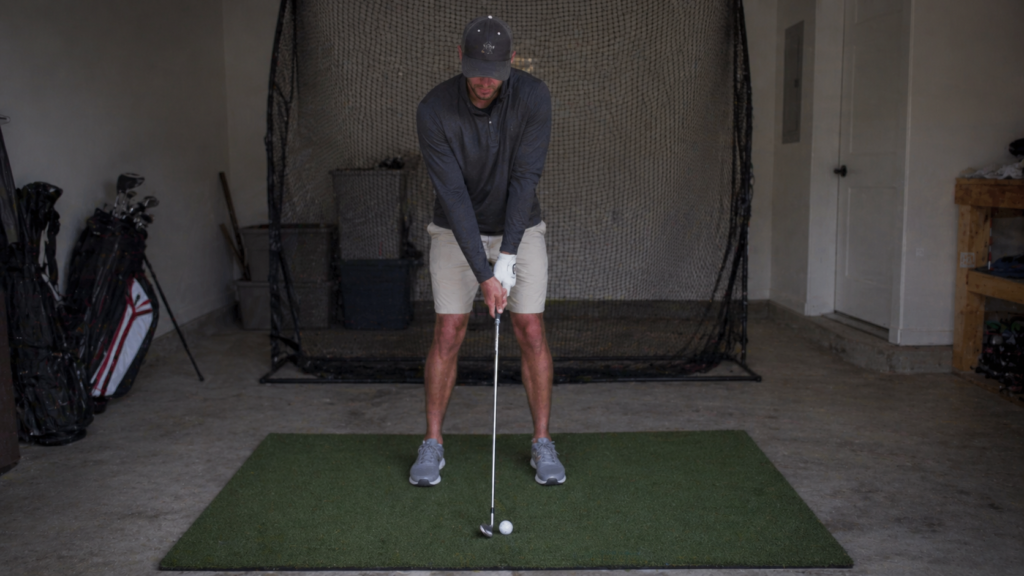
You are going to rehearse three wedge swings at home — hip to hip, rib to rib, and shoulder to shoulder — using the same pre-shot routine every time. No ball flight to judge. No range grind. No standing there trying to fix your swing after every rep.
Just a clean routine, a committed motion, and enough repetition for your body to start recognizing the swing.
That is how feel starts getting built.
This Is Where the Training Starts to Get Real
The last step was learning your stock wedge swing lengths. Hip to hip. Rib to rib. Shoulder to shoulder. That gave you the basic map.
Now we start training them like they matter. Because knowing the swing lengths is one thing. Repeating them with commitment is another. That is where a lot of golfers fall short. They make a few practice swings. They kind of feel it. Then they get to the range or course and start guessing again.
This drill is designed to close that gap.
You are not just making swings in the garage. You are teaching your body what these swings feel like before pressure gets involved.
Why This Drill Starts at Home
Home is the best place to start this work because home does not care where the ball goes.
There is no flag. No carry number. No buddy watching. No temptation to hit one more ball to “find it.”
That is a good thing.
When golfers go straight to the range, the ball starts bossing them around. One shot comes off thin, and they change the motion. One shot flies too far, and they slow down. One shot feels good, and they try too hard to recreate it.
Pretty soon, they are back in their head.
At home, you can train the motion without all that noise. You can feel the club travel. You can rehearse the same routine. You can pull the trigger without judging the result.
That is exactly what we want.
The Point Is Not Perfect Technique
This is not a technical drill. You are not checking positions. You are not stopping halfway back. You are not trying to make the swing look good on video.
You are building a familiar motion.
That is different.
The goal is to make each stock swing feel clear enough that your body starts to recognize it without needing a bunch of instructions.
Hip to hip should feel compact.
Rib to rib should feel comfortable.
Shoulder to shoulder should feel strong, but still controlled.
That is it. Do not make it harder than it needs to be. A good drill should clean things up, not give you more to think about.
Your Pre-Shot Routine Still Runs the Show
This is the part I want you to take seriously. Do not just stand there and make random swings. Use your routine.
Every rep. Even at home, especially at home.
In the previous article on stock wedge swings, we talked about building three familiar swing lengths before measuring distance. This drill is the next step. Now you are going to connect those swing lengths to a real pre-shot routine so they start feeling like golf shots, not just garage practice swings.
That matters because the course does not care how nice your practice swing looks.
The course asks one question:
Can you step in, commit, and hit the shot?
That is what we are training here.
What You Need for the Drill
Keep this simple.
You can use:
- A plastic practice ball.
- A foam ball.
- No ball at all.
- Your hands together, mirror-style.
- One of your actual wedges.
- An indoor hitting mat.
- A garage, carpet, backyard, or safe practice space.
First time through, do not use a ball, just work on the motion.
Do not wait for perfect conditions.
You do not need a full simulator.
You do not need launch monitor numbers.
You do not need a perfect setup at home.
You need enough room to rehearse the motion safely and enough discipline to run the routine the same way each time.
That is plenty.
The Drill: A Simple Three-Swing Circuit
This drill works best as a short circuit.
You will rehearse three stock wedge swings:
- Hip to hip.
- Rib to rib.
- Shoulder to shoulder.
Each swing gets five committed reps. That is only fifteen total reps.
That may not sound like much. Good.
This is not supposed to be a mindless workout. It should feel focused, quick, and clean. You are not trying to wear yourself out.
You are trying to install the pattern.
Stock Swing 1: Hip to Hip
Start with the shortest motion.
Hip to hip.
For many golfers, this swing represents a shorter pitch shot. In the chapter, we use a simple 40-yard picture as the starting point. Your real distance may be different later, and that is fine.
Right now, the number is just there to give your mind something to commit to.
Here is how to run it:
- Mentally commit to a 40 yard shot.
- Pick a target, anything (actual distance doesn’t matter).
- Step in with the clubface first.
- Let the aim drive your setup.
- Look at the target and take a clear mental snapshot.
- Bring your eyes back to the ball.
- Feel grounded.
- Pull the trigger.
Then repeat full routine. Five times.
Do not analyze each rep. Do not stop and ask whether it was perfect.
Run the routine and make the swing.
That is the win.
The hip-to-hip motion should feel compact, smooth, and low effort. You are not poking at it. You are not quitting on it. You are making a small committed swing.
There is a difference.
Stock Swing 2: Rib to Rib
Next comes the middle swing.
Rib to rib.
This is the one a lot of golfers end up trusting the most because it feels like a normal wedge motion. Not too short. Not too long. Enough swing to let the club move, but not so much that you feel like you have to force it.
In the chapter, we use a 70-yard picture for this swing. Again, do not get hung up on the exact yardage right now. Your distances will get measured later.
For now, commit to the picture and run the same process:
- Mentally commit to the 70-yard shot.
- Pick a target.
- Step in with the clubface first.
- Let the aim drive your setup.
- Look at the target and take a clear mental snapshot.
- Bring your eyes back to the ball.
- Feel grounded.
- Pull the trigger.
Then repeat full routine. Five times.
Same rhythm.
Same commitment.
This is where you have to watch yourself.
The middle swing can tempt you into adjusting. You might start wondering if it is really “half” or if the hands are high enough or if the finish matched the backswing.
Leave that alone.
You are not here to inspect the swing.
You are here to make the motion familiar.
Stock Swing 3: Shoulder to Shoulder
Now move to the longest stock wedge swing.
Shoulder to shoulder.
This is controlled power. Not a full rip. Not a lazy swing.
A strong wedge motion you can repeat.
In the chapter, we use an 110-yard picture for this swing. That gives you the feeling of a longer wedge shot without turning it into a full-blown distance chase.
Run the same process:
- Mentally commit to the 110-yard shot.
- Pick a target.
- Step in with the clubface first.
- Let the aim drive your setup.
- Look at the target and take a clear mental snapshot.
- Bring your eyes back to the ball.
- Feel grounded.
- Pull the trigger.
Then repeat full routine. Five times.
Do not rush just because it is the last swing. This one is where golfers often get quick. They add speed. They over-finish. They try to make it go somewhere, even when they are not hitting a real ball.
Stay controlled.
Shoulder to shoulder should feel aggressive, but not forced.
That is the line.
Why the Same Routine Matters Every Time
You may be wondering why we repeat the routine on every swing.
Here is why.
Because when you are on the course, you do not get to separate the routine from the shot. They come together. You pick the target. You step in. You see the shot. You swing.
So that is how you should train.
If you practice the swing without the routine, you may build a motion that only works in practice. But when you add the routine, you start building something that looks more like real golf.
That is the whole point of this drill.
Not just movement.
Performance preparation.
You are teaching yourself to connect the decision, the target picture, and the swing.
That is how you start building trust.
Do Not Judge the Drill by Ball Flight
If you use a plastic ball or foam ball, do not get too caught up in where it goes.
That is not the point yet.
A plastic or foam ball can lie.
A garage mat can lie. Even a real golf ball on the range can mess with your head if you are not careful.
That is why I believe a ball is not necessary for this drill. Focus on the movement.
Judge this drill by the process.
Ask yourself:
Did I commit to the shot?
Did I run the routine?
Did I step in with the clubface first?
Did I see the target?
Did I pull the trigger without adding a swing thought?
If yes, that rep did its job.
That is how you train without turning every swing into a test.
The Mindset: Quick, Clean, Committed
This drill should not feel heavy.
It should not feel like homework. It should not feel like you are grinding through a checklist. Think of it more like a quick training circuit.
Pick the shot.
Step in.
See it.
Swing.
Move on.
That does not mean careless. It means committed. There is a big difference. Careless is just swinging with no purpose. Committed is doing the full routine without dragging extra thoughts into it.
That is what you want.
Quick.
Clean.
Committed.
Why This Builds Implicit Memory
The body learns through repetition. But it has to be the right kind of repetition. If you repeat fear, you get better at fear. If you repeat doubt, you get better at doubt. If you repeat a cluttered routine, you get better at bringing clutter into the shot.
That is why this drill is so simple.
You are repeating the same useful pattern:
Decision.
Target.
Setup.
Image.
Trigger.
Swing.
Do that enough times and the process starts to feel normal.
That is implicit memory in plain English.
You are training the body and mind to recognize the shot without needing a long conversation about it.
That is the start of Blackout Mode.
How Often Should You Do This Drill?
Do it regularly.
That matters more than doing it for a long time.
You are better off doing a short, clean session most days than doing one long session where you get tired and sloppy.
Start with one circuit:
- Five hip-to-hip reps
- Five rib-to-rib reps
- Five shoulder-to-shoulder reps
That is enough.
Later, you can do two circuits if it still feels sharp.
But do not turn this into a punishment.
The goal is to leave the session feeling clearer than when you started.
If your focus starts fading, stop.
Bad reps are still reps. Be careful what you install.
Where the Fairway Wedge System Fits
This drill is one piece of a bigger training progression.
First, you build the routine.
Then you build the stock swings.
Then you start training them at home.
Later, you measure carry distances, change speeds, randomize targets, and bring the work to the course.
That order matters.
Most golfers jump to distance too early. They want the number before they own the motion. Then they start manipulating the swing to make the ball fly a certain yardage.
This system goes the other way.
Build the motion first.
Then measure what it produces.
Then learn how to use it.
That is the cleaner path.
If you want the full wedge progression, the complete wedge distance control training system walks through the process step by step.
And if you want to connect wedge play and putting under one scoring-shot system, the full golf distance control practice system brings both sides together.
What Comes Next
Once these three stock swings start to feel familiar, the next layer is speed.
That is where things get interesting.
Because eventually, you need to learn how to change distance without changing everything about your swing.
You need to know what happens when the motion stays the same, but the pace changes.
That is a different skill.
But do not rush there yet.
Own this first.
Run the drill.
Build the pattern.
Make the three swings feel like yours.
Then the next step has something solid to stand on.
Final Thought: Train It Before You Need It
You do not want to find your wedge swing on the course. That is too late. You want to arrive with motions your body already knows.
That starts at home.
Not with perfect mechanics. Not with a bucket of balls. Not with another swing thought. Just three stock swings, a simple routine, and enough clean repetition to make the motion feel familiar.
Hip to hip.
Rib to rib.
Shoulder to shoulder.
Run the routine.
See the shot.
Pull the trigger.
That is the drill.
And if you do it right, it will follow you to the course when your not looking for it.
FAQ
What is the stock wedge swing drill?
The stock wedge swing drill is an at-home training circuit where you rehearse three wedge swing lengths: hip to hip, rib to rib, and shoulder to shoulder. The goal is to build feel, rhythm, and repeatable motion before measuring distance.
Can I do this wedge drill at home without hitting balls?
Yes. You can rehearse the drill without a ball, with a plastic ball, with a foam ball, or with your hands together in a mirror-style motion. The main goal is to train the routine and swing pattern.
How many reps should I do for each stock wedge swing?
Start with five reps for each swing length. That gives you 15 total reps: five hip-to-hip, five rib-to-rib, and five shoulder-to-shoulder swings.
Should I focus on distance during this drill?
Not yet. The goal is to build the motion first. Later, you can measure carry distances for each wedge and each stock swing.
Why is the pre-shot routine part of this drill?
The routine connects the swing to real golf. It trains you to pick a target, step in, build the picture, and pull the trigger instead of making random practice swings.
Want to Keep Training This?
This article is a starting point. The real progress comes from training it consistently.
Join The Blackout Journal Training Notes for free weekly guidance on wedge distance control, putting feel, practice plans, and building trust without overthinking every scoring shot.
3 thoughts on “Stock Wedge Swing Drill: Train Three Swings at Home”
Comments are closed.