
On the golf course, you do not get three balls to discover the 63-yard answer. You choose it once, commit once, and live with the result. That sounds obvious, but a lot of wedge practice does not work that way. I used to do this without really admitting I was doing it. I would change yardages on the range and tell myself I was practicing different shots. Maybe I would go from 50 yards to 70. But the first ball would come up short, the second would get closer, and by the third I had the feel.
Then I would count the third one.
Of course it looked pretty good. I had just used two golf balls to figure out the answer. The course is not nearly that generous. You get 63 yards, one lie, one target and one chance to decide what that distance feels like. There is no calibration ball hiding in your pocket. You have to retrieve something useful before you swing.
That is what this random wedge practice test is designed to find out.
Not how good you look after you have settled into a yardage. Not how tight the pattern gets after five balls. The question is simpler and a little less comfortable:
Can you produce a useful wedge answer on the first attempt when the distance changes?
That first ball tells you a lot.
Why the First Ball Matters
There is a big difference between retrieving an answer and correcting one. If I hit a 65-yard wedge eight yards short, I have information now. I know the strike, I saw the flight, and I know I need a little more. Give me another ball and I have a pretty good chance of making a useful adjustment.
That second shot tells me whether I can correct.
It does not tell me whether I could retrieve the 65-yard shot in the first place. That matters because golf is mostly a first-ball game. You walk into a new yardage and have to solve it without the benefit of the shot before it. You may not have hit a wedge in twenty minutes. Your previous wedge might have been 48 yards from rough. Now you have 72 from a clean fairway lie.
You need a new answer.
This is where repetitive practice can fool a good player. A seasoned range grinder gets sharper as the block goes along, sees five good shots at the end and leaves feeling ready. The practice performance is real, but some of that performance is being supported by the balls that came before it.
This is why repetition can hide weak retrieval.
There is still a place for repetition. If you are learning a motion, checking contact, or establishing a stock number, use it. But once you want to know whether a distance is actually available to you, count the first ball.
That is the one most like golf.
Random Yardages Train Recall
Changing the yardage every shot creates a different kind of work. You are no longer asking the body to repeat the same solution. You have to look at a new number and find a new one.
Fifty-five yards.
Now 75.
Back to 60.
Then 45.
You cannot ride the feel of the previous shot for very long because the next shot has changed. That is why this type of practice can feel messy. You may hit a good 60-yard shot, move to 75 and feel like the wedge suddenly disappeared. Then the next number changes again before you get a chance to fix the miss.
It can be irritating.
Especially if you are used to judging the quality of a range session by how many good balls you can string together. But a messy session can sometimes be the more useful session because it keeps asking you to go through pre-shot process in order to commit to the shot.
The job is not to repeat one pretty wedge motion. The job is to select and produce the right carry, that is distance control. If the target changes from 55 to 70 yards, something has to change. You have to recognize what 70 requires, make a decision about the shot, and produce it without first sneaking in a 65-yard calibration attempt.
Over time, that is the ability you want. You see the number and the shot begins to make sense. Not because you calculated twelve mechanical pieces. Because you have trained enough distances, enough times, that there is something there to retrieve.
Start With Familiar Numbers
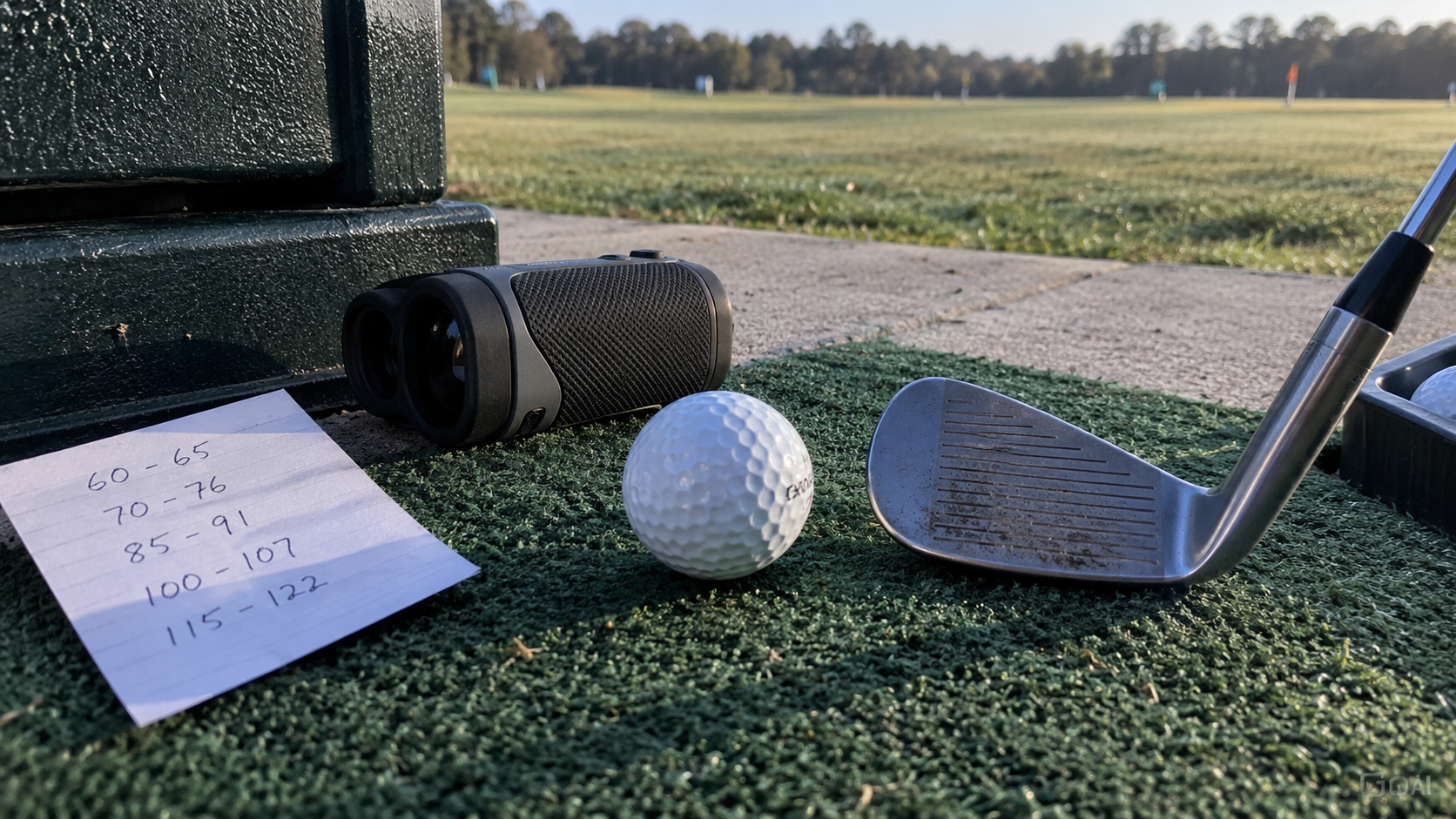
There is no reason to make this harder than it needs to be. Start with yardages you already know. If 40, 50, 60, 70 and 80 yards are familiar numbers in your wedge game, use those. If your normal system is built around different distances, use yours.
The first version of this test should not be a guessing contest. If I hand you 57, 63, 71, 46 and 84 yards before you have established a reasonable feel for your basic carry numbers, I may learn more about your ability to guess than your ability to retrieve.
That is not what we are after.
Use familiar distances first so the test asks an honest question:
Can I call up something I have already trained?
Once that becomes dependable, odd yardages can come later. Different lies can come later. Different trajectories and club choices can come later. You do not have to add every difficulty at once. Seasoned players sometimes make this mistake because we like a challenge. We think harder automatically means better.
Not always.
If the task becomes so complicated that you are searching for an answer you have never established, the test loses its point. Start with numbers you understand. Make the first ball count. See what is actually there.
Score the Window, Not Perfection
Do not make the flag the only definition of success. That is another easy way to ruin a useful wedge test. If the target is 70 yards and you carry it 69 with a playable pattern, that is different from flying it 58. Both may have missed your exact number, but they are not the same miss.
Golf is played inside useful windows.
Before starting the test, give each yardage a primary carry window and a larger safety window. Make the windows realistic for your game and the practice setup you are using. Do not borrow somebody else’s standard because it sounds impressive. The purpose is to measure whether your first attempt produced a functional distance.
A ball inside the primary window earns two points. A ball outside the primary window but still inside your safety window earns one. Anything outside both earns zero.
That simple scoring matters because it keeps you from falling into the trap of remembering one beautiful shot and forgetting four poor ones. A single flag-high wedge can make a session feel great. A score tells you what happened across the test. Maybe you never hit one perfect shot but score eight out of ten because every carry was usable. That is useful wedge control. Maybe you hole out the 60-yard shot and completely lose three other distances. The highlight was better, but the pattern was not. I would rather know about the pattern.
Dependable is more valuable than spectacular once in a while.
What the Miss Is Telling You
This is where I would resist the urge to turn every zero into a swing lesson. A wedge that comes up ten yards short does not automatically mean the motion broke down. Maybe you chose the wrong answer before you ever moved the club.
Suppose the card says 70 yards.
You pull the wedge, make a rehearsal, hit it solid and carry it 62. That may be a strike problem. But maybe not. Did you actually predict 70 before you swung? Did the rehearsal feel like your 70-yard shot? Were you committed to the club and swing category you chose? Or were you standing over the ball thinking, This feels like somewhere around 65 or 70?
That is a decision problem.
Another shot may have a clear decision and poor contact. Different problem. Another may be struck beautifully but fly farther than you predicted. Now you may have a calibration problem between feel and actual carry. Those distinctions are useful because they keep you from treating every poor outcome as proof that you need another mechanical thought.
When a shot misses, ask where the miss began.
Was the selection wrong?
Was your prediction wrong?
Did the feel not match the intended carry?
Or did you simply make poor contact?
You cannot train the right thing until you know which problem showed up. That is one reason a scored one-ball test is so useful. You are not giving yourself enough correction balls to cover the weakness.
The weakness has nowhere to hide.
The Five-Yardage One-Ball Test
This is a small test. Keep it that way.
Choose five familiar wedge carry distances. Mark a primary window and a larger safety window for each one. You will hit five golf balls total.
One ball per yardage.
Before you begin, write the five distances in mixed order. You can put them on a card, in your phone, or on a folded piece of paper. The important part is that you deal with one number at a time instead of looking ahead and preparing for the next three.
When the first distance comes up, make the decision before stepping into the shot. Name the club you are using, the swing category or stock feel you already use for that distance, the carry you expect, and the safe miss.
Then go through your normal routine.
Hit one ball.
That ball counts.
Score it immediately. Give yourself two points for the primary window, one point for the safety window and zero outside both. Then move to the next yardage.
No second ball. That part matters more than it sounds. If the first 70-yard wedge comes up short and you immediately hit another 70-yarder, you have changed the test. Now you are measuring how well you adjust after feedback.
That can be useful practice on another day. It is not this test. This one measures retrieval.
Five shots. Maximum score of ten.
When you finish, record the score rather than trying to repair the weakest yardage immediately. The baseline is more useful if you leave it alone and repeat the same basic test later. This is not something you need to hammer three times every week until you learn how to beat the drill. Use it as a check. Come back later and see whether the first-ball answers are getting better.
That is what you care about.
Do Not Cheat the Test
Golfers are good at finding ways to make practice scores look better. I say that from experience. You hit the first ball and it comes up short, so you tell yourself you were not quite ready. That one was basically a warm-up. So hit another. Or maybe the range ball felt bad, so hit another. Or the wind changed, hit another.
Pretty soon the one-ball test has become a six-ball block and, sure enough, the last one is close. That misses the entire point. If you need a warm-up, warm up before the test. If you need to establish your contact for the day, do that first.
Then begin.
Once the test starts, the first ball counts.
The score does not need to flatter you. It needs to tell you something. A five out of ten that exposes weak retrieval is more useful than a nine you negotiated your way into.
What a Good Score Really Means
I would not give you some universal number and tell you that seven means you are a good wedge player and six means you are not. That would be pretty meaningless. Your carry windows may be different from mine. The range conditions may be different. The quality of the balls may be different. Your level of play is different.
Use your own windows and compare yourself with yourself.
The first score is a baseline. If you score six today and eight the next time under similar conditions, that tells you something. More important, look underneath the score. Maybe the total stays the same but the misses change. The first time, you searched for the right feel on three of the five yardages. A month later, the decisions are immediate but you lose two points through poor strikes.
Same number.
Better information.
The score is there to keep the test honest; it is not there to become another number you chase.
Use a Launch Monitor Without Letting It Give You the Answer
A launch monitor can be very useful here if you have one. It can verify actual carry and help you see whether your feel matches the result.
But prediction needs to come first.
Do not stand there staring at the monitor, hit a ball, read 64.7 yards, and then decide that was roughly what you meant to do. Call the answer beforehand. If the target is 65, decide what you expect the ball to carry then hit it. Then look at the number.
That gap between prediction and outcome is useful feedback. Over time, you can even reduce how often you look. Hit the shot, make your own judgment first, then check the actual number. That begins putting responsibility back on feel instead of turning the monitor into another set of instructions.
Technology is helpful when it verifies the answer. It is less helpful when it supplies the answer before you learn to feel it.
Keep the Journal Entry Short
You do not need a page of notes after five wedge shots. Write down the date, the five yardages, your score and one answer to this question:
Which yardage required the most searching, and was the problem selection, feel, or strike?
That is enough. If 70 yards keeps showing up as the number where you hesitate, now you have something worth training. If your decisions are clear but your strike gets poor as the carry gets longer, that tells you something else. If every miss is short even though contact feels fine, perhaps your predicted carry and actual carry are drifting apart.
The Journal is not there to document every thought that went through your head.
Use it to catch the pattern.
Then train the pattern that matters.
Final Thought
A lot of wedge practice makes us feel good because we get enough balls to find the answer. Golf wants the answer before the first ball. That is the gap this test is trying to expose. You do not need to throw away your normal wedge work. Keep building stock distances. Keep learning your feels. Keep doing the repetition that helps you establish those answers.
Then occasionally take the training wheels off:
- Five yardages.
- Five balls.
- Full routine.
- One decision each time.
- No correction ball.
- Count the first one.
It may make the session look a little worse and that is fine.
The first ball is the one you are going to need on Saturday.
Frequently Asked Questions
What is random wedge practice?
Random wedge practice changes the problem frequently enough that each shot requires a fresh solution. The distance may change, and more advanced practice can eventually change the target, club, lie or trajectory as well. For this test, changing the carry yardage is enough. The important part is that you do not repeat the same answer before moving on.
How many yardages should I test?
Start with five familiar carry distances. That is enough to see whether you can retrieve several known answers without turning the test into a long range session. Add more difficult or irregular numbers only after the decisions at your basic yardages remain clear.
Should I use a launch monitor?
Yes, if you have one, but make your prediction before seeing the result. Let the launch monitor verify carry rather than tell you what the shot was supposed to be. As your calibration improves, you can reduce the amount of immediate feedback and judge the shot yourself before checking the number.
What is a good score in a one-ball wedge test?
There is no useful universal score because golfers, targets and carry windows differ. Establish realistic personal primary and safety zones, record your first score, and compare future tests with your own baseline. The trend is more valuable than somebody else’s standard.
Train Differently
Do not wait until the third ball to decide you know the yardage. The course is going to count the first one. Make your wedge practice count it too. Build the answer during training. Then change the number, go through your routine, and see whether the answer comes back without help.
That is the feel you are trying to take with you.
Scott | Distance Control Coach
Train Trust. Not Swing Thoughts.
Join The Blackout Journal Free for weekly Training Notes on building wedge carry you can retrieve—calm, practical work for seasoned golfers who want the first ball to look more like the fifth.
If you want a more structured foundation for building and organizing those wedge distances, the Blackout Fairway Wedge System is the natural next step. The deeper random-yardage progressions, changing lies, trajectory work, pressure consequences, and longer-term benchmarks belong in structured training rather than this single public test.