
From forty feet, the hole can be a lousy practice target.
Not because you should ignore it. You still need a line and somewhere to aim. But if every putt that does not go in gets lumped together as a miss, you are not getting much useful information about the part of the putt that matters most.
Pace.
I have watched plenty of seasoned players stand over long putts trying to make every one. I have done it myself. One comes up six feet short. The next one gets an extra shove and runs eight feet past. Then one happens to finish near the cup and suddenly the session feels better.
If the goal is fewer three-putts, the long putt has a bigger job than just threatening the hole. It needs to finish somewhere that leaves the next putt manageable.
That changes how I think about lag putting practice.
Instead of making the cup the only measure of success, give the ball a safe place to finish. A visible area around the hole. Big enough that a good pace gets rewarded, but useful enough that a poor leave still shows up.
That is what this lag putting safety zone drill is built around.
The cup still matters.
But the finish area tells you whether you controlled the part of the putt that usually decides whether you walk away with two putts or three.
The Real Goal of a Lag Putt
Of course I want to make a forty-footer, everybody does. If it falls, great, I will take it. But I would not build my long-putt practice around how many forty-footers I hole because that is not the skill I am really trying to make dependable.
The skill is controlling what happens if the ball does not go in.
That matters because there is a big difference between missing twelve inches left and leaving the putt six feet short. Both shots count as misses if the cup is your only standard. They are not remotely the same result however. One leaves a putt you expect to finish. And the other has turned a routine two-putt into work.
That is why I like giving the hole two jobs during lag practice. The hole gives you direction and the safety zone gives you pace. You are still reading the putt. You still choose a starting line. You still want the ball to have a chance.
But your real training question becomes:
Can I roll this ball into an area where the next putt stays simple?
That is a much better distance-control question than whether you happened to hole one out of ten. It is also a better way to think about how to train putting speed instead of chasing the hole.
Build a Zone That Matches the Distance
The safety zone has to be realistic. If you make it too large and everything looks good. Make it too small and the drill turns into punishment. I do not think either one helps much.
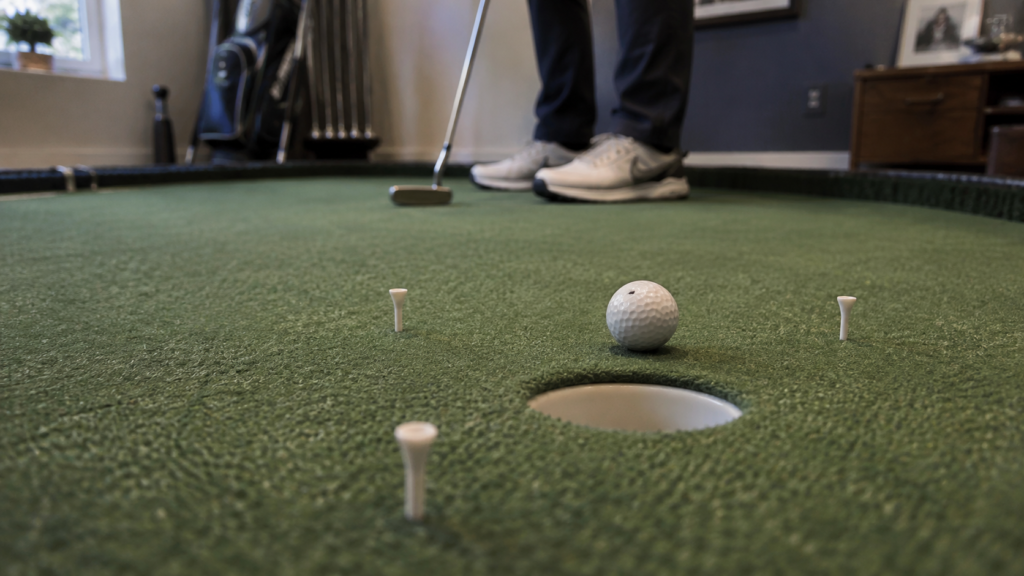
For the basic version, start with a three-foot zone around and behind the cup. You can picture a semicircle, lay a couple of clubs down as visual boundaries, or use whatever simple markers your practice green allows. I like to use flat, plastic ball markers. They show real good on the green and will not stop the ball from rolling out. Do not get hung up on making the shape perfect. You are trying to make the finish area visible.
Three feet is a useful starting point because it gives you room to train pace without pretending that every decent forty-footer needs to stop six inches from the cup. That matters with long putts.
Seasoned players sometimes practice from twenty, thirty, or forty feet using expectations that belong to six-foot putting. Anything that does not finish right beside the hole feels poor. Then the drill gets tense and the stroke gets guarded. And instead of learning speed, the player starts trying to steer every ball into a tiny circle.
I would rather see a player develop a repeatable pattern first. Can you keep long putts in an area that leaves a manageable next putt? Once that becomes normal, you can ask for more.
Difficulty should expose where your control stands.
It should not make an ordinary miss feel like failure before you have learned anything.
Ladder the Distance Before the Pressure
Distance itself gives you plenty to work on. You do not need to add consequences, make-or-miss pressure, and a dozen rules right away.
Start at twenty feet. Then thirty. Then forty.
That change is enough to force you to recalibrate. The stroke that sends a ball twenty feet is not the answer from forty. You have to look again, feel again, and produce a different amount of speed.
That is the work.
And I would change the distance before I start piling pressure on top. This is something range grinders can overlook. We like to make drills harder because harder feels more serious. But there is a difference between useful difficulty and noise. If your pace changes wildly just moving from twenty to thirty to forty feet, you already have a training problem sitting in front of you.
Work on that.
The pressure can wait. Once you can move between distances and keep producing useful finishes, then a harder version makes sense.
Earn the next difficulty.
Do not add it just because the drill feels too simple on paper.
Read Slope Through the Zone
A three-foot leave is not always a three-foot leave.
That sounds obvious when you say it out loud, but it is worth remembering during practice. Three feet straight uphill is one thing. Three feet above the hole on a slick breaking green can be a completely different next putt.
So the safety zone is not just a geometric circle you blindly obey.
You still have to read the green.
If the putt is downhill, the dangerous leave may be long.
If the ball is coming up a slope, being slightly past the hole might not bother you nearly as much.
If one side of the cup leaves a nasty downhill slider and the other side leaves a simple uphill putt, the useful finish area is not really equal in every direction.
This is where distance control and course awareness start working together. You are not simply trying to stop the ball inside a painted circle. You are trying to understand what kind of leave creates the least risk. For this basic drill, keep the setup simple. You do not need a different mathematical zone for every slope.
Just notice it.
Pay attention to where your misses collect and whether those misses would actually leave the next putt manageable.
That little bit of awareness starts making the drill feel more like golf and less like rolling balls at a target.
Score the Pattern
One great putt can fool you. You hit four poor lag putts and then roll the fifth one to six inches. That six-incher feels so good that it becomes the shot you remember. The other four quietly disappear.
A simple score fixes that.
Instead of judging the session by its best ball, judge the pattern.
How many finished inside the safety zone?
Where did the misses go?
Were most of them short?
Did you repeatedly run the ball past the zone?
Did the thirty-foot putts look controlled while forty feet turned into guesswork?
That tells you much more than the prettiest ball of the afternoon. For long-putt distance control, I care a lot about the distribution of the misses. If five balls all finish a little short but inside a manageable area, that is one pattern. If one finishes next to the hole, two stop six feet short, and two race well past, that is another.
The second group may contain the best individual putt. I would still trust the first pattern more. That is why I want the score and the short-versus-long tendency. One number tells me how often the pace was usable.
The direction of the misses tells me what kind of adjustment may be needed.
The Three-Distance Safety Zone Ladder
You only need six golf balls for the basic version of this drill.
Set up a safety area around the hole about three feet deep. A semicircle behind and around the cup works well, or place two clubs or simple markers so you have a clear visual finish area.
Mark three starting distances: twenty feet, thirty feet, and forty feet.
The first ball comes from twenty feet:
- Read the putt.
- See the finish area.
- Use your full pre-putt routine.
- Roll one ball.
- Do not hit a correction putt.
Move to thirty feet and do the same thing.
Then move to forty. Consistent routine.
That gives you the first half of the ladder.
Now reverse it:
- Hit one ball from forty.
- One from thirty.
- Finish from twenty.
Six putts total.
Score one point each time the ball finishes inside the safety zone. A ball outside the zone scores zero.
Maximum score: 6 points.
Keep the scoring that simple.
At the same time, mark whether every miss finished short or long. You do not need a complicated chart. A quick “S” or “L” beside the miss is enough.
What you are looking for is how your pace changes as the distance changes. Can you go from twenty to thirty without needing a calibration or practice ball?
What happens when you get to forty?
When you reverse the ladder, does the first twenty-footer race past because your feel is still stuck at forty?
That is useful information. Do not erase it by hitting another ball from the same spot. The distance changed and you made your decision.
That attempt counts.
Journal Prompt
At which distance did my picture of the finish zone become unclear?
That question matters more than it may seem. Sometimes a poor lag putt is not really a stroke problem. You simply never formed a clear picture of how far the ball needed to travel.
Twenty feet may look obvious. Thirty still feels comfortable. Then you walk back to forty and suddenly you are just hitting it harder.
That is worth noticing.
Do Not Shrink the Zone Too Fast
This is where seasoned players can take a good drill and make it miserable. You score well once and immediately decide the three-foot zone is too easy. Now it is two feet. Why not eighteen inches?
Before long, you are practicing forty-footers as though every ball should finish tap-in close.
That is not progression. That is impatience.
The zone should be challenging enough to tell you something about your pace control without making normal long-putt dispersion look like disaster. If the current setup is producing repeatable finishes, good. Stay with it long enough to know that was not one lucky session.
Then you can make the challenge harder in a structured way. The purpose of the safety zone is to train control. Not to prove how difficult you can make a putting drill.
Why Long Putts Keep Coming Up Short
Leaving long putts short is not always about needing a longer stroke. That may be part of it, but I would look at the decision before jumping straight into mechanics.
Did you have a clear pace intention?
Could you picture the finish?
Were you worried about the comeback putt?
Did the previous fast putt make you protect against the next one?
Did you recalibrate when you moved from twenty feet to forty?
Sometimes golfers leave long putts short because they are trying very hard not to hit them long. That fear changes the task. Instead of rolling the ball into a finish area, you are trying not to make a mistake. And those are different intentions.
The safety zone helps because it gives the mind somewhere useful to go. You are not thinking, Don’t run this six feet past. You are seeing a place where the ball can finish.
That is cleaner.
And if the ball repeatedly stops short of that zone, you have a pattern you can train instead of a vague feeling that you are “bad at lag putting.”
The Hole Is Still Allowed to Get in the Way
There is one thing I do not want this drill to turn into. I do not want you rolling forty-foot putts with no intention of making them.
The hole still matters. Read the line, pick your start, roll a putt that has a chance, and if it falls, wonderful.
But do not let whether it falls become the only information you keep. A good lag putt can miss the cup and still do its job beautifully. A poor one can scare the edge and run six feet past. That is why the safety zone helps. It gives you a better measure of the skill you are actually trying to train.
Pace first.
Make-or-miss noise second.
Final Thought
Three-putts usually do not begin with the three-footer. They begin with what you left yourself from thirty or forty feet. So practice that part honestly. Do not make every long putt a referendum on whether the ball went in. Give yourself a finish area that represents a manageable next putt.
Move between distances. Always count the first ball. Notice whether the misses collect short or long. And when the pattern becomes dependable, then make the challenge harder.
The hole tells you where you are going.
The safety zone tells you whether you controlled the trip.
Train that.
Frequently Asked Questions
How large should a lag putting safety zone be?
Start broad enough that it represents a manageable next putt for your current skill level. A three-foot zone is a useful starting point for the basic drill, but distance and slope matter. The point is to make the zone demanding enough to reveal pace control without turning every reasonable long-putt miss into failure.
Should long-putt practice focus on making putts?
Making long putts is always welcome, but it should not be the only measure. From longer distances, pace dispersion and the quality of the next putt tell you more about three-putt risk. Read the line and give the ball a chance, but also judge where the putt finishes when it does not fall.
How many lag putts should I hit?
Use small, deliberate sets where the distance changes. The safety-zone ladder uses only six putts—two each from twenty, thirty, and forty feet. You can do other putting work around it, but changing distance keeps you from simply repeating an answer you just learned.
Why do I leave long putts short?
Several things can contribute. The pace intention may be unclear, you may be protecting against a long comeback putt, or you may not be recalibrating well when the distance or green speed changes. Look at the pattern first before assuming the stroke needs another mechanical correction.
Train Differently
Quit asking every forty-footer to prove whether you can make it.
Ask a better question.
Can you leave the ball somewhere that keeps the next putt simple?
Give yourself a visible finish area, change the distance, and make the first ball count. When the pattern gets better, your three-putt risk starts getting better with it.
That is the work.
Scott | Distance Control Coach
Train Trust. Not Swing Thoughts.
Join The Blackout Journal for weekly Training Notes on building putting speed you can trust—calm, practical work for seasoned golfers who would rather train distance control than spend another session chasing the cup.
For golfers who want to go deeper into putting setup, stroke training, speed work, and building a putting motion they can trust without carrying mechanical thoughts onto the green, the Blackout Putter System is the natural next step.