
You finish the session with five good wedge shots in a row.
Solid contact. Good flight. Tight pattern.
You put the club back in the bag feeling like you finally found it.
Then you get to the course the next day, face one ordinary wedge shot, and the motion is nowhere to be found.
I have lived that one more times than I care to admit.
Most seasoned players have.
The frustrating part is that the range session was not fake. You really did hit those good shots. You really did feel in control.
But a good range session and a learned skill are not always the same thing.
That is the part most players miss.
The last five balls may prove that you could repeat a motion while the club, yardage, lie, target, and rhythm all stayed the same.
They do not prove that you can call that motion back tomorrow. They do not prove that you can adjust it to a different distance. And they certainly do not prove that it will show up on the first ball when the shot counts.
So the real question is not:
How good did the session look?
The better question is:
What will still be there when the conditions change?
A Good Range Session Can Still Be a Poor Test
There is nothing wrong with hitting several balls from the same place.
Sometimes you need repetition.
You may be working on contact. You may be trying to settle into a stock motion. You may be learning what a certain swing feels like with a certain wedge.
That work has value.
The problem begins when we use a smooth run of shots as proof that the skill is ready for the course.
It feels convincing because every ball gives you another chance to adjust. The first one comes up short, so you add a little speed. The second leaks right, so you make a small correction.
By the fourth or fifth ball, you have the answer.
Then you hit several good ones and walk away believing the motion has been learned. Maybe it has, but maybe you simply became good at repeating that exact task for a few minutes.
You will not know until you test it under different conditions.
Range performance tells you what you can do while the answer is still fresh.
Learning shows up when you have to retrieve the answer later.
That is a much tougher test.
It is also a much more honest one.
The Three Tests That Matter
When I want to know whether practice is actually holding, I look at three things.
1. Can you recall it after a delay?
Step away for a few minutes.
Put the wedge down. Roll a few putts. Get some water. Do something that breaks the rhythm of the session.
Then come back and hit one ball without rebuilding the motion through several warm-up shots.
Can you find the feel again?
Not perfectly. That is not the standard.
The question is whether the answer is still available without starting over.
2. Can you use it for a different target?
A golfer may look sharp hitting twenty balls to 70 yards.
But what happens when the next shot is 63?
Or 78?
Changing the target forces you to make a fresh decision. You have to choose the club, picture the flight, feel the required energy, and commit to the shot.
That begins to look more like golf.
3. What happens on the first ball?
This may be the most important test of all.
The course does not give you six balls to find the right speed.
You get one. One lie. One number. One target. One decision.
The first ball shows you what was actually available before correction took over.
That is why repetition is not the same as training.
Repetition can help build or recalibrate a motion. But eventually, you need to ask whether that motion can survive a delay, adjust to a different target, and show up without several practice balls.
Those three tests tell you far more than the prettiest group you hit all day.
Why Repetition Creates False Certainty
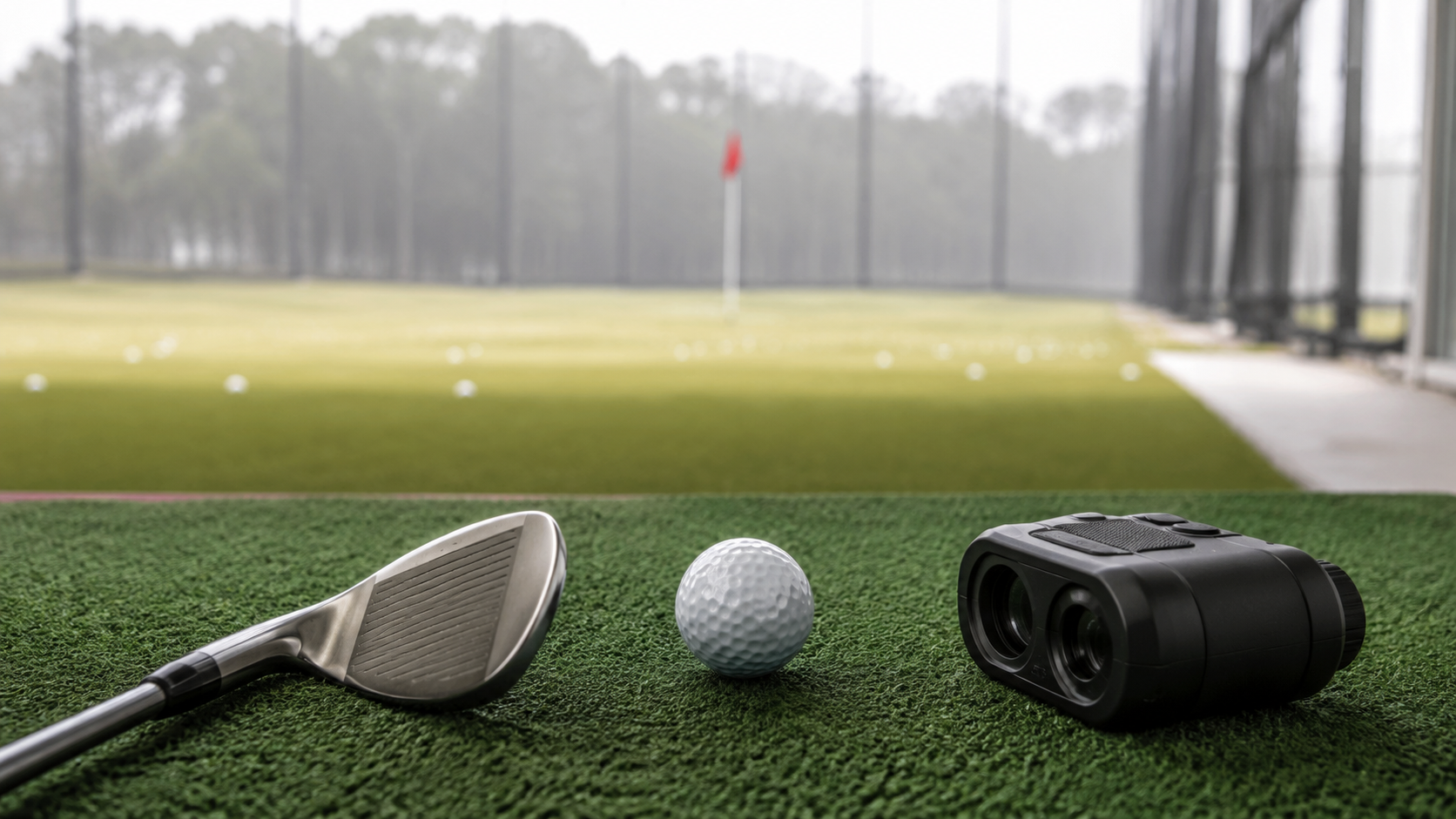
Repetitive practice makes the task easier with every ball.
You keep the same club in your hands. You look at the same target. You stand on the same lie. You make the same basic decision.
Before long, there is not much left to decide.
The task begins to supply the answer for you.
That can create a powerful feeling of certainty. You start believing, “I own this shot.”
Then you go to the course.
Now the lie is slightly uneven. The pin is between stock numbers. There is a bunker short. The wind is moving across you. You have been waiting several minutes since your last swing.
Suddenly, the answer is not sitting there waiting.
You have to produce it.
That is the difference.
The course rarely asks you to repeat the shot you just hit. It asks you to solve a new problem with one ball.
This does not mean every practice ball needs to be random. That can become its own kind of nonsense.
If you are still trying to establish basic contact or learn a new stock motion, bouncing between clubs and targets every shot may create confusion instead of learning.
Build the motion first.
Settle the feel.
But once the motion begins to stabilize, stop using more repetition as the only proof that it works.
Give yourself an honest test.
Make the Last Ball Tell the Truth
Most golfers finish a range session when they hit a shot they like.
I understand why. Nobody wants to leave after a poor strike.
But the last ball can serve a better purpose than protecting your confidence.
It can tell you the truth.
Instead of finishing with another ball from the same block, step away for five minutes.
Then come back.
Choose a different carry distance.
Go through your full routine.
Hit one ball.
No warm-up shot. No second chance. No immediate correction.
Score the result and leave it alone.
That single ball may not look as good as the final five balls from your normal session.
Good. Now you have learned something useful. Maybe the motion did not return after the break. Maybe you became too focused on the strike. Maybe you chose the wrong shot. Maybe your attention drifted back toward mechanics instead of staying with the target.
Maybe you made a good decision and simply missed.
Those are different problems. They require different training.
You cannot see the difference when you keep hitting balls until the result looks good.
The Five-Minute First-Ball Transfer Test
Use this at the end of your next wedge session.
It is simple, and it should stay simple.
Setup
Choose one wedge target that is different from the distance you practiced most during the session.
Give yourself a primary landing window and a larger safe window.
The test
- Finish your normal practice.
- Put the club down and step away for five minutes.
- Return without hitting a warm-up ball.
- Select a new carry distance.
- Name the intended landing window.
- Make one rehearsal swing.
- Use your full pre-shot routine.
- Hit one ball.
- Score it before hitting anything else.
Scoring
2 points: The ball finishes inside the primary landing window.
1 point: The ball misses the primary window but finishes inside the larger safe window.
0 points: The ball finishes outside both windows.
Do not hit another ball and call it a retest. That is just a correction ball.
Record the score and repeat the test on another day.
One result tells you something.
Several results collected over time begin to tell you the truth.
What to notice
Pay attention to more than where the ball finishes.
Did the intended shot come back to you after the break?
Did you trust the motion?
Did you stay focused on the landing area?
Did you become crowded with mechanical thoughts?
Did you make a clear decision and commit to it?
The score matters, but so does the way you produced it.
Journal prompt
What did the first ball reveal that the final practice block hid?
Do not write an essay.
One honest sentence is enough.
What to Carry Into the Next Session
A poor first-ball result does not automatically mean your swing needs fixing.
That is where seasoned players often get themselves in trouble. We see one weak shot and immediately go searching for a mechanical answer.
But the miss may have come from somewhere else. The decision may have been unclear. The target may have been too vague. The selected shot may not have matched the distance. Your attention may have shifted inward. Your pace may have changed. You may have rehearsed one motion and tried to hit another.
Before adding another swing thought, name what actually failed.
Was it:
- The decision?
- The target?
- The contact?
- The pace?
- The commitment?
- The ability to recall the feel?
Choose one.
That becomes the starting point for the next session.
This is how practice becomes training.
You stop judging the day by how many good shots you hit in a row.
You begin judging it by what you can recall, adapt, and trust when you do not get a correction ball.
That is a harder standard.
It is also the standard that matters on the golf course.
The Next-Day Test
The five-minute test is a useful preview. The next-day test tells you more.
At the beginning of your next practice session, choose a wedge target before settling into normal repetition.
Use your routine and hit one scored ball.
Do not warm up with the same club and distance first.
See what returns.
You are not looking for perfection.
You are looking for evidence that the training stayed with you.
That first ball may teach you more than the next twenty.
Final Thought
A clean range session feels good.
There is nothing wrong with enjoying it.
But do not confuse a good feeling at the end of a repetitive block with proof that the skill is ready for the course.
The course will ask you to wait.
It will ask you to adjust.
It will ask you to trust the first motion you have.
So give your practice the same responsibility.
At the end of your next session, step away.
Change the target.
Use the full routine.
Hit one ball.
Let that ball tell the truth.
Frequently Asked Questions
Why do I hit the ball well on the range but poorly on the course?
Range practice often removes many of the decisions and consequences you face on the course. You may use the same club, target, lie, and motion for several balls in a row. On the course, you must solve a new problem with one attempt. Practice transfers better when it includes delays, changed targets, and first-ball tests.
Is blocked practice bad for golf?
No. Repeating the same shot can help you establish contact, learn a motion, or recalibrate a stock distance. The mistake is using blocked practice as your only proof that the skill is ready. Once the motion is stable, include a test that requires recall and adjustment.
How long should I wait before a retention test?
A five-minute break works well for a simple in-session check. A first-ball test the following day provides stronger evidence that the skill stayed with you.
What should I score during golf practice?
Score first-ball target outcomes, prediction accuracy, and the quality of your decision. Strike quality matters, but it should not be the only measure. A well-planned shot that finishes inside a safe window may tell you more than a perfect strike hit after five correction balls.
1 thought on “Why Great Range Sessions Do Not Transfer to the Golf Course”
Comments are closed.