
The shot matters, so you add one more thought. Because that is what you do.
Check the grip and make sure the takeaway is right. Make sure you make a full turn.
Then you stand over a 75-yard wedge shot you have hit a thousand times and suddenly the swing feels like something you have to supervise. That is the strange thing about pressure, it can take a motion you know and make it feel unfamiliar.
I know this one well. For years, I thought the answer was more control. If a shot mattered, I wanted to make sure I did everything right. So I checked more, thought more, and tried harder.
Usually, that made things worse.
And this is where seasoned players can get themselves into trouble.
You have spent years learning the game. You have taken lessons, worked on your grip, your takeaway, your turn, your tempo, your face angle, your path.
You know plenty about the golf swing, maybe too much to carry into a two-second motion.
The problem is not that you learned those things, the problem is when you try to use all of them.
Mechanics belong in training.
But when the shot matters, consciously inspecting a well-learned motion can get in the way of the very thing you are trying to protect. That is why overthinking your golf swing under pressure can feel so much worse than overthinking it on the range.
The stakes go up and your attention turns inward.
And suddenly you are trying to operate a swing that normally works better when you leave it alone.
The Seasoned Player’s Particular Risk
A beginning golfer may simply not know what to do yet.
An seasoned player has a different problem.
You may know ten ways to fix it, I know that sounds like an advantage.
Most of the time it is.
You understand your tendencies. You know what poor contact usually feels like. You probably have a few drills that can straighten things out when the swing gets loose.
That knowledge was earned, keep it.
But there is a time and place for it.
Under pressure, all that information can turn into an emergency checklist. You hit one wedge a little heavy and now you remember something an instructor told you three years ago.
Your grip feels funny, you check it. Then you wonder about the takeaway and then the turn. Maybe you are getting quick. Maybe your hands are too active. Maybe you are hanging back.
By the time you address the next ball, you are not preparing to hit a golf shot anymore.
You are performing an inspection.
I have done it.
Plenty of good players have done it.
The irony is that the better you understand your swing, the more material you have available when your mind decides something needs fixing. That is why this is not simply a beginner’s problem.
A seasoned range grinder can be especially vulnerable.
We have collected a lot of answers.
Pressure convinces us we need all of them at once.
We don’t.
Pressure Changes Where Attention Goes
Think about a comfortable 75-yard wedge on the practice area.
Flat lie, plenty of balls, no trouble. So you see the target, make a rehearsal, and pull the trigger.
Now put that same shot on the course.
Water short. Maybe a bunker long.
Tight lie.
One ball.
Scorecard in your pocket.
Nothing about your ability to swing a wedge disappeared.
But the shot feels different.
You begin checking things. “Don’t get quick.” “Make sure I turn.” “Keep the hands quiet.” “Don’t decelerate.”
Pretty soon, you have stopped solving the shot and started monitoring your body. That change in attention matters. You were thinking about the ball you wanted to hit and now you are thinking about how to make your body hit it.
Those are not the same thing.
The first is a golf problem.
Thinking about how far? What trajectory? Where do I want it to land? What pace does this shot need?
The second is a mechanics problem.
Where are my hands? What is the club doing? Did I turn enough? Where should my weight be?
Those mechanical questions may be useful on a practice mat. They are much less useful when the club is already moving.
That is one reason why swing thoughts disrupt distance control.
The more attention you use supervising the motion, the less freely you can respond to the actual shot.
And distance control needs that response.
You need to see something.
Feel something.
Then send the ball there.
Monitoring Is Not the Same as Preparing
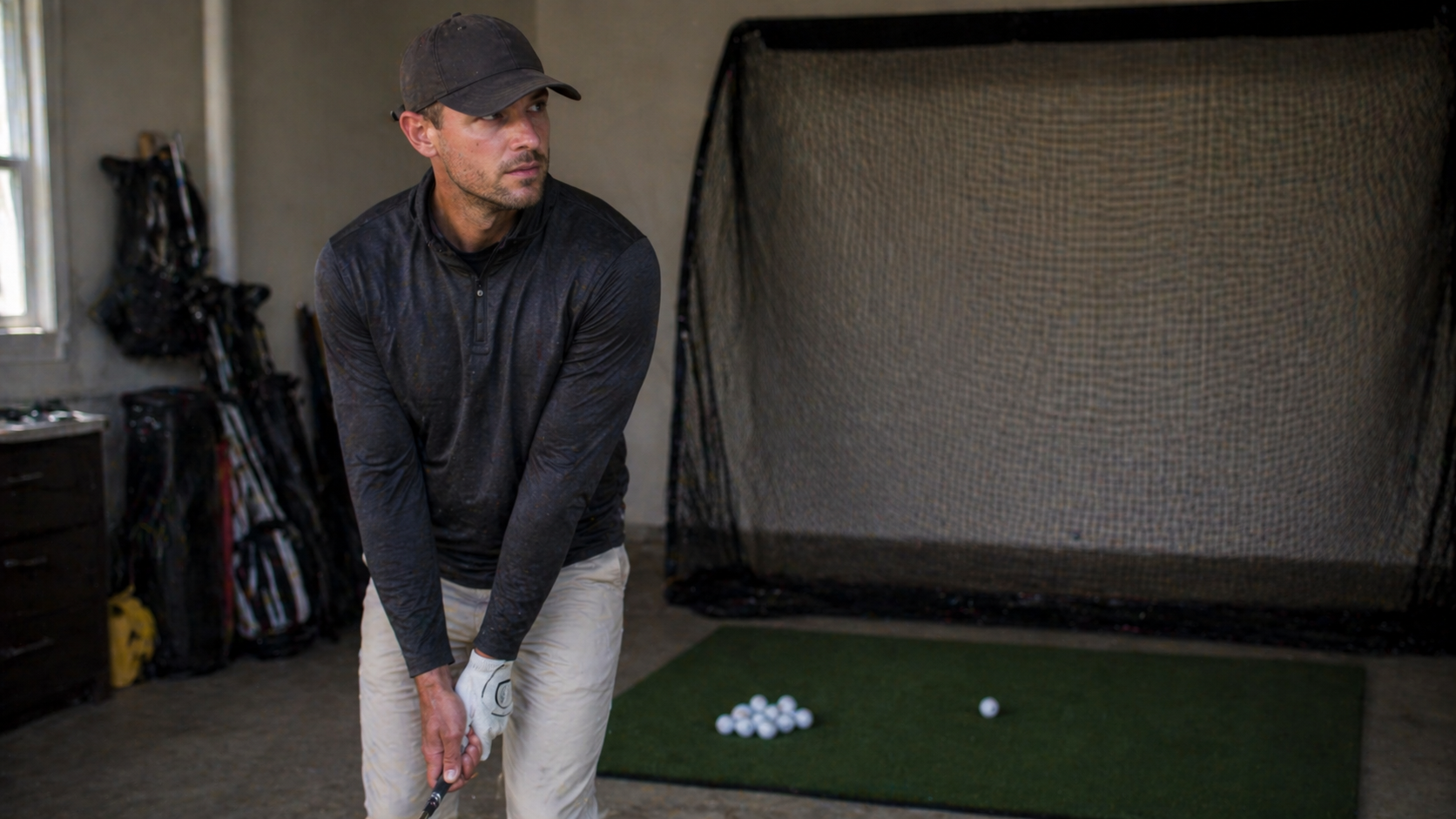
This is an important distinction.
I am not telling you to walk up to the ball with an empty head and hope your body figures it out.
That is not Blackout Mode. And it is not good golf.
You still prepare. You get the number, read the lie and choose the club. Then you pick the landing spot, see the trajectory, make your pre-shot routine, and feel the pace.
All of that can happen before you hit the shot.
The difference is what you carry with you once you step in.
A useful pre-shot routine might give you one simple feeling:
This is the pace.
Or:
This is the flight.
Good.
Now pull the trigger.
The trouble starts when the pre-shot routine becomes five commands. Now you have turned preparation into supervision.
That is a hard way to move a golf club.
A rehearsal should help organize the shot. It should not create another list of instructions you have to remember during it. There is a point where the preparation needs to end.
Decision made and picture clear.
Now go.
That transition is a big part of learning to trust a motion you already own.
Give Attention a Better Job
Trying to “stop thinking” usually does not work very well. Tell yourself not to think about your takeaway and guess what shows up?
The takeaway.
So instead of asking your mind to do nothing, give it a better job.
Put it on the shot.
For a wedge, that might be:
- The landing spot.
- The intended trajectory.
- The pace of the motion.
- The finish distance.
For a putt:
- The start line.
- The pace.
- The picture of the ball rolling to the hole.
You do not need all four.
Pick one.
The point is to move attention away from body-part inspection and toward what you are trying to make the ball do.
That is a much cleaner job for the mind.
If I have a wedge over a bunker, I would rather be absorbed in where that ball needs to land than trying to feel whether my hands are in the correct position halfway back.
I already did the mechanical work.
Now I need to hit the shot. I know… that sounds almost too simple.
But simple is exactly what many seasoned players are missing.
We keep adding information when the better answer is often narrowing attention.
One target.
One intention.
Then pull the trigger.
Recognize the Moment You Go Back to Mechanics
The mechanical thoughts usually do not appear randomly.
Something triggers them.
Start noticing when it happens.
Maybe you get a bad lie. Maybe there is trouble short. Maybe you have been waiting five minutes in the fairway. Maybe you just missed the green with the same club. Maybe you are between distances. Maybe somebody in your group just stuffed one close.
Maybe you suddenly realize, This shot matters.
That is often when the mind goes looking for control.
It says:
We better make sure the swing is right.
And there you go.
Back into the workshop.
I call that the moment you try to rebuild the swing right before you need to use it. There is rarely enough time to do anything productive with that information. You just add tension.
This is why simply telling yourself “don’t think” is not enough.
You have to recognize the trigger.
The doubt.
The trouble.
The waiting.
The consequence.
The bad shot before it.
Once you can see the moment where you normally retreat into mechanics, you have a chance to choose something different.
Not a blank mind, but a clearer job.
See the target.
Feel the shot.
Commit.
Try the Three-Shot Thought Audit
You can get a useful look at this without turning it into a complicated mental-game exercise.
All you need is three shots. Use a wedge distance you already know or a straight putt with a clear target.
This is not a test of whether you can hit three perfect shots. It is a test of what happens to your attention.
Step 1: Choose one target intention
Before the first shot, name one thing.
For example:
Land it on the front edge of that target.
Or:
Roll this through the center of the gate.
That is your job.
Nothing mechanical.
Step 2: Hit the shot
Go through your normal pre-shot or pre-putt routine.
Then execute without adding a body-part instruction.
Do not try to manufacture a quiet mind.
If a mechanical thought shows up, let it show up.
We are trying to notice it.
Step 3: Mark what entered
Right after the shot, make a quick note.
Did you stay with the target intention?
Or did another instruction thought enter?
Whatever it was, write it down.
No judgment.
Step 4: Identify the trigger
Ask yourself what caused the urge to control the motion.
Was it:
- Trouble?
- Doubt?
- Concern about contact?
- Waiting too long?
- The result of the previous shot?
Again, keep it simple.
Step 5: Repeat for three attempts
Score one point each time you complete the shot with one clear target intention and do not add a mechanical command.
Maximum score: 3 points.
A score of 0 does not mean your swing is broken.
It means you just learned something about where your attention goes.
That is useful.
Journal prompt
Which situation made me feel I had to supervise a motion I already know?
That question is worth sitting with.
Because once you know what pulls you back into mechanical control, you can start training the moment where trust normally disappears.
Do Not Turn This Into Another Rule
There is an easy mistake to make here.
You read an article about swing thoughts and decide:
“Okay. No swing thoughts ever again.”
That is not the point.
Sometimes a simple swing cue is useful.
Sometimes you are working through a change.
Sometimes a coach gives you one thought that helps organize a motion.
Fine.
Use it.
The issue is not whether a swing thought is universally good or bad.
The issue is whether you are trying to consciously manage several pieces of a well-learned motion while performing a scoring shot.
Those are different situations.
Train mechanics when mechanics need training. Make corrections when corrections need to be made. But eventually you have to give the motion a chance to run without constant supervision.
Otherwise, you never find out whether you actually trust what you trained.
What Blackout Mode Really Means Here
Blackout Mode does not mean blacking out your mind.
You are still aware and you still make decisions. You still respond to the situation. What begins to disappear is the need to consciously control every mechanical piece of the motion.
The work was done beforehand. Now your attention can stay with the task.
That distinction matters.
Because golf is not played with an empty mind. It is played with attention in the right place. For a scoring shot, that place is usually much closer to the target, the distance, the flight, and the feel than it is to your right elbow.
Prepare the motion in training.
When it is time to play, organize your attention around the shot.
Final Thought
There is nothing wrong with knowing your golf swing.
You should know it.
You should understand what you are working on and why. But knowledge has a time. The middle of a pressure wedge shot is usually not it. That 75-yard shot over water does not need every lesson you have ever taken.
It needs a number, a picture, and a landing spot. And a decision you are willing to trust.
Do the mechanical work before you need it. Then, when the shot matters, stop trying to supervise a motion you already know how to make.
Give your attention to the shot.
And let the training do its job.
Frequently Asked Questions
Why do swing thoughts increase under pressure?
Pressure creates uncertainty and consequence. When a shot feels important, experienced golfers often respond by trying to gain more control. That can pull attention away from the target and back toward grip, takeaway, turn, tempo, or other mechanical pieces of a motion that normally runs with much less conscious supervision.
Should I never use a swing thought?
No. A simple cue can be useful during training or while making a specific correction. The trouble usually comes when several mechanical instructions are carried into a scoring shot. Work on mechanics when you are training mechanics. When it is time to perform, simplify.
What should I think about instead?
Give your attention one job that relates directly to the shot. That might be the landing spot, start line, trajectory, pace, or finish distance. You are not trying to think about nothing. You are trying to keep attention on what you want the ball to do.
Can overthinking affect putting too?
Absolutely. Putting is especially easy to supervise because the motion is small and feels controllable. Golfers start monitoring the face, path, hands, stroke length, and follow-through. Just like a wedge swing, too much live mechanical control can interfere with pace and commitment.
Train Trust When the Shot Matters
You do not need another swing thought every time pressure shows up.
You need practice that teaches you when to prepare, when to decide, and when to let the motion happen.
Join The Blackout Journal for free weekly guidance on training trust, wedge distance control, putting feel, and playing scoring shots with less mechanical thought.