
Blocked practice usually looks better.
Hit twenty wedges from 50 yards and, somewhere along the way, you will probably start getting pretty good at hitting a 50-yard wedge. Now try six balls at 43, 67, 54, 78, 48, and 61 yards, might be a different story. The contact may not look as clean. Your dispersion probably gets wider. You may stand over a couple of shots feeling like you have no rhythm at all.
That second session can feel worse even when it is asking you to do something much closer to what golf actually requires. I spent a lot of years judging practice by how good I looked while I was doing it. If I could hit several solid wedges in a row, I figured I was making progress. The tighter the pattern got, the more confident I became.
Then I would get on the course and have 63 yards from a slightly different lie with one ball and no chance to groove anything. That is when you find out what kind of practice you actually did.
This is where the conversation about blocked vs random golf practice matters. Both blocked practice and random practice has value. The mistake is treating one as good and the other as bad because they do different jobs.
Blocked practice can help you build an answer. Random practice asks whether you can find that answer again when the problem changes.
And if your goal is distance control that holds up on the golf course, eventually you need both.
What Blocked Practice Gives You
Blocked practice simply means repeating the same task before moving on to something different. Same club, same distance, and same target. If you hit fifteen wedges from 60 yards before changing anything, you are doing blocked practice. I am not saying you are doing anything wrong. In fact, there are times when it is exactly what you should be doing.
If you are trying to understand a new motion, establish cleaner contact, learn a stock wedge swing, or confirm a baseline distance, repetition gives you a stable environment. You take some of the variables away and let yourself feel what is happening.
That matters.
Let us say you are trying to establish a stock 70-yard wedge. Hitting one ball from 70, then one from 45, then one from 85, then changing clubs and lies may make the job harder than it needs to be. You do not always need more difficulty. Sometimes you need enough repetition to understand the task.
A short block lets you make a swing, see the result, adjust, and try again. After several balls, the relationship between the motion and the distance begins to become clearer.
That is useful work.
The trouble comes when the block starts looking so good that we mistake it for proof. After ten or fifteen balls, you have already solved the same problem several times. You know the club, you know the target, you know roughly how much motion you need. The previous ball is helping with the next one and that is one reason blocked practice can feel so good. You are getting another shot at a problem you just solved.
The golf course usually does not work that way.
Why Random Practice Feels Worse
Random practice changes the problem more often.
You hit 43 yards. Now 67. Then 54. Then 78.
Every time the distance changes, the old answer is no longer quite right. You have to look again, choose again, feel again, and commit again. That extra work is why random practice often looks worse while you are doing it. You never get the comfortable run of six or seven balls where everything begins falling into place. Just when you feel like you found the 50-yard shot, the next ball asks for 70. Then 45. Then 62.
You keep getting knocked out of rhythm.
That can be frustrating for a seasoned range grinder because we are used to seeing improvement as the session goes along. We want the pattern to tighten. We want the strike to clean up. We want that feeling that we finally have it. Random practice can take that feeling away.
But that is partly the point.
Changing the task forces you to retrieve an answer instead of simply repeating the answer you just used. You have to recalibrate, and that is a little uncomfortable.
It also looks a lot more like golf.
On the course, your last wedge may have been 82 yards from the rough. Your next one might be 47 yards from a tight lie. Later, you get 64 yards over a bunker. Nobody hands you five balls from each spot so you can settle in.
You get one.
That is why a practice session can look less impressive and still be doing something valuable.
A Worse Session Can Produce Better Evidence
This took me a while to understand. A bad-looking session does not automatically mean you practiced badly. Sometimes it means you finally made the practice honest enough to expose what you do not know yet.
That is useful.
If I hit fifteen balls from the same yardage and the final ten are solid, I have learned something. I know I can produce that shot once I have settled into it. But I still do not know what happens when I have to call it up cold. Change the target, wait a minute then give me one ball.
Now we are getting better information.
Maybe I struggle to choose the motion and maybe my first attempt is consistently short. Or maybe my contact gets worse as soon as I am unsure of the distance. Maybe I rush the routine when I do not immediately recognize the shot.
Those are things a smooth block can hide.
This is why I would be careful about grading your practice based on how grooved it felt in the middle of the session. I know, grooved feels good, but retrievable matters more.
One of the better questions you can ask is not, How many good shots did I hit?
Ask:
How well could I produce the shot when I did not get a correction ball first?
That shifts what you pay attention to because you start scoring first attempts. You notice how quickly you adjust when the distance changes. You begin caring about whether the skill comes back tomorrow instead of whether balls fourteen through eighteen looked pretty today.
That is the same reason I recommend learning how to practice distance control without repetition rather than using repeated shots as your only measure of readiness.
The point is not to make practice ugly for the sake of making it ugly.
The point is to get better evidence.
Random Is Not Automatically Better
This is where I would not go too far with the idea. Once seasoned players hear that random practice can help transfer to game day, the temptation is to randomize everything.
Different distance. Different club. Different lie. Different trajectory. Different target.
Maybe add a little pressure while we are at it. Now every ball is a brand-new circus. That is not automatically better training. If a player cannot produce reasonable contact with a 50-yard wedge yet, making every shot a different club, lie, trajectory, and distance may just create noise.
There is not much value in practicing confusion.
Build some stability first. If you are learning a new stock motion, give yourself enough repetitions to understand it. If you are recalibrating wedge distances, establish the baseline, then start changing one meaningful thing.
Distance is a good place to begin.
Instead of hitting twenty balls from 60 yards, you might rotate between 50 and 70. Once that becomes manageable, add 60. Later, mix the order so you do not know which distance comes next. You are earning the difficulty instead of manufacturing it.
That is a much better progression.
Random practice should challenge your ability to solve the shot.
It should not make the task meaningless.
Use a Simple Progression
I like to think about this in four stages.
Establish. Alternate. Randomize. Test.
You do not need to make it more complicated than that.
Establish the answer
Start with enough stable repetition to understand the shot. Maybe you hit a small block from 50 yards. You are learning the flight, contact, pace, and feel.
Fine. Get your bearings.
Alternate the answer
Now introduce one other distance.
Hit 50. Then 70. Back to 50. Back to 70.
You are still working with a small number of problems, but you no longer get to repeat the same answer every ball. You have to switch.
Randomize the answer
Once you can move between those comfortably, add another distance and mix the order. Now it might be 70, 50, 60, 70, 60, 50.
The physical motion is still familiar.
The challenge is finding the right version of it for the current shot.
Test the answer
Finally, score one ball.
Use the full pre-shot routine. Just one attempt with no immediate correction ball. That is where you begin seeing whether the work is available when you actually need it.
Blocked work helped establish the shot. Variation made you retrieve and recalibrate it. The test tells you whether it held together. You do not need to spend an entire practice session in the final stage.
A small dose is enough to begin.
The Six-Ball Mixed-Distance Preview
Here is a simple way to feel the difference at the end of your next practice session. You can use your wedges or putter.
For wedges, choose three distances separated by at least 10 yards. For example: 45 yards, 60 yards, and 75 yards.
For putting, choose three clearly different distances.
You will hit only six balls.
Two attempts at each distance.
The important part is that you will not hit the two balls from the same distance together.
Set up the targets
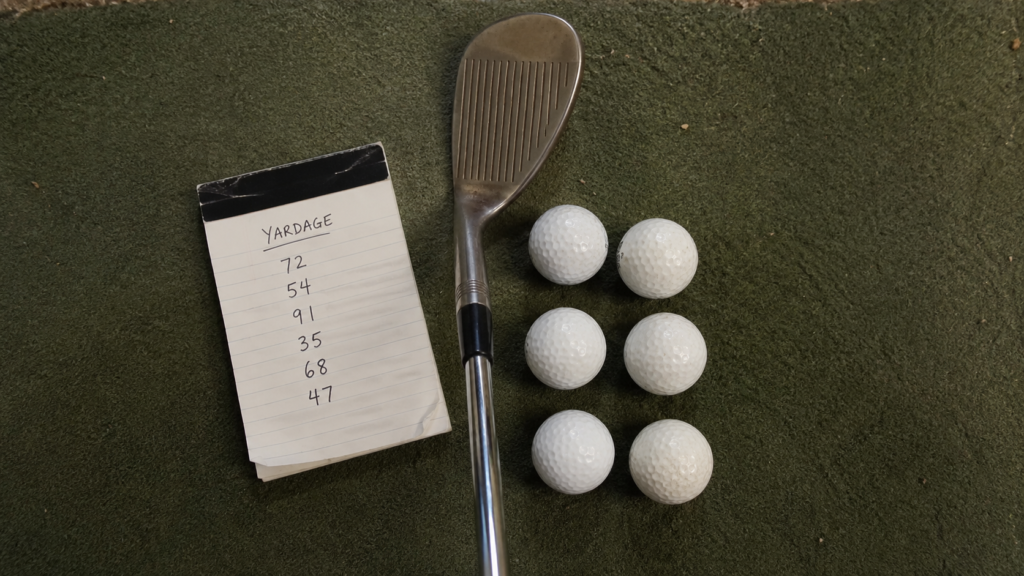
Before you begin, write down a six-shot order.
For example:
60
45
75
60
75
45
Use whatever order you want, but mix the distances. Then turn the list face down so you can not see it.
Reveal only the first distance.
Hit one ball
Go through your full routine. Get the carry number, see the target, make your rehearsal, and commit.
Hit one ball.
That ball counts. No mulligans, do not hit another from the same distance to straighten things out.
Score the result
Give yourself:
- 2 points if the ball finishes inside your primary target zone.
- 1 point if it misses the primary zone but finishes inside a larger safety zone.
- 0 points if it finishes outside both.
Record the score before looking at the next distance. Then reveal the next target and repeat the process.
Six balls. Maximum score: 12 points.
That is enough.
What to notice
Do not get too hung up on the total score the first time you try this. Pay attention to what happens when the distance changes.
How quickly can you find the next answer?
Does the new distance feel clear?
Do you make a committed rehearsal?
Do you immediately want a second ball after a poor result?
Do your misses come from contact, pace, or indecision?
That last question matters.
Journal prompt
Did the changing task expose a decision problem, a pace problem, or a contact problem?
Those are different problems. If you keep hitting the same shot until everything looks good, they can be hard to separate. Mixed practice has a way of bringing them out into the open.
That is why I like it.
Do Not Randomize Everything at Once
There is a difference between useful variation and chaos. Keep the basic task understandable.
If you are changing distance, you do not also need to change club, lie, trajectory, target shape, routine, and stance on every ball. Change one meaningful demand and see how you handle it. When that becomes comfortable, add another layer later.
This is especially important if you have spent years doing mostly blocked practice.
You do not need to turn tomorrow’s range session upside down. Start with a small scored section at the end, ten or fifteen minutes is plenty.
Do your normal work. Establish what you are trying to establish. Then finish by making yourself retrieve it. That small change can tell you a lot about whether the session actually built something you can carry with you.
Which Practice Transfers Better?
So, blocked or random?
That is probably the wrong way to frame it. Blocked practice is useful when you need to establish, understand, or recalibrate an answer. Random practice becomes useful when you need to retrieve, adjust, and commit to that answer as the situation changes, like it does on the golf course.
One is not automatically better. The question is what you are trying to train. If you are learning something new and cannot yet produce a basic solution, give yourself some stability. If you already know the motion but it disappears whenever the yardage changes, more repetition may not be what you need.
Make the task move and ask yourself to solve it again.
Then score the first attempt. That is where practice begins looking less like a range demonstration and more like preparation for golf. And yes, it may look worse, that is okay.
Golf does not grade you on how pretty your practice session was.
It asks whether you can find the shot when you have one ball.
Train for that.
Frequently Asked Questions
What is blocked practice in golf?
Blocked practice means repeating the same shot or task several times before changing the conditions. Hitting fifteen wedges from the same yardage or ten putts from the same spot are simple examples. It can be useful for establishing a motion, understanding a task, or confirming a baseline.
What is random practice in golf?
Random practice changes the problem frequently so the golfer has to find a new answer. That may mean changing distance, target, club, lie, or another part of the task. For distance-control training, simply changing the distance from one ball to the next is enough to begin.
Should beginners use random practice?
Yes, but not before they understand the basic task. A golfer who cannot yet produce reasonable contact or a repeatable basic motion may benefit from more stability first. Once the golfer has an answer to work with, modest variation can be introduced progressively.
How much random practice should I do?
You do not need to replace the entire practice session. Start with a short, scored segment at the end of your normal work. Six balls at mixed distances is enough to begin seeing how well you retrieve and recalibrate when the task changes.
Train Differently
Do not throw away repetition, use it for what it is good at. Build the answer, learn the feel, establish the baseline. Then stop feeding yourself the same problem. Change the distance. Use your routine. Give yourself one ball and see whether you can find the answer again.
The session might not look quite as good but it might be doing you more good.
Scott | Distance Control Coach
Train Trust. Not Swing Thoughts.
Join The Blackout Journal Free for weekly Training Notes on practice that holds up beyond the range—calm, practical work for seasoned golfers who want distance control they can actually take to the course.