
Most seasoned players who are trying to stop overthinking the golf swing or putting stroke eventually run into the same problem. They finally get rid of the thought, then have no idea what to do once standing over the ball. You tell yourself not to think about the technical stuff which is a good thing, but now what?
I have been there, more times than I care to admit. I would notice it most when standing over a medium birdie putt that has some speed to it. It is a putt I should make but wanted to make sure my leave was close to the hole if I missed. Nothing worse than walking away with bogie when you have a makeable birdie putt.
So I would step in to the putt trying not to think about the pace of my stroke or whatever mechanical thought I had been carrying around that week. But trying not to think about something usually made me think about it even more. It seems all I accomplished was just another argument going on in my head.
What finally made more sense was giving my attention somewhere useful to go. Instead of thinking, slow the pace of my stroke down, I could see a target spot on the edge of the hole. Instead of trying to control the length of a putting stroke, I could picture the pace of the ball and where I wanted it to finish. Same player, with the same putting stroke, but had a completely different job for my mind.
That is an important piece of Blackout Mode Training. The goal is not to empty your head and focus on thinking about nothing, that takes too much effort. The goal is to stop supervising a stroke or a swing that you have already trained, then put your attention back on the shot you are trying to hit.
So if you are wondering where to focus during a golf shot, start here:
What do you want the ball to do?
That question will usually take you somewhere more useful than another inspection of your body.
Your Mind Needs a Destination
One of the problems with telling a seasoned player to stop thinking is that attention does not work very well without a job. Your mind is going to go somewhere so if you do not give it a useful assignment, it has a habit of returning to the familiar stuff.
Like these:
- Grip.
- Takeaway.
- Shoulders.
- Hands.
- Tempo.
- Weight.
Whatever swing thought has been living rent-free in there lately. That is why simply removing a mechanical thought is often not enough. You need to replace its job. And I am not talking about another technical command.
You could be looking at a 60-yard wedge and thinking about whether your backswing is long enough. Or you could see the exact patch of green where you want the ball to land. You could stand over a 20-foot putt thinking about how far the putter needs to travel. Or you could picture the ball rolling at a pace that would finish a foot beyond the hole if it missed.
Those are different ways of organizing the same shot. One keeps pulling you back inside the motion. The other gives the motion something to accomplish. For seasoned players, this matters because most of us do not need more information while we are standing over the ball. We already have plenty. What we need is a cleaner place to put our attention.
That is part of how to train trust instead of swing thoughts. You do the mechanical work when you are training. When it is time to hit the shot, you begin handing responsibility back to the motion you trained.
Internal Focus and External Focus in Golf Language
There is research language for this. You will hear people talk about internal focus and external focus. I would not get too hung up on the terminology to accomplish implicit memory. In golf language, the difference is pretty simple. An internal focus puts your attention on your body or the mechanics of the motion.
I would refer that to all thoughts located above the ball:
Keep the shoulders turning.
- Keep the shoulders turning.
- Quiet the hands.
- Hold the finish.
- Keep your head still.
An external focus puts your attention on what the movement is supposed to produce:
- Land the ball on that spot.
- Start the putt over that mark.
- Roll it with enough pace to finish inside that circle.
- Carry the wedge onto the front half of the green.
The swing still happens, obviously. Your shoulders and your hands still move. The club still travels through space. You just are not trying to consciously run every part of it while it happens.
That distinction is easy to overlook because mechanical thoughts can feel responsible. They make us feel like we are doing something. Believe me, I know the feeling.
If I have a difficult wedge shot, thinking about my technique can make me feel as though I have more control over the outcome. But feeling more involved is not always the same as being more effective.
There comes a point where you have prepared enough. You know the distance, you picked the club and you saw the shot. You have made your pre-shot routine many times over.
Now the ball needs to go somewhere and that is where your attention belongs.
Choose the Cue That Matches the Shot
This is where seasoned players can make another mistake. We discover a useful idea and immediately turn it into a rule. “External focus works. Okay, I need one external cue and I am going to use it on every shot forever.”
I would not do that. Golf does not give you the same problem every time. A wedge shot may be mostly about carry distance. Or another may be about trajectory. A long putt may be almost entirely about pace while a short breaking putt might need a very clear starting line.
The cue should match the job. If I am hitting a 50-yard wedge over a bunker, the landing point may organize the shot beautifully. I can see the spot, perform the pre-shot routine, and let the shot respond to that picture.
If I am putting from 40 feet, staring at a tiny mark six inches in front of the ball may not help my distance control much. I may be better served by seeing the whole roll, focusing on a finishing zone or mark around the hole.
For a lower wedge, trajectory may be the strongest picture. It is different for everyone, for another player, pace may be what unlocks the shot.
There is no prize for using the “correct” cue. The useful cue is the one that makes the task clearer and that is the part worth remembering. You are not trying to replace six mechanical thoughts with six target thoughts. You are trying to simplify the shot and one clear intention is usually enough.
External Does Not Mean Vague
Some seasoned players hear “focus on the target” and think it sounds a little soft. I understand that if you have spent years measuring yardages, studying technique, and working hard on your game. “Just focus on the target” can sound like something somebody says when they do not have a better answer.
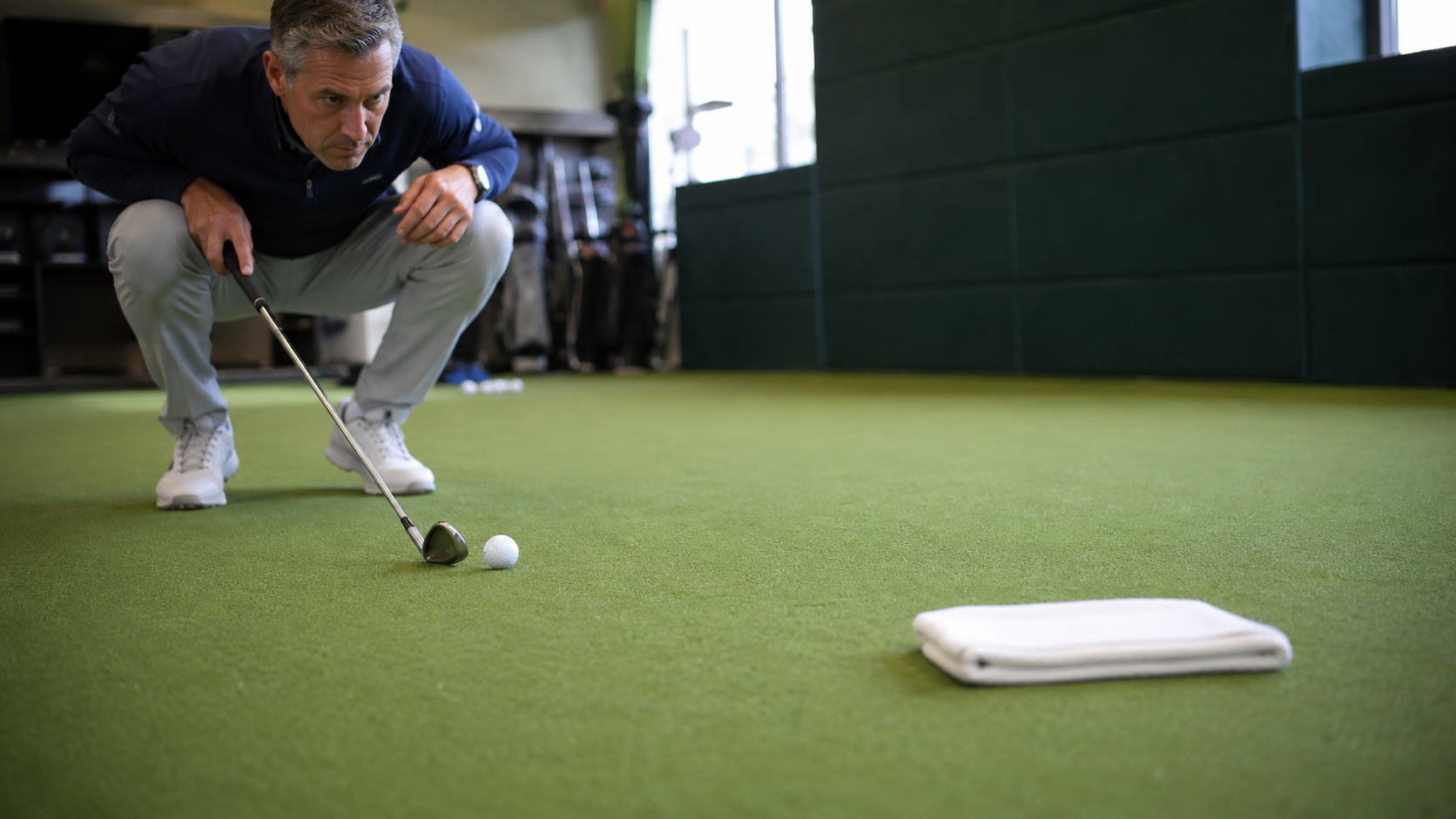
But focusing your attention out-in-front, does not need to be vague at all. In fact, it can be very precise. There is a big difference between telling yourself to hit a good wedge” and “land this on the front edge of that towel. There is a big difference between telling yourself to get this putt close and roll it with enough pace to finish inside that three-foot circle behind the hole.
The first one is hope and the second is a job. That is why I like landing spots and finish zones for distance-control training. They give the seasoned player something clear enough to measure without dragging attention back into mechanics. You can miss the landing spot and still learn from it. Or you can finish outside the three-foot circle and make an adjustment.
The feedback is sitting right there in front of you. You do not have to immediately decide that your swing was wrong or your stroke is messed up. That is a big change for a range grinder. We have spent years looking at a poor result and asking, what is wrong with my motion. Sometimes the better question is simply, Did the ball do what I intended?
If not, adjust the shot.
That is golf.
Train the Handoff
There is still room for feel, this is not a choice between feeling the motion and seeing the target. The two can work together if you give each one its proper place. I might make a couple slow practice swings from behind the ball and envision the shot landing on my target. It is possible to feel the pace of a 60-yard wedge shot, a 30-yard speed putt, or a chip and run across the green.
That kind of rehearsal can be useful. I am preparing the motion, then I look at the landing spot (target), step into the ball, and let that become the job.
That is the handoff:
- Feel during preparation.
- Intention during execution.
You do not have to make it that clean every single time, but it is a good place to start. The mistake is carrying the rehearsal into the shot as another set of instructions.
You make a practice swing and think, That felt right. Then you step over the ball and start trying to reproduce every piece of what you just felt. Now you are back to managing your swing. So, use the rehearsal to prepare and use that final look at the target to remind yourself what the shot is for.
Then pull the trigger.
Over time, that handoff can become part of your pre-shot or pre-putt routine. You prepare the motion, you see the shot, and then you play. You won’t play perfectly or without thoughts ever showing up. Golf does not work that neatly most of the time.
But your approach to hitting a golf ball will be cleaner. And for a golfer who has spent years trying to control every scoring shot, cleaner is a pretty good place to start.
Try the Three-Ball Attention Comparison
You can test this without changing your swing or spending an hour on the range.
Use one familiar wedge shot somewhere between 40 and 70 yards. If you would rather work on putting, use a putt of about 20 feet with a visible finish zone.
Hit only three balls.
The point is not to prove that one type of focus is always better. You are trying to notice how different attentional jobs change the way you organize the shot.
Ball 1: Use a body thought
Pick one mechanical thought you commonly carry into the shot. Maybe it is the position of the backswing or maybe the finish position. It could simply be to quiet the hands. But use the thought you actually use, do not invent one just for the drill.
Then hit the shot.
Then rate three things from 1 to 3:
- Clarity: How clear was the job?
- Freedom: How free did the motion feel?
- Result: How well did the ball finish relative to the intended target?
Do not overthink the ratings. Mark them and move on.
Ball 2: Use a club-motion thought
Now use an intentional thought that moves attention away from a body part and more toward the club’s action.
For a wedge, it might be brush the grass through the shot.
For a putt, it might be stroke the putter toward that spot.
Hit the ball and rate the same three things from 1 to 3.
- Clarity.
- Freedom.
- Result.
Ball 3: Use a ball-effect thought
Now give yourself a job based entirely on what you want the ball to do.
For the wedge, it might be land it on the front edge of the towel.
For the putt, it might be roll it into the finish zone behind the hole.
Hit the third ball.
Rate clarity, freedom, and result again.
Then compare the three results. The important part is not to automatically choose the cue that produced the best single shot. One lucky strike proves very little.
Start with clarity:
- Which cue made the shot easiest to organize?
- Which one helped you make a decision and go?
- Which one gave the motion room to happen without you trying to babysit it?
That is what you are looking for.
Journal prompt
Where was my attention on the attempt that felt most committed? Write down the answer while it is still fresh. You may find that the best cue is different from what you expected and that is a good thing. That is why we test things instead of simply collecting more advice.
Do Not Turn Attention Into Another Swing Thought
There is one more trap worth avoiding. You can overthink external focus too. I have seen seasoned players become so determined to “focus correctly” that they turn a simple landing spot into another technical chore.
Now they are standing over the ball asking questions:
- Am I external enough?
- Should I see the landing point or the trajectory?
- Am I supposed to think about pace?
We are right back where we started, this is not the point.
The thought or cue is there to simplify the task not add to your swing thought list. If it makes the shot more complicated, throw it out. I want to be clear, it is different for everyone, even tour pros. Some days a landing spot will be strong and building your image of your target will be clear. Some days you may feel the pace of the motion and barely think about anything else. Sometimes the picture of the entire shot is enough to produce a great shot.
The golfer matters.
The shot matters.
The situation matters.
Blackout Mode Training is not about replacing one rigid command with another one. It is about training well enough that, when it is time to perform, your attention can settle on the job instead of crawling back through the mechanics.
Before the Shot, Ask One Question
If all of this starts sounding complicated, come back to one question:
- What do I want the ball to do?
- Not what do I want my shoulders to do.
- Not what do I want my hands to do.
- Not where should the club be halfway back.
What do I want the ball to do?
- Land here.
- Start there.
- Fly under that branch.
- Roll at this pace.
- Finish inside that zone.
That is a golf shot.
You may still use mechanics in training. You may still make a rehearsal and feel something useful. You may still need a lesson from time to time because none of that goes away. But when you step into a scoring shot, give your attention somewhere better to go.
So, aim the mind at the shot and then let the motion do what you trained it to do.
Frequently Asked Questions
What is an external focus in golf?
An external focus means putting your attention on the effect the movement is intended to create rather than on the movement of your body itself. In golf, that could mean ball flight, landing point, pace, starting line, trajectory, or finish distance. It does not mean ignoring technique forever. It means putting attention on the task when it is time to perform.
Is looking at the target enough?
Not always. Looking at a target can help, but a useful intention is usually more specific than simply seeing the flag. A wedge golfer might identify a precise landing point. A putter might picture the pace and finish zone. The question is not only where you are looking, but what you intend the ball to do.
Can I use a feel cue and an external focus together?
Yes. A useful starting point is to use feel during the rehearsal and one task intention during execution. You might rehearse the pace of a wedge swing, then shift your attention to the landing spot as you step into the ball. Try not to stack several feel and target commands together.
Which focus is best for putting distance control?
There is no single cue that works for every golfer or every putt. Pace and finish zone are useful places to start for distance control because they keep attention on how the ball should roll and where it should finish. Test what gives you the clearest intention rather than forcing one cue onto every putt.
Train Differently
You have probably spent enough time learning where your hands, shoulders, clubface, and putter should be. Keep that knowledge and train with it when you need it. But when the shot is in front of you, give your attention back to golf.
See the landing spot. Feel the pace. Picture the finish.
Then trust the motion you brought with you.
Scott | Distance Control Coach
Train Trust. Not Swing Thoughts.
Join The Blackout Journal Free for weekly Training Notes on aiming attention at the shot instead of the body—calm, practical work for seasoned golfers who want their practice to hold up when the shot matters.