
The flag is where the shot finishes but distance control starts earlier than that. It starts with where you expect the ball to land. I know, that sounds simple, but watch what happens at the back of a range. A seasoned player gets 50 or 60 yards to a flag and starts firing balls straight at it. One comes in high and stops. Another lands short and releases. Another carries almost flag-high and runs through.
Different shots. Different landing points. Different results.
But the target never really changed. It was always just the flag. Here is where I used to get myself in trouble. I would know the number, look at the flag, then start figuring out the motion. How long does this swing need to be? How much speed? Where should the hands finish? I was trying to create distance with the swing instead of giving the swing a clear job.
A landing spot changed that for me.
Now the question gets simpler.
Where does this ball need to hit the ground?
Once that picture is clear, the rest of the shot has something to organize around. You still have to choose the right club. You still have to account for trajectory, firmness, lie, slope and release. None of that disappears. But now you’re solving a golf shot instead of supervising a wedge swing.
That is the Blackout idea I want you to work with here. Pick the landing spot first. Then build the rest of the shot around it.
Separate Carry From Finish
If I give you a flag at 60 yards, that doesn’t automatically mean I want the ball to carry 60.
You already know that.
But we don’t always practice like we know it. Maybe the green is soft and you’re hitting a higher wedge. The ball can land close to the number. Maybe the surface is firm and the shot is coming in lower. Now the landing spot moves back.
Same hole. Different carry. Different release.
That is the picture I want before the swing starts. When I’m working on wedge distance control, I like separating the shot into two simple parts:
Where will it land?
And:
What happens after it lands?
Not because I want you standing there doing geometry over every wedge. Quite the opposite. I want the picture clear enough that you can stop thinking about the swing. If the ball needs to finish near a flag 55 yards away and you expect eight yards of release, your job is not really “hit it 55.” Your job might be to carry it around 47 and let the shot finish the rest.
Now we have something useful.
A landing spot. A release picture. A shot.
That is much cleaner than staring at the flag and trying to manufacture the correct swing length.
Why the Landing Spot Organizes Attention
What I like about a landing spot is that it gives the mind a specific job. “Hit a good wedge” isn’t much of a job.
“Don’t get quick” isn’t a target. “Take it back to nine o’clock” may describe a motion you’ve trained, but it still leaves the question of what the ball is supposed to do.
Now compare that with:
Land it on that patch.
You know what you’re asking for. You can see it. And after the shot, you can tell whether you did it.
That is useful feedback.
Give your mind the target.
For wedge distance control, the landing spot is one of the cleanest targets we’ve got.
If you want the broader Blackout foundation behind this, it fits directly with how feel-based wedge training develops distance control. You train the motion, learn what your shots produce, and then start giving that trained motion a real golf problem to solve.
That’s where feel becomes useful. Not feel for the sake of feel. Feel attached to a result.
Choose a Large First Target
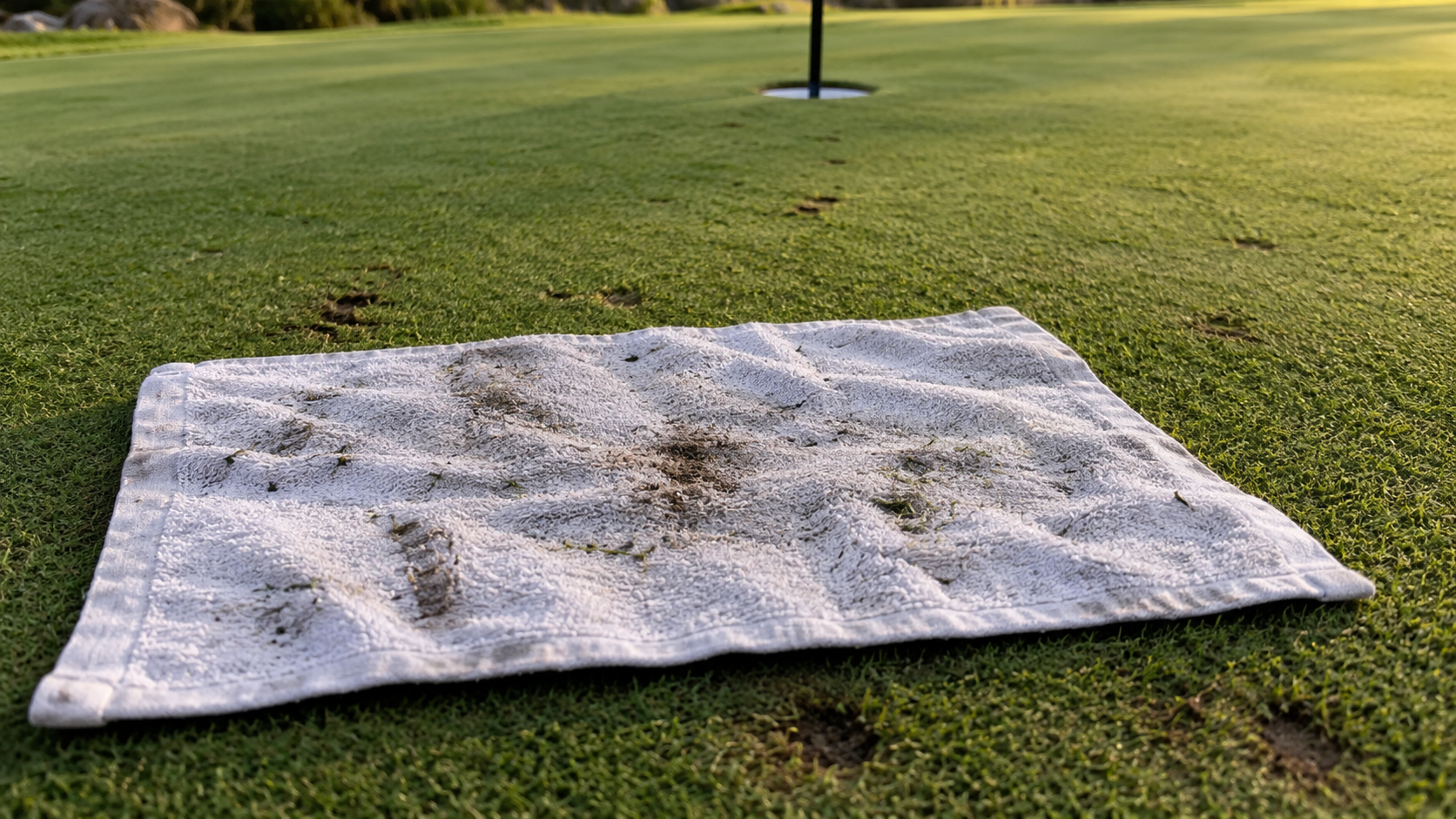
Don’t start by trying to land wedges on a dinner plate. Give yourself somewhere you can actually train. If I were standing beside you, I’d probably throw a towel out there or give you a visible patch of grass several feet across.
Large enough that you can see a pattern. Small enough that the shot has a job. Maybe six feet across to start, that is plenty. We’re not trying to prove you can hit one perfect wedge. We’re trying to learn whether your carry picture and your actual carry are beginning to match.
Those are different things.
Say the towel is 25 yards away:
- Hit three balls trying to land in that area.
- Maybe the first lands short-left.
- The second flies over.
- The third lands right in the middle.
- Don’t celebrate the third one and forget the first two.
- Look at the pattern.
- Were your carries scattered?
- Were they all long?
- Did you know before each ball what you were trying to do?
- Did the strike change because you suddenly started steering the club toward a tiny target?
That is the information I want.
The target should reveal the pattern. It shouldn’t scare you into manipulating the swing. Start broad and when your carry pattern becomes more dependable, you can make the job tighter.
Earn the smaller target.
Change Trajectory Without Adding a Checklist
Once you understand the landing picture, this gets interesting. Take the same finish area and imagine two different ways to get there. Maybe one shot flies higher and lands farther toward the flag with less release. Another comes in lower, lands earlier and runs.
Same general finish but different landing spots. Now here is where I don’t want you turning this into another technical lesson.
You know your game. Choose the club and setup you already use for the shot. Picture the trajectory. Know where that version needs to land.
Then let the shot tell you something.
You are building your wedge game, not mine. One golfer may prefer seeing a lower flight. Another sees the softer shot more clearly. One may use a different wedge. Another changes the setup slightly with the same club.
Fine.
The training principle stays the same. Change the shot picture without crowding the motion with instructions. If you want the ball lower, see the lower flight and the earlier landing spot. If you want it higher, see the different flight and where it now needs to come down.
Then pull the trigger.
We can work on mechanics when mechanics actually need work.
Right now we’re training distance control.
Judge the Complete Result
There is one trap with landing-spot practice. A seasoned players starts getting so focused on hitting the towel that he forgets why the towel is there.
The landing spot is not the final goal, the complete shot is. You can hit the landing area perfectly and still finish fifteen feet long because you misread the release. You can also miss the landing spot badly and have the ball kick or spin next to the hole. Golf will occasionally reward a bad prediction, don’t let that confuse the training.
I want you to judge two things separately.
Where did it land?
Where did it finish?
Both matter.
Suppose you planned for the ball to land on the front edge of a six-foot zone and release into a safe finish area. You strike it well. It hits the intended landing zone, then it releases well past your predicted finish. The carry was good but the release prediction wasn’t.
That is useful.
You don’t need to go searching for a swing fix. Now take the opposite case. The ball misses the landing zone short, takes a big first bounce and somehow rolls into the finish area. Nice result but poor prediction.
I’d take it on the course.
I wouldn’t call the training rep perfect.
That distinction matters because we’re trying to make your wedge game more predictable.
Not just close once in a while.
Try the Three-Ball Landing-Spot Comparison
Here is the piece I’d have you take to the range.
Three balls, that’s enough. Use one wedge and one trajectory you already understand. We’re not changing clubs or trying three different shots today.
Keep the job clean.
Place a towel or identify a visible landing zone somewhere between roughly 10 and 30 yards away. Make the landing area about six feet across to begin. Then identify a larger safe finish area beyond it. Before the first ball, stand behind the shot and decide exactly where you want it to land.
Not “around the towel.”
Pick the part of the zone.
Then predict the release.
Will the ball finish toward the short side of your finish area? The middle? The long side?
Make the call before you swing.
Now hit one ball.
Your attention goes to the landing area, not the flag. Then watch where the ball first lands and where it finishes.
Score both.
1 point if the ball lands inside your landing zone.
1 point if it finishes inside the safe finish zone.
Maximum score: 2 points per ball.
Now hit two more balls at the same target with the same club and intended trajectory.
Three balls total.
Maximum score: 6 points.
Do not move the towel because the first one missed.
Do not change the shot because ball two ran too far.
Give me three honest balls.
Then look at what happened.
What I Want You to Notice
Don’t start changing the swing yet. Look first.
Did the landing picture make you more committed?
Did the strike get freer because you had a clear job?
Were all three carries short?
Did you hit the landing zone but consistently miss the finish area long?
Did the carry wander even though your intended spot was clear?
Those are different problems. A repeated short landing pattern may mean your carry feel needs work. A good landing pattern with poor finish prediction tells you something about release. A scattered pattern may mean the target picture wasn’t as clear as you thought.
Do not fix it yet, find out what actually failed first.
Journal Prompt
Was my miss caused by the landing choice, the carry, or the release prediction?
That question keeps you out of the usual trap.
Every poor wedge doesn’t need to become a swing problem.
Sometimes you chose the wrong landing spot.
Sometimes the choice was right and the carry was wrong.
Sometimes you landed it exactly where you wanted and simply misjudged what the ball would do next.
Figure out which one you’re dealing with.
Then train that.
Don’t Stare at the Landing Spot and Forget the Shot
A landing spot is an anchor, it isn’t the entire picture. I don’t want you becoming so obsessed with the first bounce that you stop seeing what happens afterward.
Work backward from the finish:
- Start with the hole or the finish area.
- Look at the green.
- See the slope.
- See the firmness.
- See the shot you want.
- Then decide where that shot needs to land.
That order matters. The flag tells you what you’re ultimately trying to accomplish. The landing spot gives you the carry task. The expected rollout connects the two.
That’s the shot.
So when I say “focus on the landing spot,” I don’t mean ignore everything beyond it. I mean finish the planning first. Then when it is time to swing, give yourself one clear carry picture instead of five body instructions.
What a Good Landing-Spot Session Should Tell You
A useful session doesn’t necessarily end with three perfect scores. It ends with a clearer picture of your wedge game. Maybe you learn that you see 20-yard carry very well but struggle once the landing area gets closer to 30. Maybe your carry is dependable, but you’re consistently underestimating rollout. Maybe the lower shot produces a finish you trust more than the high one.
Good.
That is something you can use. This is why I like separating the parts of the shot. Without that, golfers tend to judge everything by proximity to the flag.
Close means good, far means bad, that’s not enough information.
A ball can finish close for the wrong reason. A ball can finish eight feet away after doing almost exactly what you intended. The better your training gets, the more accurately you can tell the difference.
That is how trust gets built.
You know what the shot was supposed to do. You know what it actually did. And those two pictures begin getting closer together.
Take the Landing Picture to the Course
When you get on the course, don’t turn this into a complicated routine.
You’ve already trained it:
- Read the shot.
- See the finish.
- Pick where the ball needs to land.
- Then commit to that picture.
You don’t have to stand there staring at a blade of grass like your life depends on it. A clear area is enough. What matters is that you aren’t just looking at the flag and asking the swing to figure out everything else.
Know the carry job.
Know the release.
Then play.
Some shots won’t match the prediction. Of course not. Different greens, different lies, different strikes.
That is golf.
Use what the shot gives you. If your ball repeatedly releases farther than expected, adjust the next decision. If the lie changes the flight, learn from it.
You are collecting better answers.
And over time, the landing picture becomes less something you consciously manufacture and more part of the way you see a wedge shot.
That is where I want this to go.
Final Thought
The flag is easy to look at. It is not always the best place to aim your attention when you’re trying to control a wedge.
Work backward.
Where should the ball finish?
What kind of flight gets it there?
Where does that shot need to land?
Pick that spot. Then give the motion a chance to solve the problem you’ve given it. You don’t need another swing instruction over the ball. You need a clearer golf shot.
See the landing spot.
Pick the number and mean it.
Now pull the trigger.
Frequently Asked Questions
Where should I pick a landing spot for a wedge shot?
Work backward from where you want the ball to finish. Consider the trajectory you intend to use, the firmness and slope of the landing area, and how much release you expect. The right landing spot is the one that gives that particular shot the best chance to finish where you want it.
Should I look at the flag or the landing spot?
Use the flag or finish area to understand the whole shot first. Once the plan is clear, organize execution around the chosen landing area. The flag gives you the destination. The landing spot gives you the carry job.
How big should a wedge landing target be?
Start with a visible target you have a realistic chance of hitting often enough to see a pattern. A six-foot zone is a useful starting point for this drill. Narrow it only after your carry pattern becomes stable. Making the target tiny too early usually tells you less, not more.
Can I use the same landing spot with different wedges?
Yes. It can be a useful way to compare how different clubs and trajectories release from the same general landing area. Keep that comparison simple at first, though. The full progression across clubs, trajectories, lies and changing landing spots belongs later in the training.
Train Differently
Don’t ask the flag to do every job.
See where the shot finishes.
Then work backward.
Landing spot.
Carry.
Release.
One clear picture.
The mechanics still have to produce the shot. You just don’t need to supervise every one of them while they do it.
That work belongs in training.
Over the ball, give yourself somewhere to send the ball.
Scott | Distance Control Coach
Train Trust. Not Swing Thoughts.
Join The Blackout Journal for weekly Training Notes on building wedge carry you can retrieve—calm, practical work for seasoned golfers who want the shot picture to get clearer and the swing thoughts to get quieter.