
The putting stroke looks simple.
That is what makes it so frustrating.
It is not a big motion. It is not violent. It does not take much strength. But the second a putt matters, the mind gets loud. Path. Face. Grip. Tempo. Don’t pull it. Don’t leave it short.
And once those thoughts creep in, feel usually leaves.
That is why training your putting stroke at home matters.
Not because the carpet is the same as a green.
It isn’t.
But at home, you can build the stroke without chasing results. No break. No pressure. No hole making you feel like you failed. Just the motion, the rhythm, and the habit.
That is where trust starts.
The Stroke Has to Be Trained Before It Is Trusted
Most seasoned players want to trust their putting stroke on the course.
But they have not really trained it.
They have tested it.
That is different.
They go to the practice green, roll a few putts, miss one, adjust something, miss another, change something else, then leave wondering why putting feels hard.
That is not building trust.
That is reacting.
The putting stroke has to be trained in a quieter place first. Somewhere you can work on the motion without judging every roll like it tells the whole story.
That is why this part of the Blackout Putter System starts at home.
You are not trying to make every putt.
You are trying to make the stroke familiar enough that your mind can stop babysitting it.
This Comes After Setup
Do not skip the setup work.
The stroke does not float in space. It comes from how you stand to the ball.
Your ball position.
Your posture.
Your eye line.
Your stance.
Your balance.
Your grip pressure.
If those pieces keep moving, the stroke has to keep adjusting. And once the stroke starts adjusting, the mind starts talking.
That is why the previous article on putting setup at home matters. You build the foundation first. Then you train the motion that comes out of that foundation.
Setup first.
Stroke second.
Trust later.
That order matters.
The Goal Is Not a Perfect Stroke
Let’s be clear.
You are not trying to build a perfect putting stroke.
That can turn into a trap fast.
The more you chase perfect, the more you inspect everything. The hands. The face. The path. The shoulders. The length. The finish. Pretty soon, you are standing over a three-footer with a full committee meeting going on in your head.
That is not Blackout putting.
The goal is a stroke you can trust.
A stroke that feels centered.
A stroke that has rhythm.
A stroke that rolls the ball without your hands jumping in to save it.
A stroke that can hold up because you trained it before you needed it.
That is enough.
And for most players, that is a big step.
Why the Stroke Should Start at Home
The practice green is important.
You need to learn speed. You need to see the ball roll on real grass. You need to learn how slope, grain, and green speed change the putt.
But the practice green is not always the best place to build the stroke.
Too many golfers get distracted by the result.
The ball misses left, so they change the stroke.
The ball comes up short, so they hit the next one harder.
The ball rolls past, so they get careful.
Now they are not training the stroke anymore.
They are chasing the last putt.
At home, you can strip that away.
You can make short, clean reps.
You can feel the putter move.
You can learn what centered feels like.
You can train rhythm without worrying about whether the putt broke half a cup.
That kind of work may not look exciting.
But it matters.
A Good Putting Stroke Is Quiet
A good putting stroke does not feel busy.
That is the first thing to understand.
The hands are not fighting.
The wrists are not flipping.
The shoulders are not frozen.
The body is not lunging.
The stroke feels like the hands, arms, and shoulders are moving together.
Not locked together.
Not robotic.
Together.
There is a difference.
You do not want a stroke that feels like a machine. You want a stroke that feels connected enough to repeat and free enough to feel speed.
That is the balance.
Too loose, and the face gets unstable.
Too tight, and the feel dies.
The work at home helps you find the middle.
Rock, Don’t Steer
One of the big putting mistakes is steering.
You know the feeling.
You take the putter back, then try to guide it through the ball with your hands. You want to make sure the face is square. You want to keep it online. You want to help it.
But the more you help, the worse it gets.
A better putting stroke starts with a simple idea:
Rock, don’t steer.
Let the shoulders initiate the motion. Let the arms and hands come along with it. The putter should feel like it is being swung, not shoved around.
That does not mean your shoulders need a big dramatic move.
Putting is quiet.
But there should be a steady motion that keeps the hands from taking over.
When the hands run the stroke, the face gets chatty.
And a chatty face is hard to trust.
Keep the Stroke Centered
A stroke that starts centered has a better chance to stay organized.
This is where golfers can get sloppy.
The hands drift.
The sternum moves.
The putter gets disconnected from the body.
Then the stroke loses its shape.
You do not need to think about this over the ball on the course. That is the point of training it at home. You build the feel of the hands staying connected to the center of the body until it starts becoming normal.
Again, not stiff.
Not locked.
Just centered.
The shoulders can rock. The putter can move. The stroke can have rhythm.
But the hands should not feel like they are wandering off on their own.
That is where a lot of poor strokes begin.
Distance Control Starts With Symmetry
Putting distance control is not just “hit it harder” or “hit it softer.”
That kind of thinking gets golfers in trouble.
A better starting point is symmetry.
The putter travels back and through with a balanced shape. Not always exactly equal like a ruler measured it, but close enough that the rhythm has something to work with.
A short backswing with a long hit through the ball can get jabby.
A long backswing with a scared little finish can lead to deceleration.
Both create problems.
At home, you can train the feeling of the stroke traveling with better balance on both sides of the ball. That gives your tempo a foundation.
You are not trying to measure every inch.
You are learning what a balanced stroke feels like.
That matters when you get to the green and start working on real speed.
Do Not Get Obsessed With Measurements
This is important.
Training stroke length does not mean you should become obsessed with exact measurements.
Golfers love to turn feel into math.
Six inches back.
Six inches through.
Eight inches back.
Eight inches through.
There is nothing wrong with using markers during training. They can help. But do not turn the marker into the point of the drill.
The point is feel.
You are teaching the body what a balanced motion feels like. The actual length will vary depending on the putt, your natural stroke, and the speed of the green.
So use structure.
But do not worship it.
The goal is not to putt like a ruler.
The goal is to build a stroke that is yours and can feel distance.
Acceleration Matters, But Do Not Force It
A lot of putting trouble shows up around impact.
Especially on medium-length putts.
The player gets careful.
The backswing gets a little long.
Then right before the ball, the putter slows down.
The wrists break.
The face changes.
The ball comes off with no real roll.
That is usually fear.
Fear of running it too far by.
Fear of missing the comeback putt.
Fear of looking bad.
But careful putting is rarely good putting.
You need the putter moving through the ball.
Not slapped.
Not punched.
Not forced.
Moving.
At-home stroke training helps you feel a clean finish so the putter does not die at impact. That finish does not have to be big. It just has to keep the stroke from quitting.
That one change can help both direction and distance control.
The Lead Hand Has a Job
In putting, the lead hand matters.
It helps keep the face stable.
It helps keep the stroke from getting too trail-hand dominant.
It gives you a better sense of where the putter face is going through impact.
That does not mean you squeeze the handle with the lead hand until your forearm locks up.
It means the lead side has a job.
Stable face.
Quiet support.
Let the stroke roll.
Some golfers use variations in training to exaggerate that lead-hand feel, then return to their normal grip with a better sense of face control. That is useful work when it is done correctly.
But again, we are not trying to give you a new list of thoughts.
We are training the feel at home so it can disappear into the motion later.
For the full grip, lead-hand, and stroke progression, the complete putting stroke training system walks through the drills in order.
Tempo Is the Glue
Pressure ruins rhythm.
You can have a good setup.
You can have a decent stroke.
You can even read the putt well.
But if the tempo changes when the putt matters, distance control gets shaky.
Some seasoned players rush.
Some freeze.
Some take it back slowly and then jab.
Some make a short, nervous stroke and hope.
Tempo is what keeps the motion together.
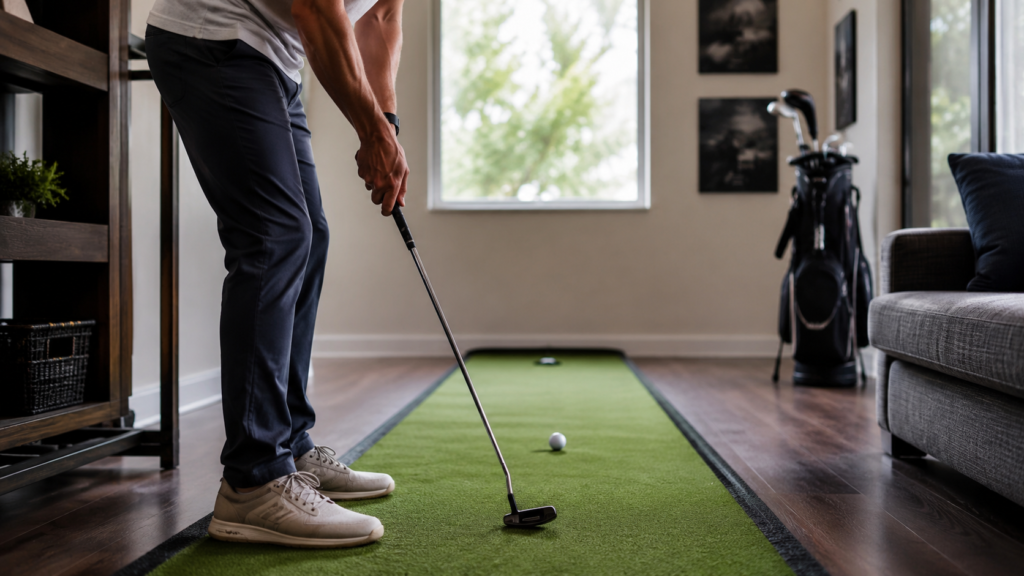
At home, you can train a basic cadence without worrying about results. Back and through. Smooth. Same rhythm. No rush. No stall.
Not slow.
Not fast.
Yours.
That is the word.
Your tempo should feel natural enough that you can bring it to the green without thinking about it too much.
That is why short, clean at-home reps can help more than a long session full of careless putts.
Train the Stroke Without Turning Into a Technician
This is the trap.
You start working on the stroke, and before long you are thinking about everything.
Shoulders.
Hands.
Sternum.
Finish.
Face.
Tempo.
Acceleration.
Now the stroke feels worse than before.
That is not the goal.
You want to train one piece at a time. Let it settle. Then move on.
The detailed drills in the full Blackout Putter System are organized for that reason. They give you the sequence without turning every practice session into a mechanics lecture.
This article gives you the bigger idea:
Build the stroke at home.
Keep the work simple.
Do not carry the checklist to the green.
Train it until it becomes feel.
How This Connects to Blackout Mode
Blackout Mode is not a trick.
It is not something you summon while standing over the ball.
It is what becomes possible when enough of the work has been trained into the body.
Your setup feels familiar.
Your stroke feels connected.
Your rhythm feels steady.
Your target picture is clear.
Then you pull the trigger.
No last-second lesson.
No stroke correction.
No internal debate.
Just see the target, trust the stroke, and roll it.
That is what you are building here.
Not with one magic tip.
With repeated, focused reps.
Where This Fits in the Blackout Putter System
This putting stroke article is one layer of the training progression.
First, you build the big idea of trust.
Then you build the setup.
Then you train the stroke.
After that comes more feel work, speed control, practice-green training, and learning how to bring the routine into real putts.
The complete putting distance control training system gives you the full sequence, including the specific drills, coaching cues, and daily structure that are part of the paid system.
And if you want to connect putting and wedge play under one scoring-shot method, the full golf distance control practice system brings both sides together.
Different shot.
Same problem.
Too much thought.
Different training.
Same answer.
Build the habit before pressure shows up.
A Simple Way to Think About Today’s Work
You do not need to make this complicated.
Tonight, grab your putter.
Set up like you practiced.
Make a few slow strokes.
Feel the shoulders start the motion.
Keep the hands quiet.
Let the stroke move through the ball.
Notice your rhythm.
Then stop before you get sloppy.
That is enough for now.
The goal is not to master the full putting stroke in one night.
The goal is to begin making the motion familiar.
That is how trust is built.
Quietly.
Rep by rep.
Final Thought: The Stroke Should Not Need a Speech
A putting stroke that needs a speech every time is not ready.
If you have to stand over the ball and remind yourself of six things, you have not trained the stroke deeply enough yet.
That is not a criticism.
It is just the work.
Train the motion at home.
Build the setup.
Let the stroke become centered.
Let the rhythm settle.
Let the finish move through the ball.
Then take it to the green and start feeling speed.
The goal is simple.
When it is time to putt, you should not be explaining the stroke to yourself.
You should be seeing the putt.
Trusting the stroke.
And pulling the trigger.
That is Blackout putting.
FAQ
Can I train my putting stroke at home?
Yes. At-home putting stroke training is useful because it removes pressure and lets you focus on motion, rhythm, and setup without reacting to every missed putt.
What should I focus on during at-home putting stroke practice?
Focus on a connected stroke, quiet hands, steady rhythm, centered motion, and a finish that does not quit at impact. Keep the work simple and do not try to fix everything at once.
Does putting stroke training help distance control?
Yes. A repeatable stroke helps distance control because it gives your feel a more stable motion to work through. If the stroke changes every time, speed becomes harder to trust.
Should my putting stroke be equal back and through?
A balanced back-and-through motion is a good starting point for rhythm and distance control. It does not need to be measured perfectly, but the motion should feel smooth and symmetrical.
Why do I decelerate on putts?
Many golfers decelerate because they are afraid of hitting the ball too far past the hole. That fear can make the wrists break down and the face change through impact. Training a clean finish can help.
Should I think about mechanics on the practice green?
The practice green should mainly be used for roll, speed, and feel. Build the stroke fundamentals at home first so you are not carrying a long mechanics checklist to the green.
Want to Keep Training This?
This article is a starting point. The real progress comes from training it consistently.
Join The Blackout Journal Training Notes for free weekly guidance on wedge distance control, putting feel, practice plans, and building trust without overthinking every scoring shot.
1 thought on “Putting Stroke at Home: Train Trust Before You Roll It”
Comments are closed.