
Every seasoned player says they want fewer swing thoughts.
Then one sneaks in when you are not looking.
Maybe it came from a lesson. Maybe it came from a buddy. Maybe it came from one bad shot that bothered you for three holes. Either way, now it is in your head, and if you are not careful, you will drag it straight to the range or, worse, the golf course.
That is how golf swing thoughts become a problem.
Not because every thought is wrong, but because most players try to use them at the wrong time.
This Is Advanced Training
This is advanced training, but not because it is complicated. It is advanced because it takes discipline.
If you are still trying to think your way through every wedge swing, this is not the first place to start. Go back and build the basics first. Build the routine. Build the three stock swings. Build the speed-control work. Get comfortable stepping in, seeing the shot, and pulling the trigger.
Then come back to this.
Because this lesson is about something every serious golfer eventually faces:
What do you do when a swing thought shows up? You cannot pretend it will never happen because it will.
The question is whether you have a plan for it.
The Problem With Swing Thoughts
I know. I have said it plenty of times, stop with the swing thoughts already.
But let’s be honest. If you are anything like me, they still find a way in.
You may have a lesson and hear something that makes sense. You may watch a video and think, “That could help me.” You may hit a few poor shots and start looking for one little move to clean things up.
That is golf.
We are always learning, always noticing, always trying to get better.
The problem is not that a swing thought exists.
The problem is taking that thought straight into performance training on the range.
That is where golfers go backward.
Do Not Take a New Thought Straight to the Range
This might be the most important part of the article.
If a swing thought feels like a keeper, the worst thing you can do is rush to the range and test it with a bucket of balls.
That sounds backwards, but it is true.
The range will tempt you to judge it too early. You hit one good one and think you found the answer. You hit one bad one and throw the thought away. You start mixing the new move with old habits. Then you are chasing ball flight so you make adjustments.
Now the thought is running the session.
That is not Blackout training.
That is the old cycle wearing a new hat.
If the thought matters, train it first. Quietly, away from the ball, away from the score, and most importantly away from the pressure to prove it.
Blackout Mode Does Not Mean You Never Work on Mechanics
This is where people misunderstand the idea.
Blackout Mode does not mean you ignore mechanics. It means you stop trying to manage mechanics while you are performing.
Big difference.
There is a time to work on movement and there is a time to rehearse a feel. There is a time to train something new into your body.
But when it is time to hit the shot, the thought has to get out of the way.
That is the switch.
Training is where you install and performance is where you trust.
Most seasoned players blur those two together, and that is why they feel so crowded over the ball.
A Good Swing Thought Must Be Installed
A useful swing thought should not stay a thought forever.
That is the whole point.
If the move is worth keeping, you want to train it until your body understands it without needing a speech from your brain.
That is how it becomes useful.
You do not want to stand over a wedge shot thinking:
“Shift. Elbow. Turn. Finish. Don’t rush. Stay smooth.”
That is too much.
Instead, you want the movement to be familiar enough that it shows up when you are looking out in front, not worried about what is going on above the ball.
That is how you keep the mind quiet and still improve your swing.
Harvey Penick Had This Right
Harvey Penick had a simple move he talked about over and over.
He called it the “Magic Move.”
The basic idea is the weight shifts to the front foot while the back elbow returns down toward the body.
Simple to say.
Harder to own.
But here is the part that matters most for Blackout training: Penick did not say you needed to beat balls for hours to learn it.
He talked about practicing the move again and again.
Without a golf club if needed.
Until you could feel the rhythm of it.
That is the lesson.
Not just the move itself.
The lesson is how to train a movement before you ask it to hold up under pressure.
That is where so many golfers miss it.
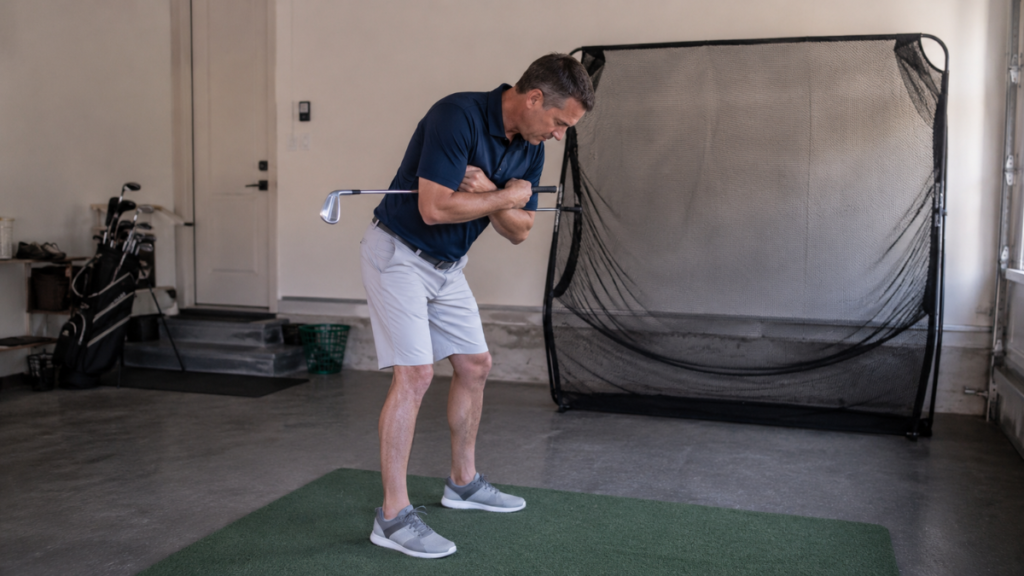
You Can Train Movement at Home
This is why at-home wedge training matters.
You do not need perfect conditions to build a movement pattern.
You need attention, repetition, and a clear purpose.
You can train a movement in your garage, in your living room, in a hotel room, or in your office if you have enough room to rehearse safely.
That is not glamorous, but it works.
And more importantly, it keeps the thought away from the ball until the body has had a chance to learn it.
That is the cleaner way.
Train the movement first, then blend it into your wedge routine. Do it without the thought of doing it correctly.
Then take it to the range when it starts feeling natural.
Not before.
Why This Matters for Wedge Distance Control
Wedge distance control depends on rhythm and a new swing thought can wreck your rhythm fast.
You may think the thought is helping, but if it changes your tempo, tightens your hands, or makes you guide the club, your distance control will suffer.
That is why you have to be careful.
Inside 120 yards, you are not just trying to hit the ball.
You are trying to feel distance.
A cluttered mind makes that harder.
A stiff body makes that harder.
A half-trained movement makes that harder.
So if you are going to bring a movement thought into your wedge game, train it the right way first.
That is the only way it has a chance to help instead of interfere.
How This Builds on Speed Control
In the previous wedge article, we talked about changing speed without changing the whole swing.
That was a big step.
You learned how the finish can add or remove energy, and how speed becomes part of feel. If you missed that step, read this related article on wedge swing speed control before trying to add any movement thought.
Why?
Because once you start adding thoughts too early, feel gets buried again.
The sequence matters.
First, you build stock swings.
Then you learn to adjust speed.
Then, if a movement thought is worth keeping, you learn how to install it without dragging it into the shot.
That is the order.
Be Picky About What You Let In
Not every swing thought deserves a home.
Some thoughts are useful, but most are noise.
That may sound harsh, but it is true.
Seasoned players collect swing thoughts like loose change. A tip here, a video there, a feel from the last good shot, or a fix from the last bad one. Pretty soon, they have a pocket full of junk and no idea what to use.
You have to be picky.
Before you start training a new thought, ask yourself:
Does this help my motion?
Does it fit the system?
Does it improve rhythm?
Does it help me trust the shot?
Or is it just another thing to think about?
If it does not make the swing freer, be careful.
The goal is not more information.
The goal is better training.
The Right Way to Handle a Swing Thought
Here is the big idea without jumping in to the full paid training sequence.
When a useful thought appears, do not take it straight to the course.
Do not test it under pressure.
Do not pile it on top of your normal routine.
Instead, move it backward in the process.
Train it at home.
Rehearse it without the pressure of ball flight.
Feel the rhythm.
Blend it into your existing motion.
Then connect it to the same pre-shot routine you already use.
That is how you keep the system intact.
The thought gets trained into the motion.
It does not become something you recite over the ball.
Keep the Pre-Shot Routine Untouched
This is important.
A new movement thought does not get to take over your routine.
Your routine still runs the show.
You still pick the shot.
You still step in with the clubface first.
You still build the image.
You still return your eyes.
You still pull the trigger.
The movement work happens before that, at home during training.
By the time you are hitting a golf shot, your mind should be back on the target.
That is the discipline.
If the thought keeps interrupting the routine, it is not installed yet.
Keep training.
The Thought Must Become a Feel
This is the whole purpose.
A swing thought is only useful if it eventually becomes a feel.
A feel is quieter and does not need a paragraph. A feel does not argue with the target, it simply supports the motion.
That is why the best players can work hard on their swings and still play with freedom. They know how to separate training from playing.
They install movement in practice.
Then they trust it in performance.
Most amateur golfers do the opposite.
They barely train the movement, then try to perform with it immediately.
That is a tough way to play.
At-Home Training Gives You a Place to Put the Thought
One of the best parts of at-home training is that it gives swing thoughts a proper place.
Instead of letting a thought attack you on the course, you can say:
“Fine. I’ll train that later.”
That alone is powerful. You do not have to solve every thought in the moment. You do not have to chase it during the round. You do not have to rebuild your wedge game after one miss.
You have a place for it.
Home. Training. Repetition.
Then, if it proves useful, it can earn its way into your motion.
Where the Fairway Wedge System Fits
This article gives you the concept.
The full training gives you the progression.
Advanced movement work can help, but only when it is layered into the system correctly. If you try to skip ahead, you risk turning Blackout training into another mechanical project.
That is not the goal.
The complete wedge distance control training system shows how to build the routine, stock swings, speed control, and advanced movement training in the right order.
And if you want to connect wedge play with putting under one scoring-shot approach, the complete golf distance control practice system brings the same trust-based training method to both sides of the game.
Do Not Go Backward
This chapter exists for one reason, to keep you from going backward.
You have done the work to quiet your mind. You have trained the routine, built the stock swings, and started learning speed and feel.
Do not let one new swing thought drag you back into the old cycle.
The old cycle looks like this:
Miss a shot. Find a thought. Take it to the range. Chase results. Add another thought. Lose the feel. Start over.
We are not doing that anymore.
Now you have a plan.
A thought appears.
You test whether it matters.
You train it away from pressure.
You blend it into the motion.
You keep the routine clean.
Then you trust what shows up.
That is a better way.
What It Should Feel Like When It Is Ready
You will know the thought is getting close when it stops sounding like a sentence.
At first, you may have to think through it.
That is normal.
Then it becomes shorter.
Then it becomes more of a rhythm.
Then it becomes a feel.
Eventually, you do not need to say much at all.
That is when it can start coming with you to the range.
Not as a command.
As something already living in the motion.
That is the difference between training a movement and carrying a swing thought.
A Simple Rule for the Course
Here is the rule.
If you have to explain the swing thought to yourself over the ball, it is not ready for the course.
That may save you a lot of trouble.
The course is not the place to install swing thoughts. The course is the place to use what you trained. When you are playing, the target gets your attention.
Not the elbow.
Not the weight shift.
Not the takeaway.
Not the finish.
The target.
That is how you protect Blackout Mode.
Final Thought: Give Swing Thoughts a Place to Go
Swing thoughts are not going away forever.
That is just the truth.
You are a seasoned player. You care. You practice. You notice things.
Thoughts will show up.
The difference now is that they do not get to run the show.
You have a plan.
You do not take every thought to the course.
You do not let every thought invade the routine.
You do not let every thought become the new answer.
You train the good ones at home.
You let the bad ones go.
And when it is time to play, you step in with a clear picture and pull the trigger.
That is how you keep improving without losing the freedom you have been training for.
FAQ
Are golf swing thoughts always bad?
No. Some golf swing thoughts can be useful during training. The problem is using them at the wrong time, especially during performance when your focus should be on the target and shot.
How do I stop thinking about mechanics on the course?
Train mechanics away from the course first. If a movement needs work, rehearse it at home or in practice until it becomes a feel. On the course, keep your attention on the shot, target, and routine.
Can swing thoughts help wedge distance control?
They can help if they are trained correctly and do not disrupt rhythm. But too many thoughts can hurt wedge distance control by creating tension and interfering with feel.
What should I do when a new swing thought appears?
Do not take it straight to the course. Decide whether it is worth keeping, then train it at home without pressure before blending it into your wedge practice.
Why is at-home wedge training useful for swing thoughts?
At-home training gives you a quiet place to rehearse movement without ball flight, pressure, or result-chasing. That helps a thought become a feel before you use it on the range or course.
When is a swing thought ready for the course?
A swing thought is ready only when it no longer feels like a thought. If you have to explain it to yourself over the ball, it is not ready yet.
Want to Keep Training This?
This article is a starting point. The real progress comes from training it consistently.
Join The Blackout Journal Training Notes for free weekly guidance on wedge distance control, putting feel, practice plans, and building trust without overthinking every scoring shot.