
Most putting problems start before the putter ever moves.
That is the part seasoned players don’t want to hear.
We want to blame the stroke. The path. The face. The tempo. The nerves. And sometimes those things matter. But if your setup changes from putt to putt, your stroke is already trying to save you before it even starts.
That is why training your putting setup at home matters. Not because setup is exciting, but because setup is the ground you stand on.
If that ground keeps moving, you will struggle trusting the stroke.
Your Stroke Can Only Work From the Setup You Give It
A putting stroke does not happen by itself.
It comes out of your posture.
Your ball position.
Your eye line.
Your stance width.
Your balance.
Your grip pressure.
If those pieces are different every time, the stroke has to adjust every time.
And once the stroke starts adjusting, the mind starts talking.
“Am I aimed right?”
“Is the ball too far forward?”
“Are my eyes over it?”
“Why does this feel different?”
That is the kind of noise that ruins putting.
The goal of at-home setup work is simple: remove the questions before you get to the green.
You do not want to be standing over a six-footer in a match trying to figure out where your ball position should be.
That work should already be done.
Why We Train Setup at Home
The practice green is not the best place to build setup fundamentals.
It can be, but for most seasoned players, it turns into a guessing game.
You miss a putt and you change your stance.
You miss another, you move the ball.
You push one, you adjust your eyes.
You pull one, now you are three putts into the session and already rebuilding everything.
That is not practice.
That is chasing.
At home, the result does not boss you around as much.
You can slow down.
You can step in.
You can check your posture.
You can feel where the ball sits.
You can build the same stance again and again until it starts feeling normal.
That is the point.
Not perfect, just normal.
Because when setup feels normal, you stop inspecting it.
And when you stop inspecting it, the stroke has a chance to roll.
This Is Still Blackout Training
Some golfers hear “setup work” and think we are going full technician.
We are not.
This is not about turning you into a robot over the ball.
It is the opposite, we train the setup at home so you do not have to think about it on the green.
That is Blackout Mode.
You are not ignoring fundamentals.
You are building them early enough that they stop demanding attention later.
A good setup should feel like tying your shoes.
You do it.
You do not narrate every step.
That is what we are after.
When you step into a putt, you want the setup to show up without a debate.
Then you can see the line, feel the speed, and pull the trigger.
The Setup Is Part of Distance Control
Most golfers think setup only affects aim.
It does affect aim.
But it also affects distance control.
If you are too far on your toes, the stroke can get tense.
If your stance width changes, the ball position can shift without you knowing it.
If your eyes move around, the line can look different.
If your shoulders are not square, the putter may not start where you think it is starting.
All of that changes how freely you can roll the ball.
Distance control is not just “how hard did I hit it?”
It is whether your body is in a position where it can feel the putt in the first place.
A steady setup gives feel a better chance.
That is why this work matters.
Start With Ball Position
Ball position is one of those things golfers think they know until they actually check it.
Then they find out it moves.
A little forward one day.
A little back the next.
Different on short putts.
Different on long putts.
Different when they are nervous.
That creates problems.
The ball needs to live in a reliable place.
For many golfers, that means the ball sits slightly forward in the stance, often around the lead eye or lead ear area. The exact spot can vary, but the habit cannot be random.
You want to train yourself to step in and find the same position without needing a full inspection.
At home, that is easy to rehearse.
Set up, step away.
Set up again, notice whether the ball returns to the same place.
That simple work can clean up more than golfers expect.
Your Eyes Change What You See
Eye position matters because putting is visual. You are not just standing over the ball, you are seeing a line.
If your eyes sit too far inside the ball, the line can look one way. If they sit too far outside, it can look another way.
Some great putters like their eyes directly over the ball. Some prefer them slightly inside. There is room for personal feel here.
But you need to decide.
That is the key.
You do not want to be asking eye-line questions when the putt matters.
At home, you can experiment a little. You can find the spot where the line looks clean, the contact feels solid, and the ball starts where you expect.
Then you train that spot.
Not forever with a microscope.
Just enough so it becomes familiar.
Same Stance, Every Time
Your stance does not need to look like somebody else’s. It needs to be yours.
But once you find it, stop changing it.
This is where a lot of golfers create problems without realizing it. They set the ball position, then widen the stance.
Now the ball position feels different.
They narrow the stance. Now it feels different again.
They move their feet around until something looks right, but the setup has already shifted.
The stance is not just where your feet go. It affects how the ball sits relative to your body and how the putter swings.
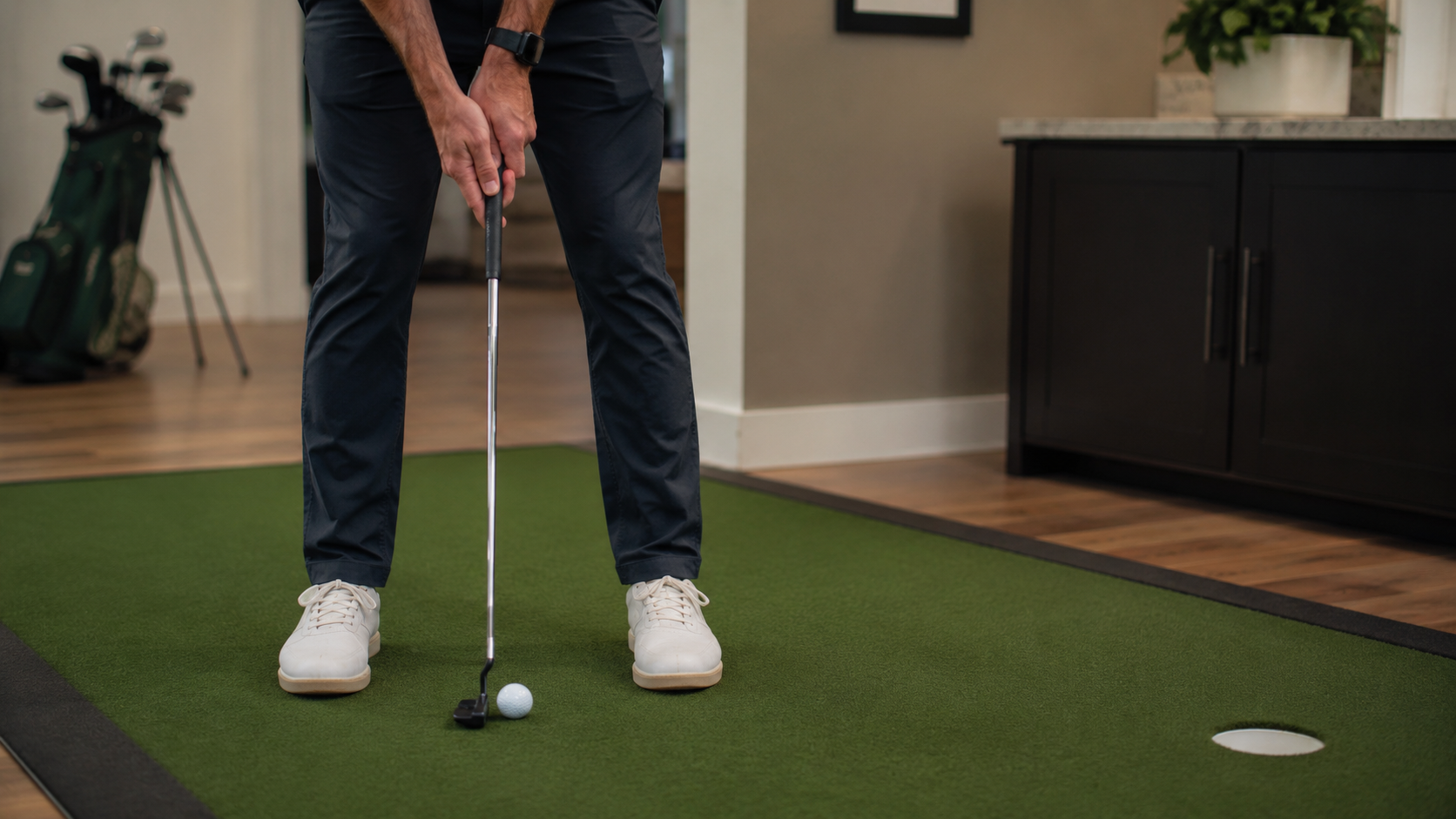
A simple baseline is a comfortable, balanced stance that you can repeat. Some golfers use a tile line, floorboard, putting mat edge, or a small piece of tape at home to learn what repeatable feels like.
That is not cheating.
That is training.
Get Square Without Getting Stiff
Square matters.
Feet.
Knees.
Hips.
Shoulders.
Forearms.
Eyes.
The more your body fights the target line, the more the stroke has to compensate.
But here is the warning: do not make “square” mean stiff.
You are still an athlete. You need to feel balanced and ready, not locked into a statue. A good putting setup should feel clean, athletic, and quiet.
Not frozen.
At home, you can use simple references like a floor line, alignment stick, or the edge of a mat to see whether your body is aimed where you think it is aimed.
Then put the tool away and feel it.
That second part matters.
You are not trying to become dependent on training aids. You are using them to teach your body what square feels like.
Balance Is the Hidden Setup Key
Balance does not get talked about enough in putting.
But it shows up fast.
If your weight is too far toward your toes, tension creeps in.
If you are sitting too far into your heels, the stroke can lose freedom.
If your knees collapse or your body feels pinched, the stroke starts from a bad place.
You want to feel grounded.
Centered.
Comfortable.
Like you could stay there without strain.
Not sleepy or rigid, but athletic.
A balanced body gives the putter a better chance to swing without you grabbing it.
That is a big deal.
Because the more your body feels unstable, the more your hands try to save the stroke.
And once the hands start saving, distance control gets messy.
Grip Pressure Belongs in the Setup Too
Your grip is not separate from your setup.
It is part of it.
The hands tell the putter how free it is allowed to move.
If both hands get tight, the stroke gets tight.
If the trail hand takes over, the face can get active.
If the lead hand is too loose, the face may feel unstable.
The goal is not to squeeze the putter into submission.
The goal is connection.
In the Blackout Putter System, the setup work connects with grip pressure, face control, and the stroke drills that follow. This article gives you the big picture, but the detailed grip and setup progression belongs inside the full paid training.
For the complete sequence, the full putting distance control training system walks through the setup, grip, stroke, and feel work in order.
Do Not Try to Fix Everything at Once
This is where seasoned golfers get themselves in trouble.
They read about setup and immediately try to check ten things at the same time.
Ball position.
Eyes.
Feet.
Shoulders.
Hands.
Weight.
Grip.
Face.
Posture.
Tempo.
Now they are worse than when they started.
Do not do that.
Pick one setup piece at a time.
Start with ball position, then stance, then eyes, then balance.
Then how the whole thing feels together.
Small pieces.
Clean reps.
That is how you build something useful. Trying to fix everything at once usually just gives you a new list of putting thoughts.
And the whole point is to need fewer of those.
A Simple At-Home Setup Session
Keep this short.
You do not need to roll a hundred putts or turn the living room into a lab.
Start with a few quiet minutes:
- Set the putter down.
- Step in.
- Find the ball position.
- Let your stance settle.
- Feel your eyes and posture.
- Check your balance.
- Hold the setup long enough to feel whether it is stable.
- Then step out and do it again.
That is the work.
The full training system includes more detailed setup drills and a daily progression, but even this simple version teaches an important lesson:
You are training the setup before the stroke.
That order matters.
How This Connects to At-Home Putting Drills
This setup work fits right after the bigger idea of building putting trust before the green.
In the article on at-home putting drills, we talked about why the early work belongs in a quiet space. The green is for roll, speed, and feel. Home is where you can build the fundamentals without chasing every miss.
This article goes one layer deeper.
Now we are talking about the setup itself.
The way you stand to the ball.
The way your eyes see the line.
The way your body gets balanced.
The way the putter sits before it moves.
If that part gets more consistent, the stroke starts from a better place.
Do Not Bring Setup Thoughts to the Green
Here is the whole reason we train this at home.
When you get to the practice green, you do not want to be thinking:
“Is my ball under the right eye?”
“Are my feet the same width?”
“Are my shoulders square?”
“Is my weight too much on my toes?”
Those questions have their place.
But not when you are trying to roll the ball.
The practice green should be where you train speed, pace, read, and feel. If you are still fighting your setup there, you are using the green for the wrong job.
Do the checking at home.
Do the trusting on the green.
You will thank yourself later.
Why This Helps Under Pressure
Pressure exposes whatever is loose.
If your setup is inconsistent in practice, pressure will make it worse.
That is why short putts can feel so uncomfortable.
The target is close.
The miss feels obvious.
The hands get careful.
And suddenly the golfer starts checking everything.
A trained setup gives you something to stand on.
Not a guarantee.
Golf does not give those.
But it gives you a familiar starting point.
When the setup feels like home, the stroke has a better chance to stay free.
That is what we want.
Where This Fits in the Blackout Putter System
The putting setup is not the finish line.
It is the foundation.
After setup comes stroke.
Then tempo.
Then release.
Then distance control.
Then feel training on the practice green.
That order matters because you cannot trust a stroke that starts from a different setup every time.
The full Blackout Putter System goes deeper into the exact drills, checks, and progression for building this into implicit memory. This article is meant to point you in the right direction without giving away every paid training detail.
For golfers who want the complete progression, the putting setup and stroke training system gives you the step-by-step work.
And if you want the full scoring-shot approach that connects putting with wedge play, the complete golf distance control practice system brings both sides together.
Same idea.
Build it at home.
Trust it when it matters.
Final Thought: The Stroke Starts Before the Stroke
Most golfers think the putt starts when the putter moves.
It does not.
It starts when you step in.
It starts when the ball sits in the right place.
It starts when your eyes see the line clearly.
It starts when your stance feels familiar.
It starts when your body is balanced enough to let the putter swing.
That is why setup matters.
You are not just standing there.
You are giving the stroke a place to come from.
Train that place at home.
Make it repeatable.
Make it quiet.
Then when you get to the green, stop checking and start putting.
That is the path toward Blackout Mode.
FAQ
Why should I practice my putting setup at home?
Practicing your putting setup at home helps you build ball position, stance, eye line, posture, and balance without pressure. The goal is to make the setup feel automatic before you get to the green.
What is the most important part of putting setup?
There is not one magic part. Ball position, eye line, stance width, square alignment, balance, and grip pressure all work together. The key is making them repeatable.
Can setup affect putting distance control?
Yes. A steady setup helps the body feel balanced and free, which makes it easier to control speed. If the setup changes every time, distance control becomes harder to trust.
Should my eyes be directly over the ball when putting?
Some golfers putt best with their eyes directly over the ball. Others prefer slightly inside the line. The important thing is finding the position that helps you aim clearly and strike the ball solidly, then training it consistently.
How long should I practice putting setup at home?
Start with a few short sessions each week. Even five to ten minutes of focused setup rehearsal can help if the reps are clean and consistent.
Should I think about setup on the practice green?
Use the practice green mostly for speed, roll, and feel. Setup checks are better trained at home so you do not carry too many technical thoughts into your putting practice.
Want to Keep Training This?
This article is a starting point. The real progress comes from training it consistently.
Join The Blackout Journal Training Notes for free weekly guidance on wedge distance control, putting feel, practice plans, and building trust without overthinking every scoring shot.
1 thought on “Putting Setup at Home: Build Trust Before the Stroke”
Comments are closed.