
Once you have three stock wedge swings, you have a solid starting point.
But golf rarely gives you the exact yardage that matches one of them.
That is where wedge swing speed control comes in. You keep the backswing you already trained, then change the energy of the finish to add or remove a few yards.
No thinking about hitting it harder.
No slowing everything down and hoping.
Just a familiar swing with a different finish.
Your Stock Swings Give You the Structure
The first step was building three repeatable wedge motions:
- Hip to hip
- Rib to rib
- Shoulder to shoulder
Those swing lengths give your wedge game some order.
Instead of making up a new motion for every shot, you now have three familiar starting points. Each one has a shape. Each one has a rhythm. And eventually, each one will have a carry distance you know you can trust.
That work matters.
But it does not cover every number.
You might know that your rib-to-rib swing carries 70 yards and your shoulder-to-shoulder swing carries 82.
Then the course gives you 76.
That is the gap we are learning to fill.
Not by inventing a fourth swing.
By changing the speed inside a motion you already know.
Swing Length and Swing Speed Do Different Jobs
Here is the easiest way to understand it:
Swing length gives you structure.
Swing speed gives you feel.
Your three stock swings organize the size of the motion. Speed lets you make smaller adjustments within those motions.
That is an important distinction.
Most golfers mix the two together without realizing it. They try to take something off a shot, so they shorten the swing, slow it down, tighten their grip, and hold off the finish.
Now four things have changed.
If the shot comes off wrong, they have no idea why.
We want to make the adjustment cleaner than that.
Keep the backswing familiar.
Change the finish.
Then notice what happens.
Stop Telling Yourself to Hit It Harder
“Hit it harder” is not a useful wedge thought.
It usually creates tension.
The hands get involved.
The transition gets quick.
The body lunges at the ball.
And the strike becomes less predictable right when you are trying to control distance.
The same thing happens when golfers try to “take something off.”
They make a decent backswing, then quit through impact.
Or they guide the club into the ball and hope it travels the right number.
Neither one builds much trust.
A better approach is to let the finish organize the speed.
Want a little more from the shot?
Finish with more energy.
Want to soften it?
Let the finish come out lower and quieter.
You are not forcing speed into the ball.
You are allowing the motion to carry more or less energy through the finish.
That feels different.
And that difference is what your body needs to learn.
A Higher Finish Adds Energy
As a general training pattern, a more complete finish creates more speed, height, and carry.
A lower finish takes some of that energy away.
This does not mean you need to pose the club in a perfect position. We are not trying to manufacture a picture for the camera.
The finish is simply a feel cue.
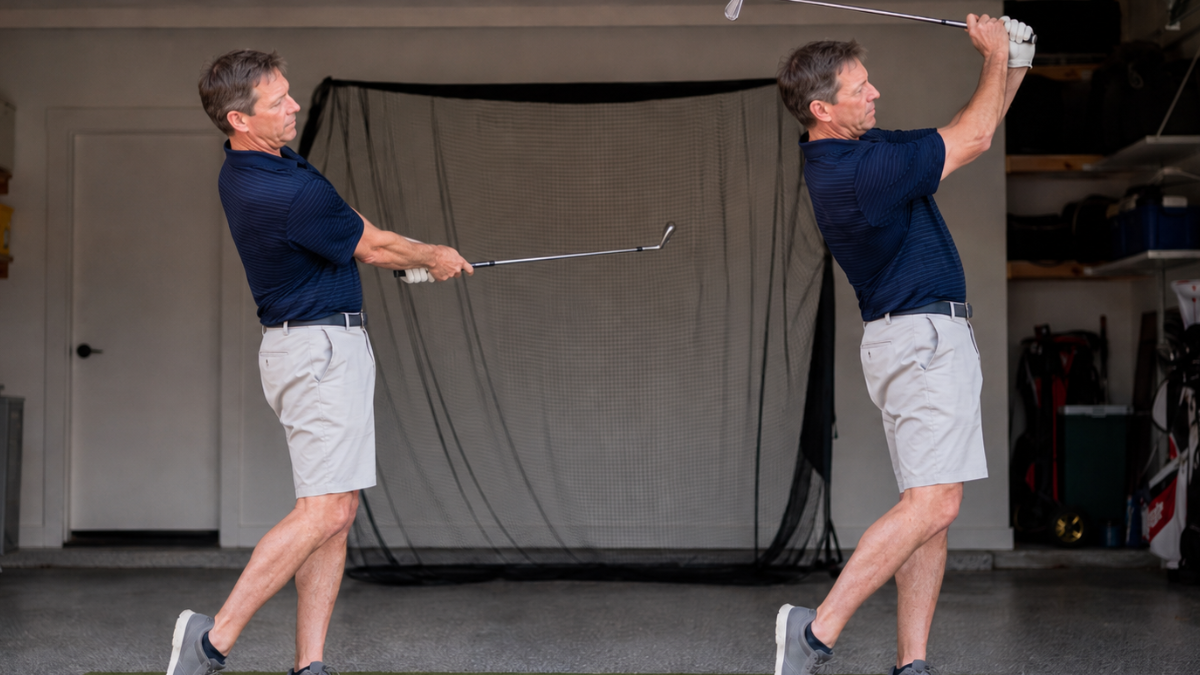
For example, you can make your normal rib-to-rib backswing, then let the club finish closer to your shoulder-to-shoulder position.
The backswing stays familiar.
The finish gets bigger.
That naturally adds some energy without asking you to consciously swing harder.
That is the whole idea.
Same Backswing, Different Finish
Let’s use the stock half wedge as an example.
Your normal half wedge is:
Rib-to-rib backswing.
Rib-to-rib finish.
Now suppose you want a few more yards without jumping all the way to the next stock swing.
Try this:
Rib-to-rib backswing.
Shoulder-to-shoulder finish.
The motion starts from a place you already know. You are not taking the club farther back. You are simply allowing more energy to move through the ball and into the finish.
That small change can add carry and height.
More importantly, it gives you a clean feel to train.
You are not standing over the ball asking, “How hard is 75 yards?”
You are choosing a swing combination you have already practiced.
That is much easier to trust.
Why This Still Counts as Blackout Training
We are changing the motion, but we are not turning this into a mechanical project.
That matters.
Blackout training is not about avoiding all fundamentals. It is about training them at the right time so you do not need to consciously manage them on the course.
At home, you rehearse the swing combinations.
You feel the difference between the finishes.
You repeat them until the adjustment starts becoming familiar.
Then, when you face the shot on the course, your job is not to explain the mechanics to yourself.
Your job is to choose the shot, see the target, and pull the trigger.
The training happens now.
The trust comes later.
Build This on Top of the Stock Wedge Swing Drill
Do not rush into speed control before the three stock swings feel familiar.
You need the basic motion first.
The Stock Wedge Swing Drill teaches you to run your pre-shot routine and rehearse hip-to-hip, rib-to-rib, and shoulder-to-shoulder swings at home.
That gives you the base for this drill.
Once those swing lengths start feeling like your own, you can begin mixing the backswing and finish positions.
Without that foundation, the combinations will feel random.
With it, they become useful adjustments.
The Adjust Your Speed Drill
Start with one wedge.
A sand wedge or gap wedge is fine.
You can use a foam ball, plastic ball, practice ball, or no ball at all. At this stage, the goal is to feel the change in speed—not to prove an exact yardage.
We will begin by adding speed to the stock half wedge.
The swing combination
Backswing: Rib to rib
Finish: Shoulder to shoulder
Picture a yardage that sits just beyond your normal half-wedge distance.
The original drill uses 75 yards as the target. Your actual number may be different, and that is fine. The number is there to give the motion a purpose.
Step 1: Commit to the Shot
Choose the distance and pick a target.
Even at home.
Do not make a loose practice swing with no intention behind it. Give the swing a job.
Picture the landing spot.
See the shot you are trying to produce.
Then commit to it.
Step 2: Step In With the Clubface First
Set the clubface on your intended line before arranging your feet.
Let the aim guide the setup.
This keeps the practice connected to the same pre-shot process you will use later on the range and course.
The goal is not just to train a motion.
It is to train how you enter the shot.
Step 3: Build the Picture
Once you are set, look at the target.
Take a simple mental snapshot.
You do not need a detailed movie running in your head. Just see the landing area and the shape of the shot.
That picture gives the swing somewhere to go.
Without it, you are just moving the club.
Step 4: Return Your Eyes and Pull the Trigger
Bring your eyes back to the ball.
Feel grounded.
Then go.
Make the rib-to-rib backswing you already know, but allow the club to continue into the higher shoulder-to-shoulder finish.
Do not tell yourself to hit harder.
Do not throw your hands at it.
Do not force the finish.
Let the fuller finish carry the extra energy.
Step 5: Repeat Five Times
Make five committed reps.
Use the full routine every time.
That part is important.
Do not make one proper rep, then rake through four quick swings. Each repetition should begin with the decision and target picture.
You are training the whole shot.
Not just the club movement.
What a Good Rep Feels Like
A good rep should feel smooth.
There is more energy than your normal half wedge, but it should not feel violent.
The backswing still feels familiar.
The transition does not get rushed.
The finish simply carries farther through.
You should feel like you added speed without having to manufacture it.
That is the sensation you are after.
Do not worry about whether every finish reaches the exact same height. The positions are guides, not measurements.
The bigger question is:
Did the motion stay free while the energy changed?
If it did, the rep worked.
Do Not Analyze Every Swing
This is where a range grinder can turn a useful drill into another swing investigation.
You make one rep and start checking.
Was the backswing exactly rib high?
Did the finish reach the shoulder?
Was the clubface square?
Did the body turn enough?
Leave it alone.
You are trying to feel a speed change, not pass a mechanics exam.
Make the swing.
Notice the energy.
Reset.
Go again.
That is enough.
Add Speed to the Stock Pitch Shot
Once the half-wedge version feels clear, try the same idea with your shortest stock swing.
Use:
Backswing: Hip to hip
Finish: Rib to rib
This gives the stock pitch shot a little more energy without turning it into a completely different motion.
The backswing remains compact.
The finish carries farther through.
This can eventually help cover the gap between your normal pitch shot and stock half wedge.
Again, do not assign a precise distance yet.
Learn the feel first.
Measure it later.
Soften the Stock Half Wedge
The same idea works in the other direction.
Use:
Backswing: Rib to rib
Finish: Hip to hip
This softens the shot while keeping the width of the half-wedge backswing.
That can be useful when you want to take some energy out without getting careful or chopping the backswing down.
The motion still needs rhythm.
You are not stopping at the ball.
You are simply letting the finish come out quieter and lower.
Soft does not mean decelerated.
It means less energy carried through.
Soften the Stock Three-Quarter Wedge
You can also make the longer stock swing softer.
Use:
Backswing: Shoulder to shoulder
Finish: Rib to rib
This keeps the width of the longer backswing but takes some energy out of the shot through the finish.
It may feel odd at first.
That is normal.
You are teaching your body a new combination.
Do not judge it after one rep. Give yourself time to understand the feel.
Add More to the Three-Quarter Wedge
At the top end, you can rehearse:
Backswing: Shoulder to shoulder
Finish: Full, balanced finish
This is your strongest wedge variation.
But it still should not feel like a wild full swing.
The word is smooth.
You are allowing the club to finish fully, not trying to squeeze every last yard out of it.
If the motion becomes rushed or you lose balance, you have gone too far.
A stronger wedge shot still needs control.
Otherwise, you may as well choose another club.
Stock Swing Speed Combinations
Here is the simple progression:
| Backswing | Finish | General Result |
|---|---|---|
| Hip to hip | Rib to rib | Adds speed to the stock pitch |
| Rib to rib | Shoulder to shoulder | Adds controlled speed and height |
| Shoulder to shoulder | Full finish | Strongest wedge variation |
| Rib to rib | Hip to hip | Softens the half wedge |
| Shoulder to shoulder | Rib to rib | Reduces energy while keeping width |
These are not exact yardage formulas.
They are training combinations.
Your distances will depend on your wedges, strike, speed, launch, and natural motion.
The goal is to discover what each combination produces for you.
Do Not Turn Five Wedges Into Fifty Swing Thoughts
There is a danger here.
Once golfers see the different combinations, they start trying to memorize everything at once.
Do not do that.
Start with one wedge and one adjustment.
For example:
Half-wedge backswing. Three-quarter finish.
Train that until it feels clear.
Then add another.
The point of the system is to reduce guessing, not create a giant menu you have to sort through over the ball.
Build the feels gradually.
Let each one settle in.
Train the Feel Before Measuring the Number
At home, you are building the motion.
Later, you will take it to the range and find out how far it carries.
That order is important.
If you chase yardage too soon, you may start forcing the swing to reach a number.
Then you are right back to manipulating the club.
At home:
- Learn the swing combination.
- Feel the speed change.
- Keep the routine consistent.
- Make the motion without judgment.
At the range:
- Hit several shots with the same combination.
- Measure carry, not total roll.
- Look for the pattern.
- Record the dependable number.
The ball gets the final say.
Not the distance you hoped to hit.
This Is How You Begin Filling Yardage Gaps
Your three stock swings give you your main distances.
Changing the finish helps fill the spaces between them.
Over time, one wedge can give you several useful carry options.
Then you repeat the process with the rest of your wedges.
That is how a real distance-control system begins to take shape.
Not through guesswork.
Through familiar motions, trained speeds, and measured results.
The complete wedge distance control training system builds this progression from the at-home motion to measured carry distances and on-course use.
You Still Need the Right Shot for the Situation
More options do not mean you should use every option.
Suppose two different combinations both carry around 75 yards.
One may fly higher.
One may come out lower.
One may feel easier from a clean fairway lie.
Another may work better when you need to clear trouble and stop the ball faster.
The point is not just to hit a number.
The point is to choose a shot you trust for the situation in front of you.
That is where feel-based distance control becomes real golf.
Record What You Notice
You do not need to write a full report after every practice session.
One short note is enough.
Something like:
“Half backswing to three-quarter finish felt smooth.”
Or:
“Soft half wedge got too careful. Keep moving through.”
That little note helps you remember what the session actually taught you.
It also keeps the focus on awareness instead of judgment.
You are not grading yourself.
You are learning your own wedge game.
Where This Fits in the Full Training System
This is one layer of the Blackout Mode progression.
First, you learn how to quiet the mechanical noise.
Then you build your pre-shot routine.
Then you install the three stock wedge swings at home.
Now you begin adjusting speed without changing the entire motion.
Later, you measure the carry distances and take those trained feels into random-target practice.
Each step builds on the one before it.
That is what makes the broader golf distance control practice system different from simply hitting more balls.
You are not hoping feel appears.
You are training it on purpose.
Final Thought: Let the Finish Change the Speed
Golfers make partial wedge shots harder than they need to be.
They try to calculate effort.
They try to hit the ball 73 percent.
They try to slow the club down at just the right moment.
That is a lot to ask in the middle of a swing.
Keep it simpler.
Choose the stock backswing.
Choose the finish.
See the shot.
Then let it go.
The finish changes the energy.
The energy changes the distance.
And with enough clean repetition, you will stop needing to explain any of it to yourself.
You will just feel the shot.
That is where this training is trying to take you.
FAQ
What is wedge swing speed control?
Wedge swing speed control is the ability to add or remove energy from a familiar stock wedge swing without rebuilding the entire motion. In this drill, the finish helps organize that speed change.
How can I add distance without making a longer backswing?
Keep your normal stock backswing and use a fuller finish. For example, make a rib-to-rib backswing and continue into a shoulder-to-shoulder finish.
How do I take distance off a wedge shot?
Use a familiar backswing with a quieter, lower finish. The swing should still move through the ball. Do not stop or decelerate at impact.
Should I swing harder to hit a wedge farther?
Avoid using “swing harder” as your main thought. It often creates tension and poor contact. A fuller, balanced finish can add energy without forcing the swing.
Can I practice wedge speed control at home?
Yes. Home is a good place to learn the different swing combinations because you can focus on motion and feel without judging ball flight after every rep.
When should I measure the distance of each variation?
Measure the distances after the swing combinations feel familiar. Hit several shots with each variation, track the carry numbers, and use the repeatable pattern rather than one perfect result.
Want to Keep Training This?
This article is a starting point. The real progress comes from training it consistently.
Join The Blackout Journal Training Notes for free weekly guidance on wedge distance control, putting feel, practice plans, and building trust without overthinking every scoring shot.
1 thought on “Wedge Swing Speed Control: Fill the Gaps Between Stock Shots”
Comments are closed.