
Putting can be difficult when your mind starts helping too much.
You see the line and feel the speed. Then, right before you pull the trigger, the thoughts show up. Don’t push it. Don’t leave it short. Keep the face square. Make a smooth stroke.
Whatever.
That is where a lot of good putting strokes disappear. Not because the stroke is broken but because the mind will not leave it alone. That is where Blackout Mode putting begins. It is not about building a perfect stroke. It is about training your setup, routine, and feel so well that when it is time to putt, you can stop managing every piece and just roll the ball.
Why Putting Feels Harder Than It Should
Golf is hard.
Putting can feel harder.
That sounds strange because the stroke is small. No full turn. No driver. No bunker carry. No forced shot over water.
Just a putter, a ball, and a hole.
But that is exactly why putting gets in your head.
Everything feels close enough to control.
So golfers start controlling.
They control the face.
They control the path.
They control the speed.
They control the wrists.
They control the follow-through.
Pretty soon, the stroke is not a stroke anymore.
It is a list of instructions.
And nobody putts their best while trying to obey five instructions in two seconds.
The Stroke Is Usually Not the Whole Problem
Most golfers blame the stroke first. They miss a few putts and start tinkering with a fix.
- Grip.
- Posture.
- Eye line.
- Ball position.
- Path.
- Tempo.
- Face angle.
Some of those things matter, of course they do. But there is another problem that gets overlooked. You may already have a stroke good enough to build on. But if every putt comes with a last-second correction, your body never gets a clean chance to use it.
That is why the Blackout Putting System starts with a different goal. We are not trying to make you think more. We are trying to train the right things at the right time so you can think less when it matters.
What Blackout Mode Means on the Green
Blackout Mode is the moment just before you pull the trigger. The read is done, the decision is made, and the picture is clear.
Now your job is simple:
- See the putt.
- Trust the stroke.
- Pull the trigger.
And that is it, really. There are no extra thoughts or fixes. Blackout Mode does not mean you stop caring and rush the putt just hoping it goes in. It means you have trained the pre-putt routine, the setup, and the stroke mechanics. So, you do not have to coach all that during the putt.
That is the difference.
Your stroke does not disappear but your conscious stroke thoughts do.
It Is Not Mystical
Some golfers hear “Blackout Mode” and think it sounds too big. Like some rare zone you only find when everything is perfect. I do not see it that way because Blackout Mode is trainable. It may feel special when it happens, but it is built through simple habits. A clean setup with a repeatable routine. A clear target image and a stroke you have rehearsed enough times that you can stop babysitting it.
That is not magic, that is training.
The problem is most golfers do not train putting that way. They go straight to the green and start reacting to results. They are focused on miss or make and based on the results they start fixing something. If that doesn’t change the result, they fix something else.
That is a recipe for building doubt, not trust.
Why We Start at Home
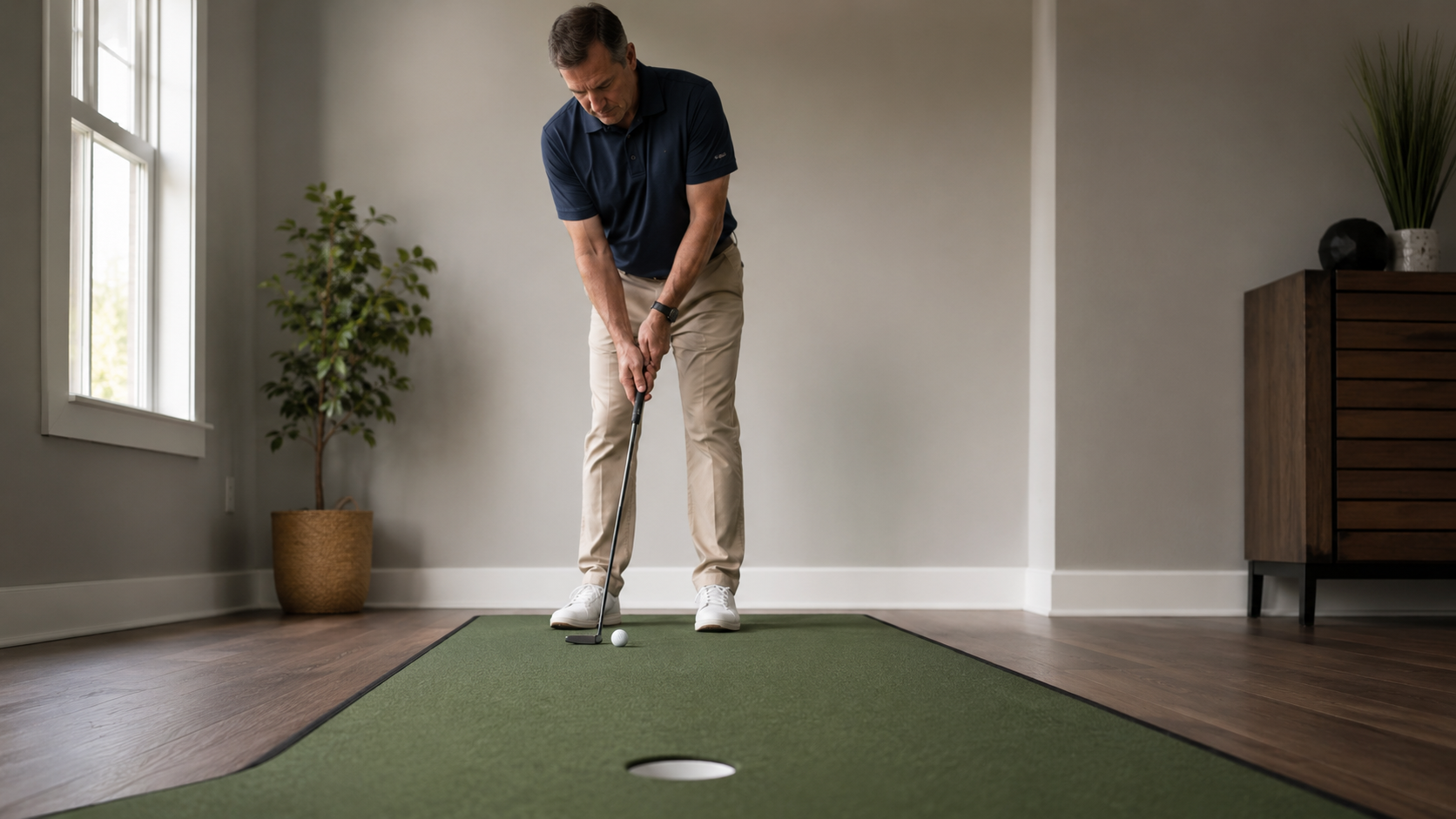
The green is where you learn roll, speed, break, and feel. But home is where you can build the foundation without all the noise. At home, there is no pressure because you are not trying to make putts. You are not worried about 3-putting, the speed, or the break.
You can work on the pieces quietly:
- Posture.
- Setup.
- Alignment.
- Tempo.
- Routine.
- Stroke.
You can train the motion without judging every result like it means something. And that matters because on the course, you do not want to be standing over a six-footer trying to rebuild your putting stroke.
That work should already be done.
Build the Fundamentals Before You Test Them
A lot of seasoned players test their putting before they ever really train it. They go to the practice green, roll balls at holes, and let the result tell them how they feel. If they make it, they conclude it was a good stroke. If they miss, bad stroke.
That is too simple.
A putt can miss for a lot of reasons. Bad read. Wrong speed. Spike mark. Grain. Break. Nerves. A little pull. A little push. If every miss sends you into repair mode, you will never build anything stable.
That is why the early work belongs at home.
You are not trying to prove the stroke, you are trying to build it.
The setup starts feeling familiar and the face starts feeling easier to aim. The stroke starts feeling less forced and the pre-shot routine starts becoming automatic. Then, when you go to the practice green, you are not starting from scratch, thinking about doing it right.
You are bringing something with you.
The Target Image Matters
Good putting is not just “hit it straight.” You need a picture or a image of the target. You must make a decision about where is the ball starting? Need to know how the greens are rolling. Is it uphill or downhill? Is it breaking outside the cup?
This is where feel starts and it is not in a checklist inside your image.
That is why players and teachers have described this idea in different ways over the years:
- Harvey Penick talked about taking dead aim.
- Tiger Woods has talked about taking a picture of the hole and putting to that picture.
- Jordan Spieth has described seeing the path and reacting to it.
Different words but same idea. Give your mind a clear target, then let your stroke respond without any other conscious thought.
That is much better than standing over the ball thinking about the putter face.
Feel Beats Calculation
Putting distance control is not math in the middle of the stroke. You can gather information before the putt. You should read the slope and notice the speed of the green. You must pick your line and the target spot too. But once you step in, you cannot calculate your way through the stroke.
That is where seasoned players get stiff. They try to decide how hard to hit it while they are already standing over the ball. They start questioning the decisions already made.
Now the stroke gets careful.
Feel works better when the decision is already made. You see the roll and trust the image of the target.
You pull the trigger.
That is what we are training.
Stop Trying to Fix Things Mid-Round
This might be one of the biggest keys to better putting. Stop rebuilding your stroke during the round. You can make small adjustments to your decision making. Your feel for speed will change as the round goes on. You can learn from what the ball is doing from watching the ball roll when playing partners putt.
But if every missed putt turns into a mechanical project, you are going to have a long day.
Mid-round is not the time to become a putting technician. It is the time to trust what you trained. That is why the work starts before the round, at home.
In short sessions with focused drills and a pre-putt routine that teaches you how to step in, see the putt, and go. When you do that enough, the course feels less like a test and more like a place to use what you already built.
How Blackout Putting Connects to Your Routine
Your pre-routine is the bridge between thinking and putting. Without a routine, you can get stuck over the ball. You look at the hole and bring your eyes back to the ball… you start thinking. You freeze for couple seconds, and add one more thought. Then you try to stroke the putt while your mind is still talking.
That is not the goal.
The routine gives you a clean process:
- Read it.
- Decide.
- Set the face to your desired line.
- Set your feet.
- Look at the target.
- Build the image of the target.
- Return your eyes back to the ball.
- Pull the trigger.
If you need the next step in that process, this article on the pre-putt routine walks through how to trust the stroke before you hit it. That routine is where Blackout Mode starts to become usable.
Not just an idea but a process.
The Goal Is Not a Perfect Stroke
Let’s be honest, you are probably not going to build a perfect putting stroke. Almost nobody does. Even great putters miss putts and have days where the ball does not fall.
The goal is not perfection, the goal is a stroke you can trust. A setup that feels familiar with a routine that keeps you from freezing over the ball. The ability to build a image of the target that gives your body something to react to. And finally, a stroke that rolls the ball without you trying to save it at the last second.
That is enough.
And for a lot of golfers, it is a lot more than they have now.
What Blackout Mode Putting Feels Like
Blackout Mode putting does not feel like trying harder.
It feels like the opposite.
It feels like you are done deciding. You already saw the line and felt the speed. You already built the image and now you just roll it.
That is the best way I can say it.
There is no little debate happening in your head. No voice giving instructions. Just a clean picture and a stroke that reacts to it. That is when putting starts to feel athletic again.
Not mechanical, not careful, just athletic.
You see it and respond.
That is what makes the game fun again.
Where the Blackout Putter System Fits
This is the foundation of the Blackout Putter System. Train the pieces at home first then take them to the practice green.
That order matters.
The complete putting distance control training system is built to help you develop the setup, routine, stroke, and feel you need before pressure shows up.
And if you want to connect putting and wedge play under one scoring-shot approach, the full golf distance control practice system brings both sides together for all shots inside 120+ yards.
Why This Matters for Wedge Players Too
Putting and wedge play have more in common than most golfers think. Both are scoring shots that depend on feel. Both punish doubt and get worse when you drag too many mechanics into the motion.
That is why the training overlaps.
In the stock wedge swing drill, the goal is to build three wedge motions you can trust before you start chasing distance.
Putting works the same way:
- You build the stroke.
- You build the routine.
- You build the feel.
Then you use it. That is golf distance control practice at its best. Not random repetition and not hope.
A system.
A Simple Way to Start
You do not need to make this complicated. Tonight, grab your putter and make ten slow reps.
Just train the process:
- Set the grip.
- Set the face.
- Set your body.
- Look at the target.
- Take the picture.
- Return your eyes.
- Pull the Trigger.
Then do it again. Ten clean reps are better than fifty distracted ones.
That is how this starts. Small, simple, and repeatable.
The kind of work that does not look impressive, but starts changing the way you putt.
Final Thought: Trust Is Trained Before It Is Needed
You cannot wait until you are standing over a downhill four-footer to suddenly become free, that is too late. Trust has to be trained before it is needed. At home where you work on the pre-putt routine, the setup, and the putting stroke.
These are quiet reps nobody sees. That is where Blackout Mode putting begins. Not with a perfect stroke or more thoughts. With a clearer picture, a quieter mind, and a stroke you finally let happen.
Once you learn how to putt that way, the greens feel different.
And honestly, the game gets a lot more fun.
FAQ
What is Blackout Mode putting?
Blackout Mode putting is the trained state where you step into a putt with a clear target picture, quiet the stroke thoughts, and let your body make the stroke without conscious mechanical control.
Does Blackout Mode mean I ignore putting fundamentals?
No. It means you train the fundamentals first so you do not have to think about them during the stroke. Fundamentals matter, but they should not clutter the moment you pull the trigger.
How does Blackout Mode help putting distance control?
Blackout Mode helps distance control by giving your body a clear picture and less mental interference. When you stop calculating during the stroke, feel has a better chance to guide the roll.
Why does Blackout putting training start at home?
At-home training removes pressure and distraction. It lets you build setup, alignment, routine, and stroke habits before taking them to the practice green.
Can Blackout Mode help with short putts?
Yes. Short putts often get missed because golfers tense up, guide the stroke, or add last-second thoughts. A simple routine and clear picture can help you trust the stroke under pressure.
Want to Keep Training This?
This article is a starting point. The real progress comes from training it consistently.
Join The Blackout Journal Training Notes for free weekly guidance on wedge distance control, putting feel, practice plans, and building trust without overthinking every scoring shot.