
Most golfers try to fix their putting stroke on the practice green.
That is usually too late.
The green is where you should be learning speed, feel, and how the ball rolls. It is not the best place to rebuild your setup, question your stroke, or chase mechanics after every missed putt.
That work starts with at-home putting drills.
Not because home practice is perfect. It is quiet at home, no pressure of someone watching, and there is no cup staring back at you. No reason to panic after one bad roll. Just you, your putter, your setup, your stroke, and enough clean repetition to start building trust.
That is where Blackout Putting starts.
Why Most Golfers Practice Putting Backwards
Most seasoned players head to the practice green and do the same thing. They drop three balls and roll one toward a hole. If they miss it, they’ll most likely start adjusting something technical. Roll the next one, miss again, change something else.
By the third putt, they are not practicing anymore. They are reacting based on the result and that is the problem. A missed putt does not always mean your stroke is broken. Sometimes it was the read. Sometimes it was the speed. Sometimes the green fooled you. Sometimes you just missed.
But seasoned players don’t treat it that way. They want to start fixing all the technical stuff. Grip, setup, path tempo, or head movement. Now the mind is full before the next stroke even starts and they just started the practice session.
That is not training.
That is chasing.
The Practice Green Is Not the Best Place to Build Mechanics
The practice green has a job, It teaches you roll, speed, break, pace, and touch. How the ball reacts on real grass, that matters. But it is not always the best place to build fundamentals.
Why?
Because the result gets in your face too fast. The ball either goes in or it doesn’t. It rolls close or it doesn’t. It feels good or it doesn’t. And the seasoned player starts judging every stroke like it is proof of something. That makes it hard to install anything.
At home, the goal is different.
You are not trying to prove you can make putts. You are building the habits you will later trust when the putt matters.
What Blackout Mode Really Means in Putting
Blackout Mode is not magic.
It is not zoning out and hoping your body figures it out. It is what happens when the thinking part gets quiet enough for the trained part to work.
You see the line. and feel the speed. You make the stroke with no speech in your head. No last-second fix and no steering the putter face through impact.
That is the goal.
But you do not get there by wishing for confidence on the golf course. You get there by training the basics until they stop needing your attention.
That is what at-home putting work is for.
Think About Riding a Bike
Everybody knows the saying. “It is like riding a bike.”
There is a reason people say that. When you first learned to ride, you probably thought about everything. Balance, steering, pedaling, braking, and staying upright.
Then one day, it started taking care of itself. You were not thinking through every piece, all the technical stuff.
You were just riding.
That is implicit memory. Putting can work the same way, but most players never give it a chance. They keep rebuilding the stroke, and changing the setup. They keep adding little thoughts before they hit the ball. So the fundamentals never settle in deep enough to trust.
That is why we start at home.
Stop Fixing. Start Installing.
This is the main shift. You should not tear your putting stroke apart. You are not trying to become a technician, standing in your living room and diagnose every little move.
You are installing the pieces that let you putt with less thought later.
That means:
- A grip that connects your hands.
- A setup that aims the face cleanly.
- A stroke that makes solid contact.
- A routine that keeps doubt out.
- A target picture you can respond to.
- A trigger that keeps you from freezing over the ball.
None of this has to be dramatic, but it does have to be repeated.
That is how habits get built.
Why At-Home Putting Drills Work
At home, you can train without the noise. You are not worried about the ball breaking left or trying to impress anybody. You are not grinding trying to make everything. You are not letting one bad result send you into repair mode.
That gives you a clean place to work on the things that matter before the putter moves:
- Your grip.
- Your setup.
- Your posture.
- Your aim.
- Your routine.
- Your stroke pattern.
And finally, your ability to pull the trigger without one more thought.
That is the foundation. And once that foundation is steadier, the practice green becomes more useful. Because then you can work on feel instead of rebuilding your stroke every ten minutes.
The First Goal: Build a Repeatable Setup
Before distance control gets better on the green, the setup has to feel normal. Not perfect, but normal.
You want to step into the putt and feel like you belong there. The putter face is aimed and the hands are settled. The feet are comfortable, and the eyes know where they are looking. The body does not feel like it is guessing and that is a big deal because if your setup feels different every time, your mind will start searching.
And when your mind starts searching, your stroke usually gets careful, and careful putting rarely rolls the ball well.
A good setup lets the stroke happen.
That is why this work belongs at home.
The Second Goal: Build a Stroke You Do Not Have to Babysit
A lot of golfers babysit the putting stroke. They guide it back and guide it through. They hold the face and try not to pull it. Or they try to release and try not to push it. They try not to hit it too hard or leave it short, sometimes in the same thought.
That is a lot to carry into a simple putt.
The stroke needs to be trained well enough that you can stop guarding it. That does not mean you ignore fundamentals. It means you train them early, in a quiet space, so they do not have to be shouted at during the stroke.
At home, you can make short, focused reps. You can feel the putter move and can learn solid contact. You can rehearse the same simple motion without turning every putt into a judgment.
That is how the stroke starts to settle down.
The Third Goal: Build Feel Without Forcing It
Feel is not something you grab. You cannot force feel by thinking harder and calculating your way into touch. Feel shows up when your body starts recognizing the motion and your mind stops interfering with it. That is why the early putting drills are not just mechanical.
They are preparing you to feel speed later.
When your grip is settled, your setup is familiar, and your stroke is not being controlled by fear, your hands and body can sense more. That is when putting distance control has a chance to improve.
Not because you found a secret.
Because you removed enough clutter to actually feel the roll.
Your Pre-Putt Routine Holds It Together
The routine is the bridge.
You can have a decent grip, a decent setup and a decent stroke. But if you stand over the ball too long and let doubt creep in, the stroke changes.
That is why the pre-putt routine matters, it gives you a way to move from thinking to putting.
In the related article on the pre-putt routine, we talked about that final moment before the stroke. You decide, aim, build the picture, return your eyes, and pull the trigger.
That same idea belongs in your at-home training. Do not just roll putts, train the full process.
Because the process is what you will need on the course.
A Simple Way to Start at Home
Do not overcomplicate this.
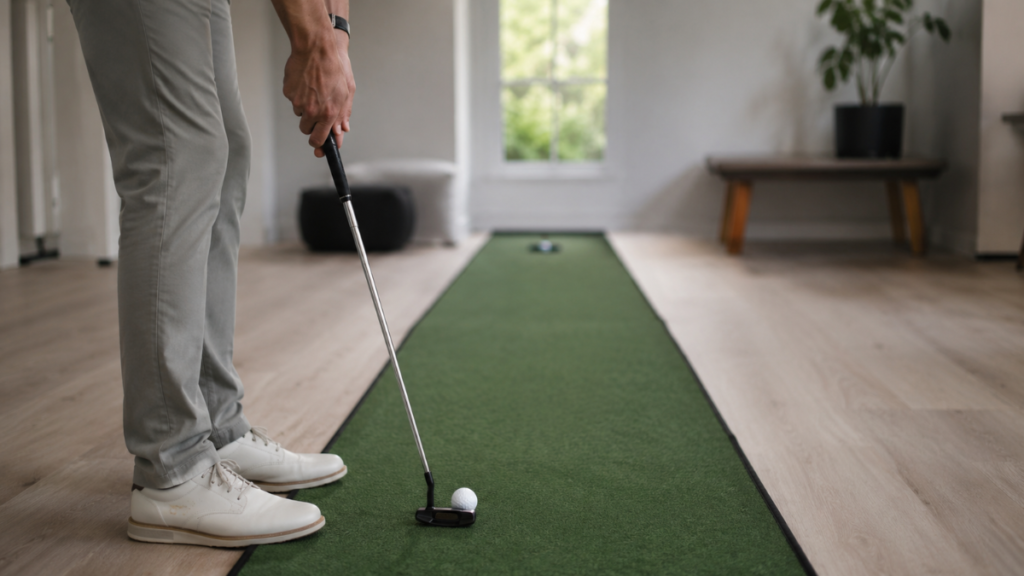
You can start with a putting mat, carpet, deck, hardwood floor, it simply doesn’t matter. I prefer to do this drill without a golf ball, especially if you are just getting started training this way. It is too easy to jump back in to being results oriented, and that is not a good thing.
After you start getting the feel of things, and want to stroke putts while doing this drill, you can putt to a cup, a coin, a line, or a small target.
The target is not the most important thing at first, the habit is.
Start with this simple structure:
- Set your grip.
- Step in with the putter face first.
- Set your feet.
- Look at the target.
- Build the picture.
- Return your eyes to the ball.
- Pull the trigger.
- Hold the finish for a second.
- Repeat without rushing.
That is enough, no need to make it a performance.
Just make it a pattern.
Keep the Reps Short and Clean
You do not need an hour grinding, making sure you are doing right. You do not need to roll 200 putts across the carpet, in fact, that can backfire. Tired reps get sloppy and bored reps get careless. Careless reps still train something, and usually it is not something you want.
Start with short sessions, ten good reps, maybe fifteen. Enough to feel the setup and stroke get clearer.
Then stop. You should finish feeling like you trained something, not like you survived something.
What to Watch For During At-Home Practice
Keep your attention on the right things. Not everything, just the things that matter.
Ask yourself:
- Did the grip feel settled?
- Did the putter face feel aimed?
- Did the setup feel repeatable?
- Did I see the target before I stroked it?
- Did I pull the trigger without adding a last-second thought?
- Did the stroke feel like it rolled, not hit?
That is plenty.
Do not turn this into a full swing lesson with a putter. You are training trust, and trust does not grow well when you keep digging it up to inspect the roots.
When to Take It to the Practice Green
Take it to the green once the routine and setup start feeling familiar at home.
Not perfect like in a technical sense, but familiar. For me, it is when you can get aligned, setup, and pull the trigger without a single technical thought creeping in.
When you get to the practice green, your job changes.
Now you start learning real speed, seeing how the ball rolls on grass. You start working with slopes, distance, and pace. But you should not be starting from scratch. You bring the grip, the setup, the stroke, and the pre-putt routine.
That way, the practice green becomes a magical place to train feel, not a place to panic-fix mechanics.
The practice green is where you prepare for game day, it is how you will “think” on the golf course.
Training for moments of pure magic.
Where the Blackout Putter System Fits
This article is the start of the putting progression.
Putter Training:
- Grip.
- Setup.
- Stroke.
- Routine.
- Feel.
- Distance control.
Those pieces have to be trained in the right order, or seasoned players end up trying to fix everything at once.
That is where a full putting distance control training system helps. It gives you the structure to build the fundamentals first, then take them to the green and train feel with a purpose.
And if you want the full scoring-shot system that connects putting and fairway wedge play, the complete golf distance control practice system brings both together under the same Blackout Mode approach.
Same idea.
Train it first.
Trust it later.
Do Not Become a Putting Technician
This is important because there is a trap in technical work. You start trying to improve your fundamentals, and before long, you are thinking about everything.
Where your elbows are. Where your eyes are. Whether the putter is moving straight back. Whether your shoulders are rocking right. Whether your grip pressure changed.
Some of that may matter.
But not all at once. The goal of technical training is not to make you more technical on the course. The goal is to make the basics reliable enough that you can stop thinking about them.
That is the whole point, train like an athlete, not a technician. An athlete trains the move until it can be trusted to happen without thought.
Then they play.
What Comes Next
Once this foundation is in place, you can begin layering in the physical putting drills.
Setup alignment.
Stroke fundamentals.
Short contact drills.
Speed-control work.
Feel training on the practice green.
But do not rush the process. The early work may not feel exciting, but it saves you later. Because when pressure shows up, you fall back on what has been trained. Not what you hoped would appear.
That is why we start at home.
Final Thought: Build the Stroke Before You Test It
Most golfers test their putting stroke before they build it. They roll putts and judge results. Then they change something and try again.
That cycle can last for years.
There is a better way:
- Build the grip.
- Build the setup.
- Build the routine.
- Build the stroke.
- Take it to the practice green and learn feel.
That order gives you a better chance. Not because it guarantees you will make every putt, you won’t. But it gives you something most golfers never really have, a putting stroke you are not trying to fix while you are using it.
That is where trust starts.
And trust is the beginning of better putting.
FAQ
What are at-home putting drills?
At-home putting drills are simple putting practice routines you can do indoors to build grip, setup, stroke, routine, and feel before taking your putting practice to the green.
Why should I practice putting at home?
Practicing at home removes pressure and distraction. It lets you build putting fundamentals without reacting to every missed putt or changing your stroke after every result.
Can at-home putting drills improve distance control?
Yes. At-home drills help stabilize your setup and stroke so you can feel speed better later on the practice green. Distance control improves when the stroke is less cluttered by doubt and tension.
Should I work on mechanics on the practice green?
Some small adjustments are fine, but the practice green is better for feel, speed, and roll. Bigger setup and stroke habits are often better trained at home first.
How long should I practice putting at home?
Start with short sessions of 10 to 15 focused reps. Clean repetition matters more than long sessions. Stop before the reps become careless.
Want to Keep Training This?
This article is a starting point. The real progress comes from training it consistently.
Join The Blackout Journal Training Notes for free weekly guidance on wedge distance control, putting feel, practice plans, and building trust without overthinking every scoring shot.
1 thought on “At-Home Putting Drills: Build Trust Before the Green”
Comments are closed.