
Most seasoned players don’t lose feel because they never had it. They lose it because they bury it under swing thoughts.
That is where Blackout Mode golf starts. Not with a new swing. Not with another mechanical fix. It starts with learning how to train trust, quiet the mind, and let the motion you already own finally have a chance to work.
That is the piece most golfers skip. They try to perform while they are still fixing.
And that is a hard way to play golf.
Why This Comes Before the Drills
Before we get into pre-shot routines, stock wedge swings, tempo control, or distance charts, we need to talk about the real goal.
The goal is not just to build a better wedge system, but to train a different state of mind before the shot.
Because if you bring the same old thinking into every drill, the drill can only help so much. You can rehearse the motion, build swing lengths, and measure distances.
But if you stand over the ball with five thoughts in your head, the shot still gets crowded. That is why this chapter matters. It tells you what we are really training. Not just wedges. Not just technique.
Trust.
What Blackout Mode Really Means
Blackout Mode is the final second before you pull the trigger. That little window where the decision is done, the picture is clear, and the body gets to respond.
No last-second correction. No checklist. No voice in your head trying to run the swing.
Just the target, the feel, and the motion… That is Blackout Mode.
It does not mean you black out and hope for the best. It does not mean you stop caring. It does not mean mechanics do not matter.
It means you trained the motion before the shot, so you do not have to drag the instruction manual into the shot.
That is a big difference because you are not forgetting your fundamentals. You are simply freeing yourself from thinking about them at the wrong time.
The Problem Is Not Always the Swing
This is where a lot of seasoned players get stuck.
They hit a poor wedge shot and immediately blame the swing:
- Too quick.
- Too steep.
- Too handsy.
- Too short.
- Too long.
- Wrong tempo.
- Wrong finish.
Maybe some of that is true. But sometimes the swing is not the biggest problem. Sometimes the problem is that your mind will not leave it alone. You step in with a club you know how to use. You have hit the shot and felt the distance before.
But then the thoughts start showing up.
The fear of chunking it. Thinking about the pace of the swing. The fear of missing the green, hitting in to a bunker. Making sure to accelerate through the swing.
By the time you swing, you are not reacting to the target anymore, you are trying to obey instructions.
That is not feel. After you experience the feel for distance control, you will realize that listening to yourself while standing over the ball is just unwanted noise. This can be disruptive to hitting quality wedges.
That is interference and it is uncalled for.
Feel Did Not Disappear
A lot of players think they have no feel, I don’t buy that. Most players have felt good shots before. They have hit that wedge where the distance seemed obvious. They have rolled that putt where the speed just matched the picture. They have made swings where the body knew what to do before the brain got involved.
So the feel is not gone.
It is buried. Buried under years of trying to fix. Years of range sessions. Years of lessons.
Years of searching for the one move that would finally make golf feel easy.
I know that road.
And I know what it feels like to keep chasing one more swing thought, thinking the next one will be the answer. But at some point, you have to ask a better question.
What if the swing is not broken?
What if the swing just never gets a quiet enough mind to work?
Training and Performing Are Two Different Jobs
This is one of the biggest lessons in golf. Training and performing are not the same thing. When you train, you can work on things.
You can slow down. You can rehearse. You can build a setup. You can measure distances. You can repeat drills. You can make adjustments.
That is training.
But when you perform, the job changes. Now you have to choose the shot and hit it. You cannot be standing over the ball trying to take a lesson.
That is where a lot of golfers get trapped.
They take practice thoughts to the course. Then they wonder why they feel tight. A swing thought that may help you during practice can hurt you during play.
The timing matters.
Blackout Mode is about learning that switch.
Train it first. Trust it later.
Think About Riding a Bike
You have heard the phrase a hundred times.
“It’s like riding a bike.”
There is a reason people say that. When you first learn to ride a bike, nothing feels automatic.
You wobble and overcorrect. You think way too much… you fall, and fall again.
Then little by little, your body figures out balance. After a while, you are not thinking about your feet, your hands, your steering, and your balance all at once.
You just ride.
That is implicit memory.
The skill gets trained deeply enough that you do not have to consciously manage every piece. That is the kind of trust we are trying to build in golf. It doesn’t happen overnight, or by pretending mechanics do not matter.
It happens by training the right things enough times that your body starts to recognize them without needing a speech from your brain.
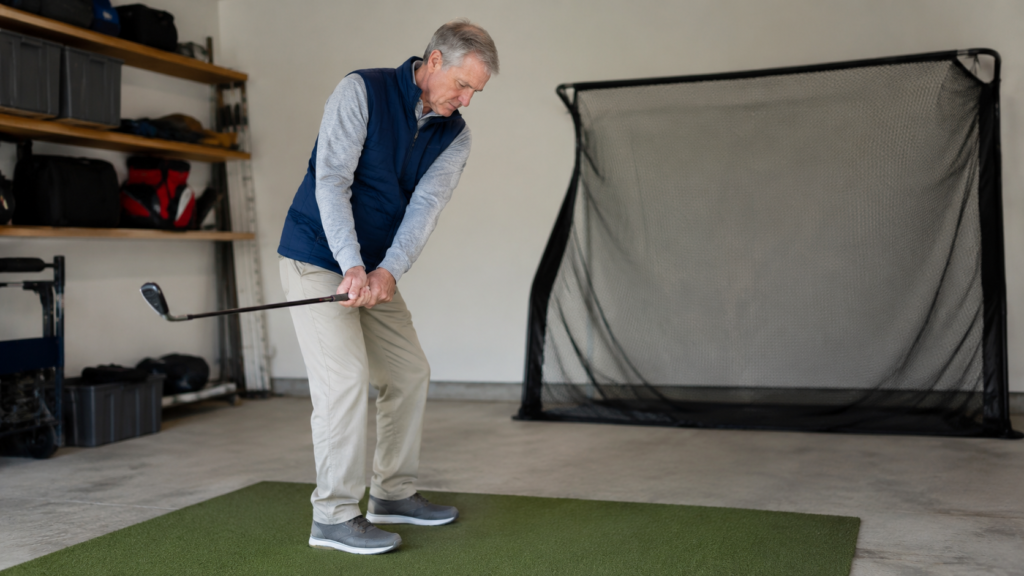
Why We Start at Home
This is why Blackout training starts at home. It is not because the range is useless. The range has a place, so does the course. But home gives you something those places often do not.
It is quiet with no ball flight to judge. There is no target to chase or bad shots sending you into another swing fix. You are not keeping score so there is no pressure.
Just the motion and the habit.
That is where you can start building the foundation without all the noise. At home, you can train the routine, rehearse the swing lengths, you can feel the club move, or you can learn how to step in, build the image, and pull the trigger.
You can begin installing the trust before the result gets in the way.
That matters.
Because once the ball starts flying, most players get pulled right back into judgment.
Stop Fixing. Start Feeling.
This is the shift.
You are not here to tear down your swing, become more technical, and collect more thoughts. You are here to build trust in the motion you already own. That does not mean your swing is perfect.
Nobody’s is.
It means your swing is probably good enough to start training differently. And for a lot of seasoned players, that is a relief. You do not need to keep starting over.
You need a better way to train what you already have.
That is where feel starts to come back.
Not by forcing or chasing it and remove enough interference for it to show up.
Here is the good news. Once you “let it go” and stop chasing the swing fix and focus distance control inside 120+ yards, your full swing will improve by default.
You might not realize it at first. But you will notice that your number fairways hit off the tee will improve.
And that is a good thing.
What We Are Going to Build
The Blackout Fairway Wedge progression starts simple.
First, we build the way you step in to the shot.
Then we build the stock motions.
Then we measure what those stock motions produce.
Then we train speed, feel, and distance control so we can feel in the gaps of your stock distances.
The early steps matter because they shape everything that comes after.
You will learn:
- A repeatable pre-shot routine
- Three stock wedge swings
- Simple at-home drills
- Tempo and speed control
- A way to measure your carry distances
- A system for scoring shots inside 120 yards
But underneath all of that is one bigger idea. You are training yourself to stop interfering.
That is the real work.
The full wedge distance control training system is built around that progression: train the motion, build the feel, measure the result, then trust it when it matters.
Why Distance Control Needs Trust
Inside 120 yards, distance control is everything. You can hit the ball solid and still miss the shot if the distance is wrong. You can make a decent swing and still leave yourself in trouble if you never committed to the target.
That is why hitting shots the correct distance is not just a wedge swing problem, it might be a trust problem.
A seasoned player standing over a 70-yard wedge shot with a cluttered mind has a hard job.
He is trying to feel distance while thinking about mechanics. That usually does not work well because feel needs room to breath. Feel needs a clear picture, a committed motion, and it needs a committed motion. It needs the mind to stop interrupting at the worst possible time.
That is why Blackout Mode and distance control belong together.
You are not just learning how far the ball goes but learning how to step into the shot in a way that lets your training show up.
The full golf distance control practice system connects that same idea across wedge play and putting, because scoring shots all demand the same thing: see it, feel it, and trust it.
What Blackout Mode Feels Like
The first time I really understood Blackout Mode, I didn’t understand it at all.
I was driving home from the club after one of those rounds that should have had me smiling the whole way. I made solid contact all day, hit 13 fairways, 16 greens, had 28 putts, and shot 71. That is a good day for most seasoned players.
For me, that was a great day.
And like always, I started doing what range grinders do on the drive home. I replayed the round in my head. One swing at a time, one miss at a time. Trying to figure out what needed work next.
That was my practice habit. Even after a good round, I still wanted to dissect it. Come up with the next plan and go pound more golf balls.
But this time, something strange happened I drew a blank. I could remember the ball flight of every shot. I remembered shots landing on greens. I remembered the confidence I had when stepping in to my putts.
The odd thing was, I could not remember what I was thinking during the swing. Almost all rounds, during the range warmup session, I would always work on my “swing thought of the day.” It’s like I would prepare myself to think my way around the golf course.
Not on this day.
There was no takeaway thought. No tempo thought either. Nothing about rhythm or finish.
Nothing.
And I’ll be honest, for a minute, it almost bothered me.
I had spent years playing golf with swing thoughts. I was used to having something in my head. Some little instruction. Some checkpoint. Some reminder I thought I needed to keep the wheels from falling off.
But this day, I played 18 holes, hit it great, scored well, and had no memory of managing the swing.
For a range grinder, that can feel like losing your wallet. You start patting your pockets. “Wait a minute… where did all my swing thoughts go?”
Then it hit me. Trust, that was the difference. I remembered stepping into shots knowing I had the right club in my hand. I remembered seeing where I wanted the ball to land and remembered feeling ready.
As I was driving home, one last thought enter my mind.
I remembered pulling the trigger.
That was it. No other thoughts.
No committee meeting in my head. No last-second correction. No trying to save the shot before I even hit it.
Just see it, trust it, and go.
That is what Blackout Mode feels like, at least for me. It does not feel loud or some kind of magical out-of-body experience.
It feels quiet. It feels like the decision has already been made. It feels like your body finally gets a chance to do what you trained it to do without your mind jumping in at the last second and trying to coach the shot.
And the funny part is, I was happier about that than the score. And it is not because I played well, I was happy because I finally noticed the stat that mattered most.
Zero.
Zero swing thoughts.
That was the best number on the card. And to this day, I’m still not entirely sure how I got home. I don’t remember much of the drive either.
Maybe I was still in Blackout Mode.
The Wrong Way to Chase Confidence
Most golfers try to get confidence from results. They hit a good shot and feel confident. Then they hit a bad one and lose it. That kind of confidence is fragile, I know it well.
It comes and goes with every shot.
Blackout training builds a different kind of confidence. Confidence in the process that leads up to pulling the trigger. Picking the shot, commit to the shot, see the target, and pull the trigger without adding three swing thoughts.
That is the foundation. Because even when the shot is not perfect, the process can still be right. And when the process is right often enough, better shots have a better chance to show up.
That is how trust grows.
Not from one perfect shot.
From repeated, committed reps, even when you hit it poorly.
Where This Leads Next
This article sits early in the training journey for a reason. First, you need to understand what Blackout Mode is. Then you need to learn how to enter the shot.
That is where the pre-shot routine comes next. The routine gives you a simple bridge from thinking to swinging. After that, you begin training the three stock wedge swings.
Then you move into the stock wedge swing drill, where the routine, swing lengths, and feel start coming together in real at-home training.
That is the path. Not chasing random tips or another swing-fix rabbit hole.
A training progression.
Do Not Turn This Into Another Thought
One warning. Do not make “Blackout Mode” another thing to think about over the ball. That would miss the point and be a huge mistake.
You do not stand there saying: “Okay, now enter Blackout Mode.”
That is just another swing thought wearing a different hat. Blackout Mode is the result of training. It shows up when the routine is familiar, the shot is chosen, and the motion has been rehearsed enough that you can let it go.
So do not chase the feeling. Simply train the pieces and allow the feeling to comes later.
Final Thought: Your Swing Needs a Chance
You may not need a brand-new swing. You may need to stop interrupting the one you have.
That is not easy.
Especially if you have spent years trying to fix every miss with another thought. But it is possible to train differently.
Start with the idea that your feel is not gone or buried. Then start building the habits that bring it back. A clearer pre-shot routine. Focus on the process and quiet the mind. A familiar motion and the image of the target that you can trust.
That is where Blackout Mode begins.
Not in theory or a slogan.
In the moment before the swing, when the decision is made and you finally pull the trigger.
Without a single swing thought, of course.
FAQ
What is Blackout Mode golf?
Blackout Mode golf is the trained state where you step into a shot with a clear picture, quiet the swing thoughts, and let your body respond without trying to consciously control every move.
Does Blackout Mode mean ignoring golf fundamentals?
No. Blackout Mode does not mean fundamentals do not matter. It means you train the fundamentals before the shot so you do not have to think about them while you are swinging.
How does Blackout Mode help wedge distance control?
Wedge distance control depends on feel and commitment. Blackout Mode helps by quieting the mind so you can respond to the target instead of interfering with the swing through mechanical thoughts.
Why does Blackout training start at home?
At-home training removes pressure, ball flight, and result-chasing. It gives you a quiet place to build routines, motions, and trust before taking the work to the range or course.
Is Blackout Mode only for wedge shots?
No. The same idea applies to putting and other scoring shots. The goal is to train feel, trust, and commitment so you can perform without dragging swing thoughts into the shot.
Stop Thinking Your Way Through Scoring Shots
Most golfers do not need more swing thoughts. They need a better way to train feel and trust.
Subscribe free to The Blackout Journal Training Notes and get weekly Blackout Golf lessons built for seasoned golfers who want to play with less mechanical thought inside 120 yards.